
Aerospace Power Supply: Requirements and Design
A guide to aerospace power supplies: what they are, the standards and ruggedization they require, key design challenges, and how Enerzolve builds them in India.
Enerzolve Smart Technologies·
What is an aerospace power supply?
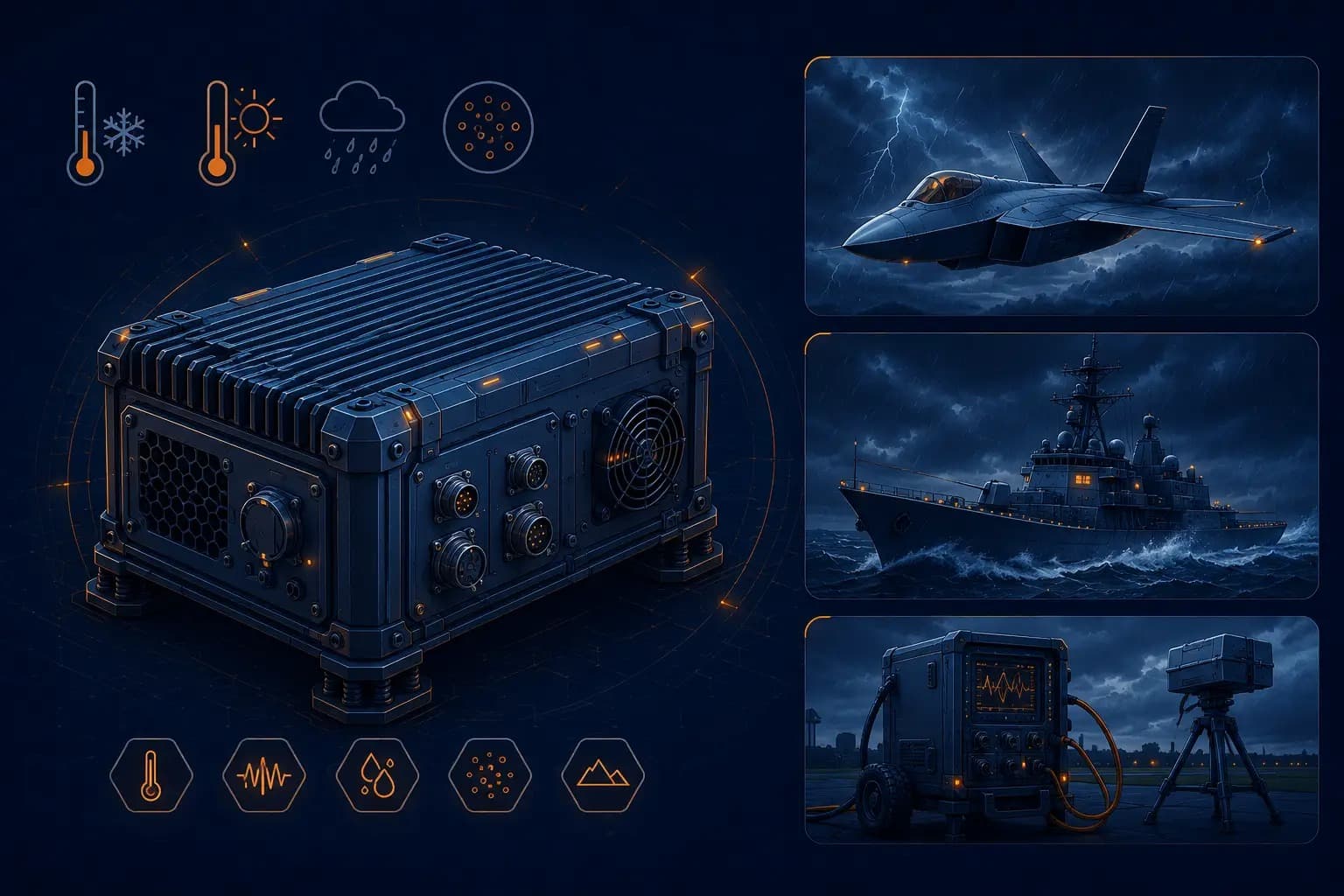
An aerospace power supply is a ruggedized power conversion unit designed to deliver stable, reliable electrical power to airborne, naval, and ground-support systems under extreme conditions. It must operate through shock, vibration, wide temperature swings, and altitude while meeting strict aerospace and defence standards, because in these applications a power failure is not an inconvenience, it is a safety risk.
That reliability requirement is what separates an aerospace power supply from an ordinary industrial one. This guide explains what these supplies must withstand, the standards they follow, the design challenges involved, and where they are used.
What makes aerospace power different
Aerospace and defence platforms place demands on power that commercial equipment never faces. A supply designed for these environments has to handle several things at once.
Extreme environmental stress. Shock and vibration from flight and launch, temperature extremes from high altitude to desert tarmac, and low-pressure operation. The unit must keep delivering clean power through all of it.
400 Hz operation. Much of aerospace runs on 400 Hz rather than standard mains frequency, because higher frequency allows lighter transformers and motors, which is critical when every kilogram matters.
Size, weight, and power (SWaP). On an aircraft, weight and volume are precious. Aerospace power supplies must deliver high power density, the most output in the smallest, lightest package.
Absolute reliability. These systems are mission-critical and often safety-critical. Redundancy, fault tolerance, and rigorous testing are built in, not optional.
Standards and compliance
Aerospace and defence power supplies are governed by strict standards that define how they must perform and survive. Common ones include MIL-STD-704 for aircraft electrical power characteristics, MIL-STD-810 for environmental testing (shock, vibration, temperature, altitude), and MIL-STD-461 for electromagnetic interference and compatibility (EMI/EMC).
Meeting these standards is not a formality. It is what qualifies a power supply for use on a platform, and it is why aerospace power design is a specialised engineering discipline rather than a variation on commercial power supply design.
Aerospace power supply vs industrial power supply
The contrast makes the requirements concrete.
| Requirement | Industrial power supply | Aerospace power supply |
|---|---|---|
| Environment | Controlled or sheltered | Shock, vibration, altitude, temperature extremes |
| Frequency | 50 or 60 Hz | Often 400 Hz |
| Weight and size | Secondary concern | Critical (high power density) |
| Standards | Commercial | MIL-STD-704, 810, 461 and similar |
| Reliability | Important | Mission and safety critical |
An industrial supply optimises for cost and general performance. An aerospace supply optimises for survival, weight, and certainty under the worst conditions.
Applications
Aerospace power supplies are used across airborne, naval, and support platforms:
Airborne avionics, powering flight systems, navigation, communication, and mission electronics. Naval platforms, where shipboard systems demand the same ruggedness in a marine environment. And ground-support and test equipment, the systems that service, test, and maintain aircraft and defence hardware on the ground.
Aerospace power supplies from Enerzolve
Enerzolve develops ruggedized aerospace power supplies as part of its power electronics portfolio, engineered for the shock, vibration, and wide environmental range these platforms demand.
The supplies are high-density power solutions built for airborne, naval, and test equipment, engineered on the same modular power conversion platform Enerzolve uses across its product lines. Crucially, they are designed and manufactured in India at a facility located in the Hitech Defence and Aerospace Park, which positions Enerzolve to support India's push for indigenous defence and aerospace manufacturing.
If you need a ruggedized power supply for an airborne, naval, or ground-support application, talk to our engineering team about your requirement.
The takeaway
An aerospace power supply is a ruggedized, high-density power conversion unit built to deliver reliable power under shock, vibration, altitude, and temperature extremes, while meeting standards such as MIL-STD-704, 810, and 461. Often operating at 400 Hz and engineered for minimal size and weight, it is a specialised discipline where reliability is non-negotiable, serving avionics, naval platforms, and ground-support equipment.
Frequently asked questions
It is a ruggedized power conversion unit that delivers stable, reliable electrical power to airborne, naval, and ground-support systems under extreme conditions such as shock, vibration, altitude, and temperature extremes. It is built to strict aerospace and defence standards because power failure in these applications is a safety risk.
Higher frequency allows transformers and motors to be lighter and smaller, which is critical on aircraft where weight and space are tightly constrained. 400 Hz is the standard for many aircraft electrical systems, so aerospace power supplies are frequently designed around it.
Common standards include MIL-STD-704 for aircraft electrical power characteristics, MIL-STD-810 for environmental testing such as shock, vibration, and temperature, and MIL-STD-461 for electromagnetic interference and compatibility. Meeting these standards qualifies a supply for use on a platform.
An industrial power supply is optimised for cost and general performance in controlled environments. An aerospace power supply is engineered to survive shock, vibration, and temperature extremes, often runs at 400 Hz, prioritises low weight and high power density, and must meet strict military and aerospace standards.
They are used in airborne avionics such as flight, navigation, and communication systems, in naval platforms, and in ground-support and test equipment used to service and maintain aircraft and defence hardware.
Keep reading
What is a BESS? Battery Energy Storage Systems Explained
A BESS is a system of systems. The BMS protects the cells, the PCS converts the power, and the EMS decides what the whole thing should do.
HES vs MDMS: How the AMI Software Layer Works
The HES talks to the meters, the MDMS makes sense of the data. One collects, the other perfects — and a serious AMI rollout needs both.
Grid-Forming vs Grid-Following Inverters (What Grid-Forming Means)
A grid-following inverter is a passenger. A grid-forming inverter can be the driver — and as conventional generation retires, that difference matters more every year.
Ultrasonic vs AMR Water Meters: Which One Fits Your Network?
Accuracy, maintenance, communication, and cost — how the two technologies actually differ, and how to pick per application rather than per vendor.
Planning a metering or power conversion program?
Talk to the engineering team about specifications, standards, and deployment.
Contact Enerzolve