
HES vs MDMS: How the AMI Software Layer Works
HES vs MDMS explained: what a Head End System and Meter Data Management System each do, how they differ, and how they work together in an AMI deployment.
Enerzolve Smart Technologies·
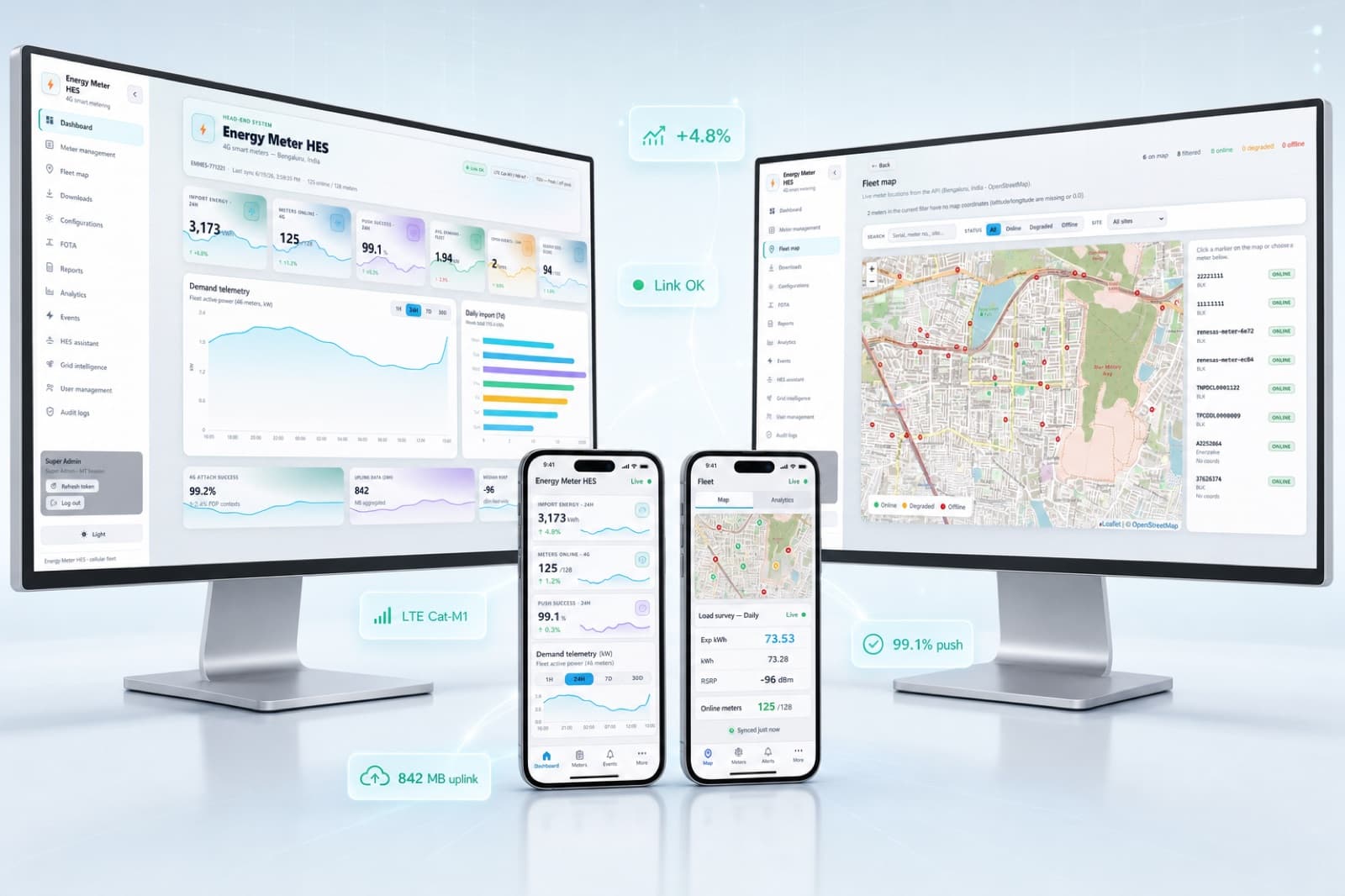
HES vs MDMS: how the AMI software layer works
In advanced metering, the meter gets the attention, but the software behind it is where a rollout succeeds or fails. Two systems do the heavy lifting: the Head End System (HES) and the Meter Data Management System (MDMS). They are often mentioned in the same breath, which leads people to assume they do the same thing. They do not.
The simplest way to hold the difference: the HES talks to the meters, the MDMS makes sense of the data. This guide explains what each one does and why you need both.
Where these systems sit
An Advanced Metering Infrastructure deployment has four layers: the meters, the communication network, the HES, and the MDMS. The HES sits right above the communication network, as the point where the utility's systems meet the meter fleet. The MDMS sits above the HES, taking the raw data the HES collects and turning it into something the business can use.
So they are not competitors. They are two stages in the same pipeline.
What the HES does
The Head End System is the utility's direct line to every smart energy meter in the field. Its job is communication and control.
The HES collects meter reads on schedule, manages the communication sessions with each meter, pushes firmware updates over the air, and monitors the health of the entire fleet in real time. When you want to know how many meters are online right now, which ones missed a read, or the status of DLMS sessions across the network, the HES is what shows you. It also carries out remote commands like connect and disconnect.
Think of the HES as mission control for the meters. It is operational, real-time, and focused on the devices themselves.
What the MDMS does
The Meter Data Management System takes over once the data is collected. Its job is to turn raw reads into trustworthy, billable information.
Raw meter data is never perfectly clean. Reads go missing, communication drops, and occasional values look wrong. The MDMS runs the VEE process, validation, estimation, and editing, to check every read, estimate the gaps, and flag exceptions for review. From that clean data it produces the determinants that billing needs, framed to the correct tariff, and it feeds the analytics that reveal load patterns and technical and commercial loss.
Think of the MDMS as the accountant. It does not talk to meters. It makes sure the numbers are right and ready to bill.
HES vs MDMS at a glance
| Aspect | Head End System (HES) | Meter Data Management System (MDMS) |
|---|---|---|
| Focus | The meters | The data |
| Nature | Real-time, operational | Process-driven |
| Key jobs | Collection, communication, firmware, fleet health | Validation, estimation, editing, billing determinants, analytics |
| Answers | Are the meters working and what did they send? | Is this data correct and ready to use? |
One collects, the other perfects. A read starts at the meter, travels through the HES, and becomes a billable number in the MDMS.
Why you need both
Utilities sometimes hope one system can do everything. It rarely works well. An HES without a strong MDMS gives you a flood of raw reads with no reliable way to validate them or turn them into clean bills. An MDMS without a capable HES has nothing dependable to process, because the collection and fleet management underneath it are weak.
Together they form the software backbone of AMI. The HES guarantees you can reliably reach and read every meter. The MDMS guarantees the data those meters produce becomes accurate revenue.
HES and MDMS from Enerzolve
Enerzolve builds both the HES and the MDMS as part of one integrated AMI platform, so the collection and management layers are designed to work together rather than stitched together after the fact. The real-time Head End System manages the meter fleet, while the Meter Data Management System provides the VEE engine, analytics, and automated billing extract. Because the same platform serves both energy and water metering, a utility can run its entire metering operation on one software stack.
If you are planning an AMI rollout and evaluating the HES and MDMS layer, talk to our engineering team about your network.
The takeaway
HES and MDMS are not two names for the same thing, and they are not alternatives. The HES is the operational layer that talks to the meters and keeps the fleet running. The MDMS is the data layer that validates those reads and turns them into billable, analysis-ready information. A serious metering rollout needs both, working as one pipeline from meter to bill.
Frequently asked questions
The Head End System (HES) communicates with the meters, collecting reads, managing firmware, and monitoring fleet health in real time. The Meter Data Management System (MDMS) processes that collected data, validating and estimating reads and turning them into billable determinants. The HES handles the meters; the MDMS handles the data.
Neither performs the final billing itself. The MDMS prepares clean, validated, tariff-framed determinants and passes them to the utility's billing or CIS system, which generates the actual bills.
VEE stands for validation, estimation, and editing. It is how the MDMS checks each meter read for errors, estimates values for any missing reads, and flags exceptions, so the data used for billing and analytics is accurate.
Some platforms bundle both functions, but they remain distinct roles. The collection and fleet-management role of the HES and the data-processing role of the MDMS are different jobs, and both must be handled well for an AMI deployment to succeed.
Yes. The same HES and MDMS layers can manage energy and water meters, which lets a utility run both types of metering on a single platform.
Keep reading
What is a BESS? Battery Energy Storage Systems Explained
A BESS is a system of systems. The BMS protects the cells, the PCS converts the power, and the EMS decides what the whole thing should do.
Grid-Forming vs Grid-Following Inverters (What Grid-Forming Means)
A grid-following inverter is a passenger. A grid-forming inverter can be the driver — and as conventional generation retires, that difference matters more every year.
Ultrasonic vs AMR Water Meters: Which One Fits Your Network?
Accuracy, maintenance, communication, and cost — how the two technologies actually differ, and how to pick per application rather than per vendor.
What is Advanced Metering Infrastructure (AMI)? A Complete Guide
AMI is four layers, not a product: meters, the communication network, the head end system, and meter data management. Here is what each one does.
Planning a metering or power conversion program?
Talk to the engineering team about specifications, standards, and deployment.
Contact Enerzolve