
Ultrasonic vs AMR Water Meters: Which One Fits Your Network?
Ultrasonic vs AMR water meters compared on accuracy, maintenance, communication, and cost, so you choose the right smart water meter for your network.
Enerzolve Smart Technologies·
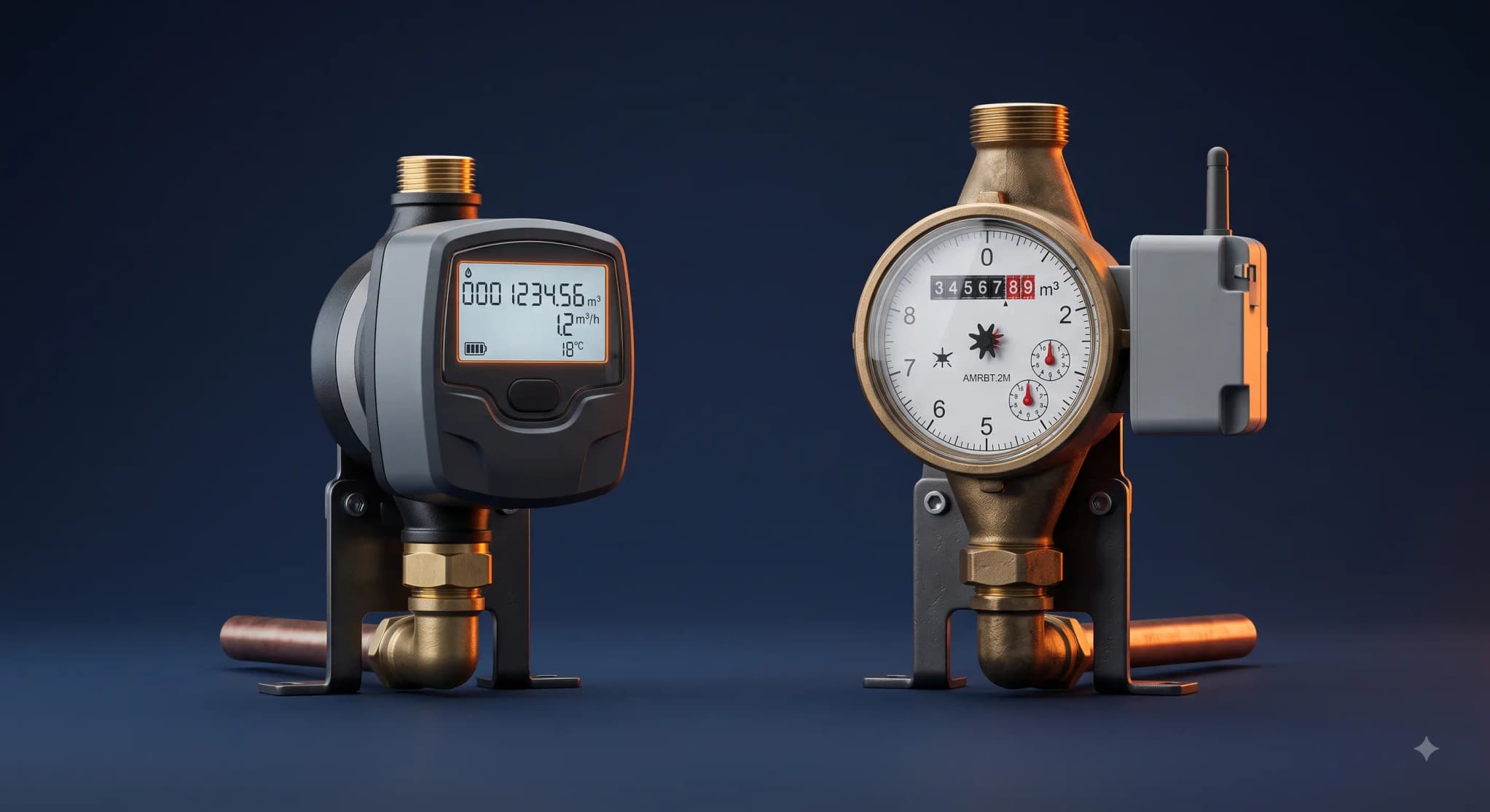
Ultrasonic vs AMR water meters: which one fits your network?
Choosing a water meter used to be simple. You picked a size, checked the certification, and installed it. Smart metering changed that. Now the choice sits between two very different technologies, ultrasonic and AMR, and the right answer depends less on which one is newer and more on where the meter will actually sit, who will read it, and what the network needs to prove.
This guide walks through the real differences so the decision is based on the application, not on whichever technology a vendor happens to stock.
The short version
An ultrasonic water meter measures flow using sound, with no moving parts. It holds accuracy for years and reads very low flows, which makes it strong for loss detection and long service life.
An AMR water meter uses a proven mechanical register with automatic meter reading added on top. It is robust, cost-effective at scale, and a natural fit where you are upgrading existing mechanical infrastructure to remote reading.
Both are part of the same smart water meter platform, so you can mix them across a network and still run everything through one software layer.
Ultrasonic vs AMR at a glance
| Factor | Ultrasonic water meter | AMR water meter |
|---|---|---|
| Measurement | Solid-state, transit-time (no moving parts) | Mechanical register with remote reading |
| Accuracy over time | Holds accuracy, up to ±1% | Accurate, gradually wears |
| Low-flow sensitivity | High | Moderate |
| Maintenance | Effectively maintenance-free | Simple to service, mechanical wear |
| Cost per unit | Higher | Lower |
| Best for | Loss-critical and bulk points, long life | Large residential scale, mechanical upgrades |
How each one actually works
Ultrasonic meters use transit-time measurement. Two sensors send sound pulses back and forth across the flow. Water moving with the pulse speeds it up, water moving against it slows it down, and the tiny time difference between the two directions translates directly into flow rate. Because nothing physically spins, there is no mechanical wear and nothing to seize up or slow down as the meter ages.
AMR meters keep a mechanical measuring element, typically a dry dial multi-jet register, and pair it with shielded magnetic coupling and a communication module. The water still turns an impeller, but the reading is captured electronically and sent out wirelessly instead of being read by eye. It is the bridge between traditional metering and a fully remote network.
Accuracy and low-flow performance
This is where the two technologies separate most clearly.
Ultrasonic meters hold accuracy up to plus or minus 1 percent across a wide flow range and stay sensitive to very low flow rates. That low-flow sensitivity matters more than it sounds. A slow, continuous leak or a small unbilled draw often sits below the threshold a worn mechanical meter can register, which means the water is used but never measured. An ultrasonic meter catches it.
Mechanical AMR meters are accurate and reliable when specified correctly, but every mechanical element wears over time, and low-flow sensitivity gradually drops as it does. For most residential and municipal billing this is well within tolerance. For loss-critical points in a network, the ultrasonic edge is real.
Maintenance and service life
With no moving parts, ultrasonic meters are effectively maintenance-free and hold their performance across a long operational life. That lowers the total cost of ownership even when the upfront price is higher, because you replace and recalibrate far less often.
AMR meters have a longer field track record and are simple to service, with a brass body built for harsh conditions and battery life up to 10 years. The mechanical element will wear eventually, but for many deployments it will outlast the billing cycle that justified it.
Communication options
Both meter types are built for remote reading, and this is where they connect into the wider network. Ultrasonic meters are AMR and AMI ready with multiple communication options. AMR meters support RF, LoRa RF, NB-IoT, and LTE-M, so they slot into most utility communication stacks.
Whichever you choose, the reads flow into the same head end and data management layer. If you want to understand how that full stack fits together, our guide on what Advanced Metering Infrastructure is covers it end to end.
Tamper detection and security
Water loss is not only leaks. Meter tampering is a real source of unbilled consumption. AMR meters include magnetic tamper detection to flag interference. Ultrasonic meters, with their solid-state design and IP68 enclosure, remove many of the physical points a mechanical meter can be manipulated at. Both approaches close gaps that a basic analog meter leaves open.
Cost and where each one wins
Ultrasonic meters cost more per unit but pay it back through accuracy retention, low-flow capture, and near-zero maintenance. They make the most sense at bulk and district metering points, in loss-critical zones, and anywhere long-term accuracy directly protects revenue.
AMR meters are the cost-effective choice at large residential scale, in mechanical upgrade programs, and where the priority is getting an existing network onto remote reading quickly and affordably.
A simple way to decide
Reach for ultrasonic when accuracy retention, low-flow detection, and long maintenance-free life are the priority, such as district metering areas, bulk supply points, and industrial monitoring.
Reach for AMR when you are scaling residential metering cost-effectively or converting an existing mechanical network to remote reading, and proven robustness matters more than the last fraction of a percent.
In most real networks, the answer is both. The point of a full-stack platform is that you deploy the right technology at each point and still manage the whole network as one system.
Water metering from Enerzolve
Enerzolve builds both ultrasonic and AMR water meters as part of one full-stack water metering platform, so a utility can deploy the right technology at each point on the network and still manage everything through a single head end and data management layer. Both meters are manufactured and certified in India to IS 779:1994 and ISO 4064, and are MID certified, and both connect into the same software backing the smart water meter platform.
If you are planning a water metering rollout and weighing ultrasonic against AMR, talk to our engineering team about your network.
Frequently asked questions
Ultrasonic water meters generally hold higher accuracy over time, up to plus or minus 1 percent across a wide flow range, and stay sensitive to very low flows because they have no moving parts to wear. AMR meters are accurate when correctly specified, but mechanical wear reduces low-flow sensitivity gradually over the meter's life.
Yes. Both connect into the same head end and meter data management layer, so you can deploy ultrasonic meters at loss-critical and bulk points and AMR meters across large residential areas, then manage the entire network through one platform.
No. Ultrasonic meters have no moving parts, which makes them effectively maintenance-free with a long operational life. AMR meters are simple to service but contain a mechanical element that wears over time.
Yes. Both the ultrasonic and AMR water meters are certified to IS 779:1994 and ISO 4064 and derived standards, and are MID certified.
Both help, but for loss detection specifically, ultrasonic meters have an edge because their low-flow sensitivity captures slow leaks and small unbilled draws that a worn mechanical meter can miss.
Keep reading
What is a BESS? Battery Energy Storage Systems Explained
A BESS is a system of systems. The BMS protects the cells, the PCS converts the power, and the EMS decides what the whole thing should do.
HES vs MDMS: How the AMI Software Layer Works
The HES talks to the meters, the MDMS makes sense of the data. One collects, the other perfects — and a serious AMI rollout needs both.
Grid-Forming vs Grid-Following Inverters (What Grid-Forming Means)
A grid-following inverter is a passenger. A grid-forming inverter can be the driver — and as conventional generation retires, that difference matters more every year.
What is Advanced Metering Infrastructure (AMI)? A Complete Guide
AMI is four layers, not a product: meters, the communication network, the head end system, and meter data management. Here is what each one does.
Planning a metering or power conversion program?
Talk to the engineering team about specifications, standards, and deployment.
Contact Enerzolve