
What is Advanced Metering Infrastructure (AMI)? A Complete Guide
A complete guide to Advanced Metering Infrastructure: what AMI is, how smart meters, HES, and MDMS work together, its benefits for utilities, and how to deploy it.
Enerzolve Smart Technologies·
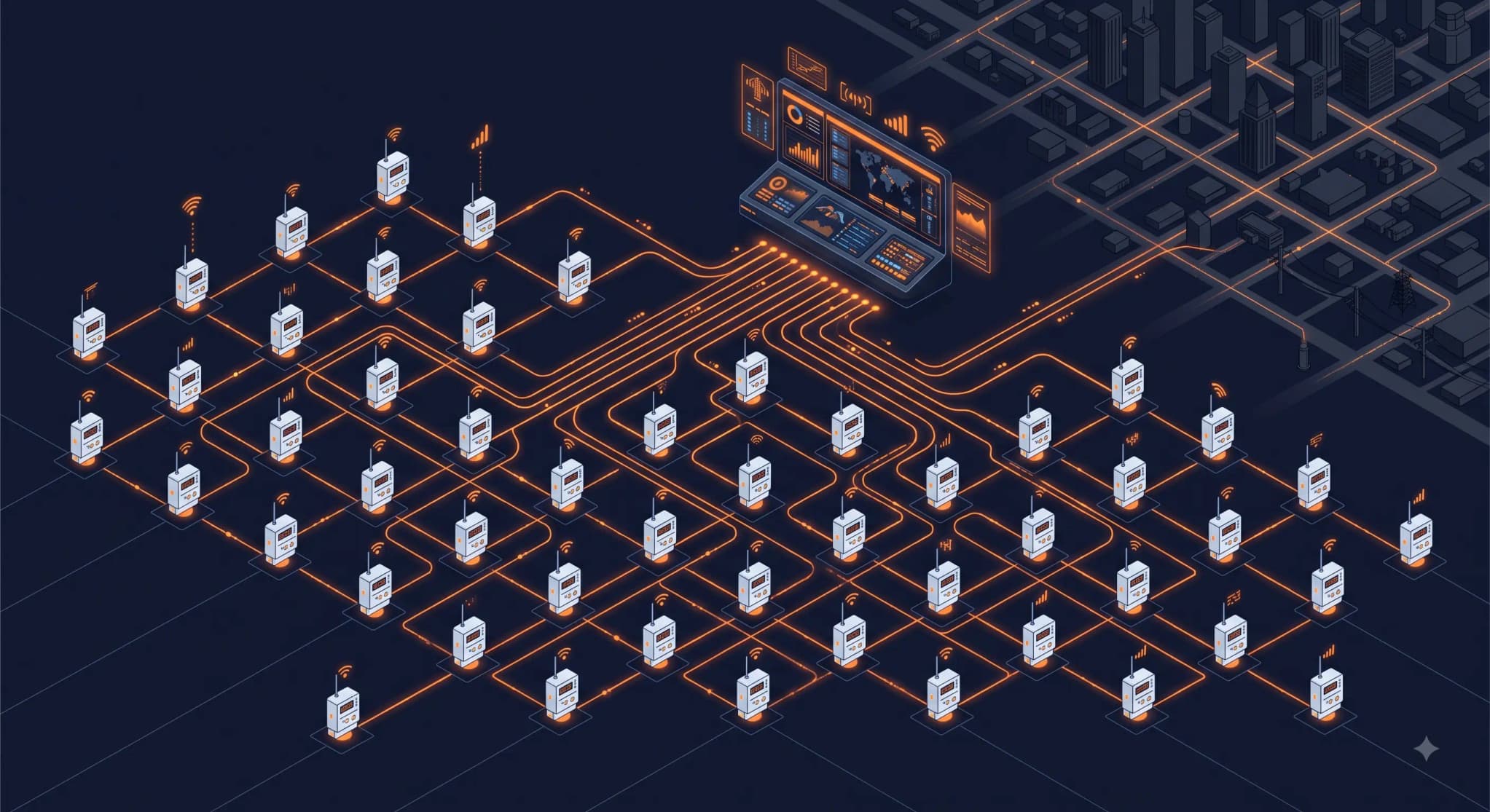
What is Advanced Metering Infrastructure (AMI)?
Advanced Metering Infrastructure (AMI) is the complete system that turns a meter from a device someone reads once a month into a live, two-way node on the grid. It combines smart meters, a communication network, a head end system, and a meter data management system so a utility receives readings automatically, along with alerts, diagnostics, and remote control.
That shift sounds small. In practice it changes how a utility bills, detects loss, forecasts load, and manages its network. This guide explains what AMI is made of, why each layer matters, and how to deploy it well.
AMI is a stack, not a single product
The word "meter" is where most people start, but AMI is really four layers working together: the meters, the communication network, the head end system, and the meter data management system. A smart energy meter is only the edge of it. The intelligence lives in how the whole stack connects.
Here is what each layer does.
1. Smart meters
The meter is the sensing point. A modern AMI meter measures far more than total consumption. It captures voltage, current, power factor, maximum demand, time-of-day registers, and load survey data, and it logs events like tamper attempts or power loss. It can be connected or disconnected remotely, updated over the air, and configured for prepaid or postpaid billing.
Accuracy class matters here. A utility-grade meter such as a Class 1.0 meter gives readings precise enough for billing and network analysis, which is the foundation everything above it depends on.
2. The communication network
A meter is only useful if its data can get out. AMI meters support a range of communication options so they work across different environments: RF Mesh where meters relay for each other, PLC over the power line itself, and cellular options like 4G and NB-IoT for wider coverage.
Underneath the physical link sits the protocol. DLMS/COSEM is the international standard that lets meters and systems from different vendors speak the same language. It is what stops an AMI rollout from locking a utility into a single supplier, and it is why interoperability is a core requirement, not a nice-to-have.
3. The Head End System (HES)
The Head End System is where the network meets the meters. It is the platform that talks to every meter, collects reads, manages communication sessions, pushes firmware updates, and monitors the health of the fleet in real time. When a utility wants to know how many meters are online, which ones missed a read, or the status of DLMS sessions across the network, the HES is what shows them.
Think of the HES as mission control for the meter fleet. We cover how it differs from the data layer in HES vs MDMS.
4. The Meter Data Management System (MDMS)
Raw reads are not the same as billable, trustworthy data. The MDMS is the layer that validates, estimates, and edits reads, flags exceptions automatically, and turns clean data into the determinants that billing and analytics need. It handles the VEE process (validation, estimation, and editing), feeds tariff-framed data to the billing system, and supports the analytics that reveal load patterns and technical and commercial loss.
Without an MDMS, a utility has a pile of numbers. With one, it has revenue assurance.
The four layers of AMI at a glance
| Layer | What it does | Key function |
|---|---|---|
| Smart meter | Measures consumption and logs events at the edge | Accurate metering, tamper detection, remote connect/disconnect |
| Communication network | Carries data between meters and the utility | RF Mesh, PLC, 4G/NB-IoT over DLMS/COSEM |
| Head End System (HES) | Talks to and manages the meter fleet in real time | Collection, firmware, session and fleet health |
| Meter Data Management (MDMS) | Turns raw reads into billable, analysis-ready data | VEE process, billing determinants, loss analytics |
Why AMI matters for utilities and DISCOMs
Put the four layers together and the benefits stack up:
Accurate, automated billing removes estimated bills and the disputes that come with them. Remote connect and disconnect cuts truck rolls. Tamper and theft detection recovers revenue that used to disappear. Load forecasting and loss analysis, drawn from granular interval data, let the utility manage the network instead of reacting to it. And prepaid support gives consumers and utilities more flexible commercial models.
For DISCOMs specifically, AMI is central to reducing AT&C loss, which is one of the clearest measures of a distribution utility's financial health.
AMI for water, not just energy
The same architecture applies to water. A smart water meter network runs on the same HES and MDMS layers, which means a utility can run energy and water metering through one platform. If you are weighing meter technologies for a water network, our comparison of ultrasonic and AMR water meters covers that choice.
AMI solutions from Enerzolve
Enerzolve builds the full AMI stack as one integrated platform, rather than leaving a utility to stitch together parts from different vendors. That matters because the value of AMI comes from how cleanly the layers talk to each other.
At the meter level, the Enerzolve smart energy meter is AMI-ready, with Class 1.0 accuracy, DLMS/COSEM support, remote connect and disconnect, and tamper detection. Above it sits the AMI 2.0 software stack: a real-time Head End System that manages the meter fleet, and a Meter Data Management System with a VEE engine, analytics, and automated billing extract. Because the same HES and MDMS layers serve both energy and water metering, a utility can run its entire metering operation on one platform.
The result is an AMI deployment engineered for Indian utility and DISCOM conditions, built and certified in India, and designed to reduce AT&C and non-revenue losses from day one. If you are planning an AMI rollout, talk to our engineering team about your network.
Getting AMI right
The mistake utilities make is treating AMI as a meter purchase. The meter is the easy part. The value is unlocked by the communication choice, the HES, and the MDMS, and by insisting on open standards like DLMS/COSEM so the system stays flexible as it scales. Get the full stack right and a meter stops being a monthly chore and becomes a live instrument for running the grid.
Frequently asked questions
AMI stands for Advanced Metering Infrastructure. It is the complete system of smart meters, communication networks, a head end system, and a meter data management system that enables two-way, automated metering.
AMR (Automatic Meter Reading) is one-way and automates the collection of meter reads. AMI is two-way and covers the full stack, adding remote control, firmware updates, event alerts, and data management, so the utility can both read from and act on the meter.
The Head End System communicates with the meters, collecting reads and managing the fleet in real time. The Meter Data Management System validates and processes that data into billable, analytics-ready information. The HES handles the meters, the MDMS handles the data.
DLMS/COSEM is the international standard protocol that lets meters and systems from different vendors work together, keeping an AMI deployment interoperable and preventing vendor lock-in.
Yes. The same HES and MDMS architecture supports energy and water metering, so a utility can manage both on a single platform.
Keep reading
What is a BESS? Battery Energy Storage Systems Explained
A BESS is a system of systems. The BMS protects the cells, the PCS converts the power, and the EMS decides what the whole thing should do.
HES vs MDMS: How the AMI Software Layer Works
The HES talks to the meters, the MDMS makes sense of the data. One collects, the other perfects — and a serious AMI rollout needs both.
Grid-Forming vs Grid-Following Inverters (What Grid-Forming Means)
A grid-following inverter is a passenger. A grid-forming inverter can be the driver — and as conventional generation retires, that difference matters more every year.
Ultrasonic vs AMR Water Meters: Which One Fits Your Network?
Accuracy, maintenance, communication, and cost — how the two technologies actually differ, and how to pick per application rather than per vendor.
Planning a metering or power conversion program?
Talk to the engineering team about specifications, standards, and deployment.
Contact Enerzolve