
How to Choose a Water Meter for a Utility: Ultrasonic vs AMR
How to choose a water meter: ultrasonic vs AMR, accuracy, communication, and what utilities should evaluate for a smart water metering rollout.
Enerzolve Metering Team··Smart Grid & Metering·7 min read
How do you choose the right water meter for a utility?
Choosing a water meter comes down to matching the metering technology to where it will sit on your network, then evaluating accuracy, communication, durability, and the manufacturer behind it. The first and biggest decision is the technology: ultrasonic or AMR. The rest, accuracy class, communication options, tamper resistance, and certifications, follow from getting that choice right for each part of the network.
This guide walks a utility through the water meter selection decision in the order that matters, starting with the technology choice that shapes everything else.
1. The core decision: ultrasonic or AMR?
This is where most of the value lies, because the two technologies behave very differently.
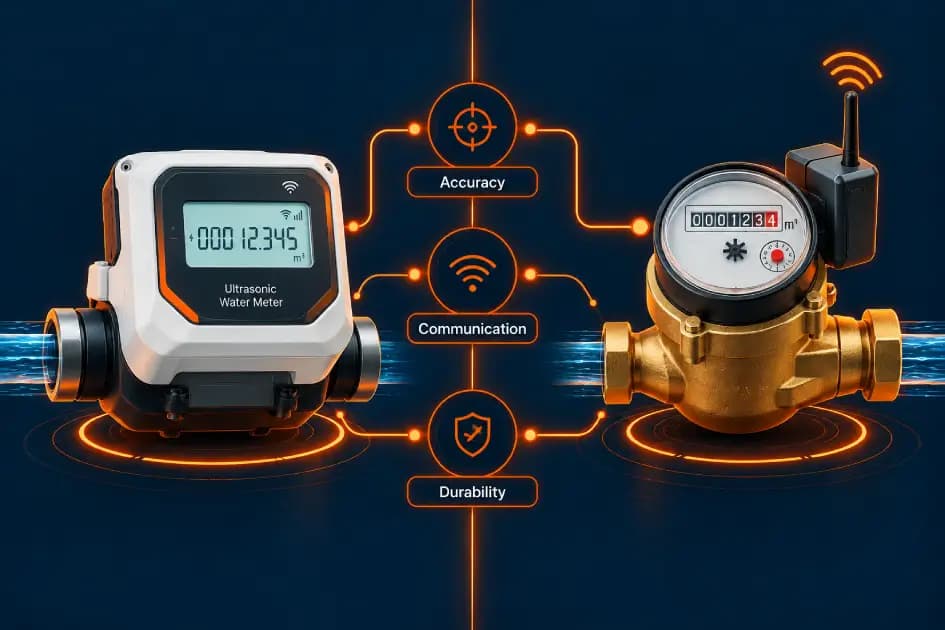
An ultrasonic water meter measures flow using sound, with no moving parts. It holds accuracy for years, stays sensitive to very low flows, and is effectively maintenance-free, which makes it strong for loss detection and long service life.
An AMR water meter pairs a proven mechanical register with automatic meter reading. It is robust, cost-effective at scale, and a natural fit where you are upgrading existing mechanical infrastructure to remote reading.
The right answer often isn't one or the other across the whole network, it's ultrasonic at loss-critical and bulk points, AMR across large residential deployments. For a full technical comparison, see our guide on ultrasonic vs AMR water meters.
2. Accuracy and low-flow performance
Accuracy sets the ceiling on billing precision and loss detection. Look at the meter's accuracy across its full flow range, and crucially its low-flow sensitivity, because slow leaks and small unbilled draws often sit below the threshold a worn mechanical meter can register. Ultrasonic meters hold accuracy over time and capture very low flows, which matters most where unmeasured water directly becomes lost revenue. Match the accuracy requirement to the role: tighter for bulk and district metering, standard for residential billing.
3. Communication and AMI readiness
A smart water meter is only as useful as its ability to report. Evaluate the communication options, RF, LoRa, NB-IoT, and LTE-M, and whether the vendor can match the technology to your terrain, since buried meters, dense urban areas, and rural networks behave differently. Confirm the meter is AMI-ready and feeds into a head end and data management layer, so the reads become actionable data rather than isolated numbers. A meter that connects cleanly into advanced metering infrastructure is what turns metering into network visibility.
4. Durability, tamper resistance, and certification
Water meters sit in harsh conditions for years, so durability is a real selection criterion. Check the ingress protection rating (IP68 for submersion), the body material, and tamper detection, magnetic tamper detection on AMR meters, and the solid-state design of ultrasonic meters that removes many physical tamper points. Confirm certifications: for India, IS 779 and MID certification, with ISO 4064 conformance. Certifications are how you verify a meter before deploying thousands of them.
5. The manufacturer and platform
Finally, evaluate the vendor, not just the meter. A manufacturer who provides both ultrasonic and AMR meters on one platform, with the head end and data management software behind them, lets you deploy the right technology at each point and still manage the whole network as one system. Single-point accountability matters: when one party owns the meters and the software, there is no finger-pointing between suppliers during a rollout. Ask about certifications, local support and manufacturing for lead times and spares, and deployment references.
A water meter selection checklist
| Decision | What to evaluate |
|---|---|
| Technology | Ultrasonic (loss-critical, long life) vs AMR (scale, cost) |
| Accuracy | Accuracy class and low-flow sensitivity, matched to role |
| Communication | RF, LoRa, NB-IoT, LTE-M; AMI-ready; matched to terrain |
| Durability | IP68, body material, tamper detection |
| Certification | IS 779, MID, ISO 4064 |
| Manufacturer | Both technologies on one platform; local support; references |
Why matching technology to the network matters
The biggest mistake in water meter selection is treating the whole network the same. Loss-critical bulk points, where accuracy directly protects revenue, justify ultrasonic meters; large residential deployments, where cost at scale dominates, suit AMR. A full-stack platform lets a utility mix both and still run one system, which is why the technology-per-location decision, not a single blanket choice, is the heart of getting water metering right.
Water metering from Enerzolve
Enerzolve builds both ultrasonic and AMR water meters on one smart water meter platform, so a utility can deploy the right technology at each point and manage the whole network through a single head end and data management layer. Both are manufactured and certified in India to IS 779 and ISO 4064, and are MID certified. If you are planning a water metering rollout, talk to our engineering team.
The takeaway
Choosing a water meter starts with matching the technology to the network, ultrasonic for loss-critical and bulk points, AMR for cost-effective residential scale, then evaluating accuracy and low-flow sensitivity, communication and AMI readiness, durability and certification, and the manufacturer behind the meter. The strongest approach is a platform that supports both technologies on one system, so you deploy the right meter at each point and still manage the whole network as one.
Frequently asked questions
Start by matching the technology to the network, ultrasonic for loss-critical and bulk points, AMR for cost-effective residential scale, then evaluate accuracy and low-flow sensitivity, communication and AMI readiness, durability and tamper resistance, certifications such as IS 779 and MID, and the manufacturer behind the meter. The best approach often uses both technologies across one platform.
Choose ultrasonic where accuracy retention, low-flow detection, and long maintenance-free life matter, such as district metering and bulk points. Choose AMR where you are scaling residential metering cost-effectively or converting an existing mechanical network to remote reading. Many utilities deploy both across one platform, matching the technology to each location.
A water meter should hold accuracy across its full flow range and be sensitive to low flows, since slow leaks and small unbilled draws often go unmeasured by worn mechanical meters. Tighter accuracy is justified at bulk and district metering points where unmeasured water directly becomes lost revenue; standard accuracy suits residential billing.
For deployment in India, a water meter should carry IS 779 and MID certification, with ISO 4064 conformance. Certifications verify the meter's accuracy and performance before a utility deploys it at scale, and are a key shortlisting criterion in procurement.
A vendor who provides both technologies on one platform, with the head end and data management software behind them, lets a utility deploy the right meter at each point and manage the whole network as one system. It also gives single-point accountability, so there is no finger-pointing between suppliers during a rollout.
Keep reading
What is a BESS? Battery Energy Storage Systems Explained
A BESS is a system of systems. The BMS protects the cells, the PCS converts the power, and the EMS decides what the whole thing should do.
HES vs MDMS: How the AMI Software Layer Works
The HES talks to the meters, the MDMS makes sense of the data. One collects, the other perfects — and a serious AMI rollout needs both.
Grid-Forming vs Grid-Following Inverters (What Grid-Forming Means)
A grid-following inverter is a passenger. A grid-forming inverter can be the driver — and as conventional generation retires, that difference matters more every year.
Ultrasonic vs AMR Water Meters: Which One Fits Your Network?
Accuracy, maintenance, communication, and cost — how the two technologies actually differ, and how to pick per application rather than per vendor.
Planning a metering or power conversion program?
Talk to the engineering team about specifications, standards, and deployment.
Contact Enerzolve