
Prepaid vs Postpaid Smart Meters: What's the Difference?
Prepaid vs postpaid smart meters explained, how each billing mode works, their pros and cons for utilities and consumers, and how ToU and ToD tariffs fit in.
Enerzolve Smart Grid Team··Smart Grid & Metering·6 min read
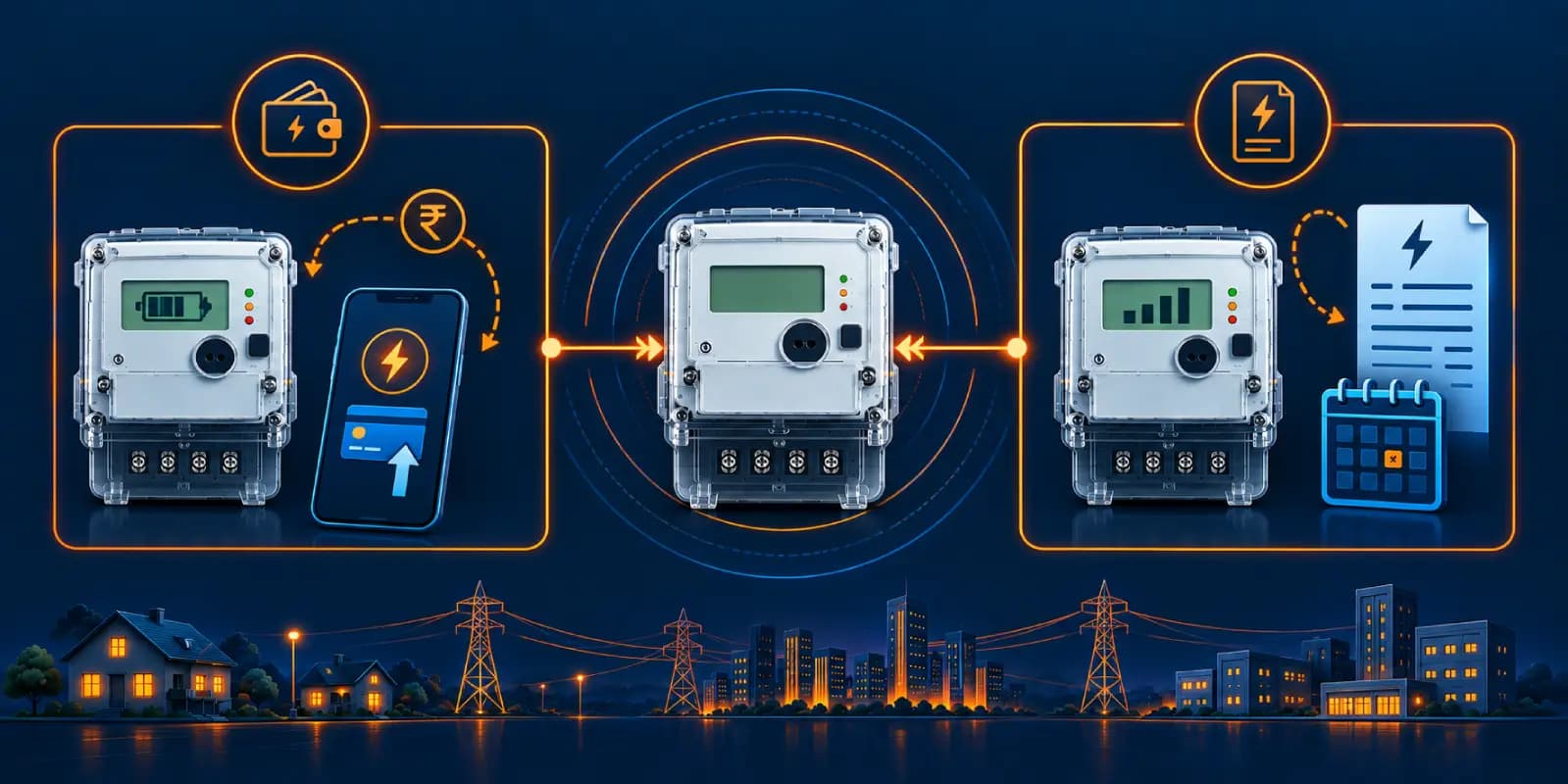
Prepaid vs postpaid smart meters: what's the difference?
The difference is when the consumer pays. A prepaid smart meter works like a mobile recharge: the consumer pays first, the meter draws down the balance as electricity is used, and supply pauses when the balance runs out. A postpaid smart meter works the traditional way: the consumer uses electricity through a billing cycle and pays afterwards, based on what was consumed. Both can be smart, remotely read and managed, the difference is the payment model, not the technology.
This guide explains how each mode works, the advantages and trade-offs for utilities and consumers, and how modern tariffs like time-of-use fit in.
How a prepaid smart meter works
A prepaid smart meter holds a credit balance. The consumer recharges it, often through an app, portal, or vendor, and the meter deducts from that balance in real time as energy is consumed. As the balance runs low, the meter warns the consumer, and if it reaches zero, it can disconnect supply remotely and reconnect automatically once recharged.
For utilities, this transforms cash flow: payment happens before consumption, not after, which removes the collection problem that drains distribution finances. For consumers, it offers control and visibility, they see exactly what they are spending and can budget accordingly. This is why prepaid metering is central to India's national smart metering programme.
How a postpaid smart meter works
A postpaid smart meter measures consumption across a billing cycle, and the utility bills the consumer afterwards. What makes it smart is that the reading, billing, and management are all remote and automated: no manual reads, no estimated bills, and the utility gets accurate interval data throughout the cycle. It is the familiar model, made accurate and automated.
Postpaid suits consumers and connections where billing-cycle payment is preferred or required, and it remains widely used for commercial and industrial connections.
| Aspect | Prepaid smart meter | Postpaid smart meter |
|---|---|---|
| Payment timing | Before consumption (recharge) | After consumption (billing cycle) |
| Utility cash flow | Improved, payment upfront | Depends on collection |
| Consumer control | High, visible balance | Lower, bill after use |
| Disconnection | Automatic when balance ends | On non-payment, after process |
| Estimated bills | None | None (smart, automated) |
| Typical use | Residential, loss-prone areas | Commercial, industrial, by preference |
The role of tariffs: ToU and ToD
Modern smart meters do more than record total consumption, they support flexible tariffs that reflect when energy is used. Two matter most:
Time-of-Use (ToU) tariffs charge different rates at different times of day, encouraging consumers to shift usage away from peak hours when power is most expensive and the grid is most stressed.
Time-of-Day (ToD) tariffs similarly vary rates across defined time blocks. Both reward off-peak usage and help utilities flatten demand.
These tariffs work with both prepaid and postpaid meters. A smart meter that complies with IS 16444 handles these tariff structures, along with net metering for consumers who generate their own power, such as rooftop solar. This flexibility is part of what separates a modern smart meter from a basic one.
Which is better for a utility?
There is no single answer, it depends on the goal. For reducing commercial losses and fixing cash flow, especially in loss-prone areas, prepaid is powerful, which is why national programmes emphasise it. For connections where billing-cycle payment is standard, such as many commercial and industrial consumers, postpaid remains appropriate. The strongest position is a meter that supports both modes, so a utility can deploy the right billing model for each consumer segment without changing hardware.
Enerzolve smart meters and billing
Enerzolve's smart energy meter supports both prepaid and postpaid billing per IS 16444, including time-of-use and time-of-day tariffs and net metering. Because the meter is part of a complete advanced metering infrastructure with head end and meter data management systems, the billing modes, tariffs, and remote operations are managed centrally across the fleet, letting a utility switch a consumer between prepaid and postpaid remotely, without a site visit.
The takeaway
Prepaid and postpaid smart meters differ in when the consumer pays: prepaid is pay-first with a drawn-down balance, postpaid is pay-after based on the billing cycle. Prepaid improves utility cash flow and gives consumers control, which is why it anchors India's smart metering programme; postpaid suits connections where billing-cycle payment is preferred. Both support modern ToU and ToD tariffs and net metering under IS 16444, and the most flexible meters support both modes, letting a utility choose the right model for each consumer.
Frequently asked questions
A prepaid smart meter requires the consumer to pay first and recharge a balance, which the meter draws down as electricity is used, pausing supply when it runs out. A postpaid smart meter measures consumption across a billing cycle and bills the consumer afterwards. The difference is the payment model; both can be smart, remotely read and managed.
Prepaid metering improves utility cash flow because payment happens before consumption, removing the collection problem that weakens distribution finances. It also reduces commercial losses and gives consumers real-time visibility of their spending, which is why programmes like India's RDSS emphasise prepaid meters.
Yes. A meter that supports both modes, managed through an advanced metering infrastructure, can be switched between prepaid and postpaid remotely, without a site visit. This lets a utility apply the right billing model to each consumer segment using the same hardware.
Time-of-Use (ToU) and Time-of-Day (ToD) tariffs charge different rates at different times, so energy costs more during peak hours and less off-peak. They encourage consumers to shift usage away from peak demand and help utilities flatten load. Smart meters compliant with IS 16444 support these tariffs.
Yes. Smart meters that comply with IS 16444 support net metering, which measures both the energy a consumer draws from the grid and the energy they export back, such as from rooftop solar, so the consumer is billed on the net amount.
Keep reading
What is a BESS? Battery Energy Storage Systems Explained
A BESS is a system of systems. The BMS protects the cells, the PCS converts the power, and the EMS decides what the whole thing should do.
HES vs MDMS: How the AMI Software Layer Works
The HES talks to the meters, the MDMS makes sense of the data. One collects, the other perfects — and a serious AMI rollout needs both.
Grid-Forming vs Grid-Following Inverters (What Grid-Forming Means)
A grid-following inverter is a passenger. A grid-forming inverter can be the driver — and as conventional generation retires, that difference matters more every year.
Ultrasonic vs AMR Water Meters: Which One Fits Your Network?
Accuracy, maintenance, communication, and cost — how the two technologies actually differ, and how to pick per application rather than per vendor.
Planning a metering or power conversion program?
Talk to the engineering team about specifications, standards, and deployment.
Contact Enerzolve