
Smart Energy Meter Specifications: A Complete Guide
A clear guide to smart energy meter specifications: accuracy class, voltage and current ratings, 4kV and 6kV surge withstand, DLMS/COSEM, and what each spec means.
Enerzolve Smart Grid Team··Smart Grid & Metering·7 min read
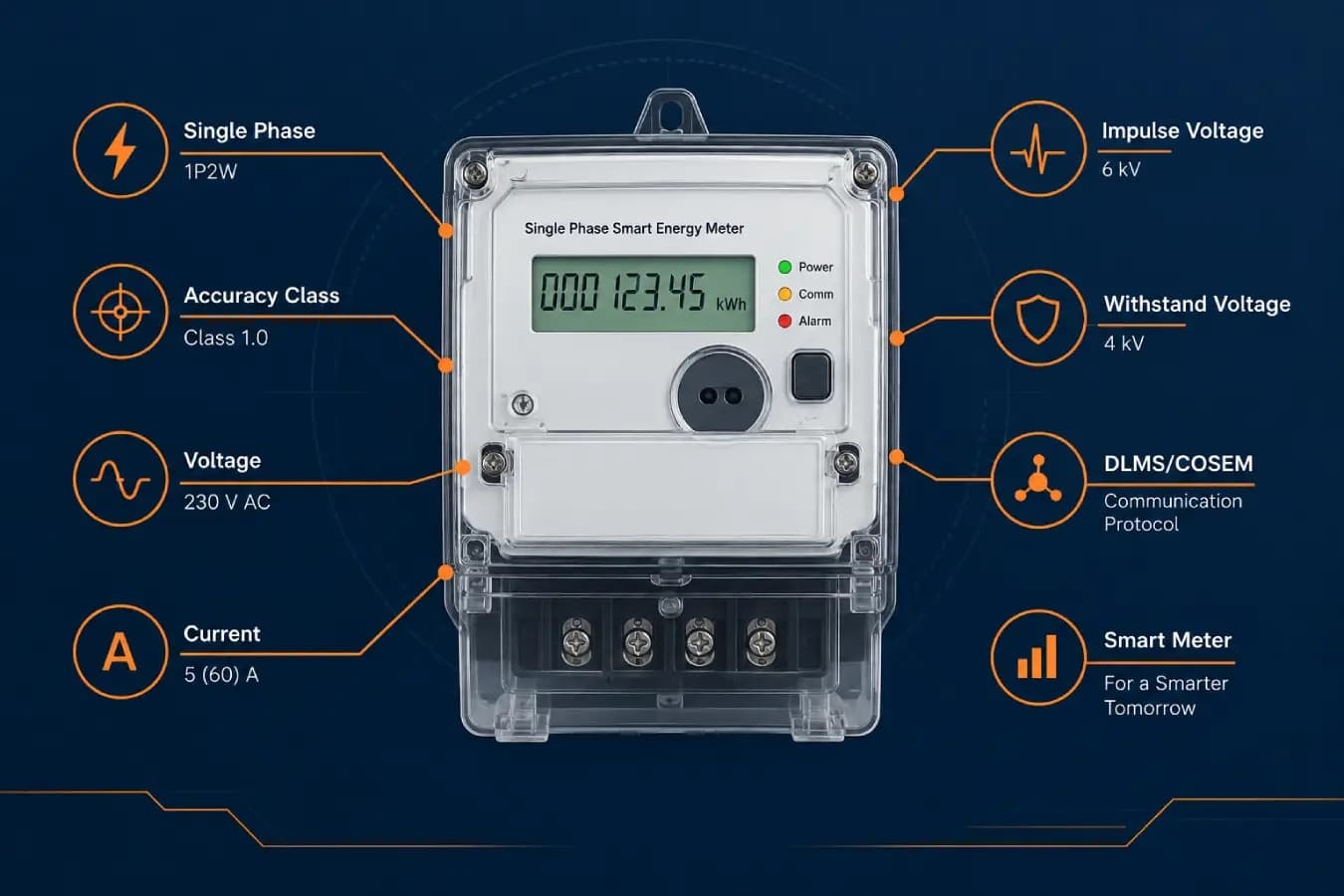
What are the key specifications of a smart energy meter?
The core specifications of a smart energy meter are its accuracy class, voltage and current ratings, frequency, surge and impulse withstand, magnetic immunity, communication protocol, and tamper detection. Together these define how accurately the meter measures energy, how well it survives real-world electrical conditions, and how it connects into a utility's network.
For a utility or a specifier, the specifications are not just numbers on a datasheet, they decide whether the meter will bill accurately for years, survive surges and tampering, and integrate cleanly with the metering system. This guide explains each specification and what it means in practice.
Accuracy class
Accuracy class is the first specification to check, because it sets the ceiling on billing precision. A Class 1.0 meter measures energy to within 1 percent, which is the standard for utility-grade single phase billing. A lower number means tighter accuracy, so Class 0.5S meters are used where higher precision is needed, typically on larger commercial and industrial connections.
Accuracy that holds over the meter's life matters as much as the initial figure. A meter that drifts out of class over time slowly under-bills, which is lost revenue, so the measurement technology behind the class (see current sensing below) is just as important as the class itself.
Voltage and current ratings
These define the electrical envelope the meter operates in.
Reference voltage is the nominal supply the meter is rated for, commonly 240 V AC line-to-neutral for a single phase meter. Operating voltage range shows how far the supply can deviate and still be measured accurately, often expressed as a multiple of nominal, such as 0.7 to 1.2 times the reference voltage. A wide operating range matters in areas with unstable supply.
Basic current (Ib) is the reference current the meter is calibrated around, for example 10 A. Maximum current (Imax) is the highest current it can measure accurately, such as 60 A. Starting current is the smallest current at which the meter begins registering, often as low as 20 mA. Low starting current matters because it lets the meter capture small, continuous loads that a less sensitive meter would miss and never bill.
Frequency
The meter is rated for the grid frequency, 50 Hz in India, usually with a tolerance such as plus or minus 5 percent. The meter must measure accurately across that band as grid frequency fluctuates.
Surge and impulse withstand: the 4kV and 6kV specifications
This is where a lot of buyer attention goes, and where two related but distinct specifications are often confused.
Impulse withstand voltage (often around 6 kV) is the meter's ability to survive a fast, high-voltage transient, the kind caused by a lightning strike or a switching surge on the line. It is a very short spike, and the meter must ride through it without damage.
AC voltage withstand (often 4 kV RMS) is the meter's ability to withstand a sustained high-voltage stress applied during type testing, proving the insulation holds up under continuous overvoltage.
Both matter. The 6 kV impulse rating protects against transient surges; the 4 kV RMS AC withstand proves insulation strength. A meter built for harsh Indian grid conditions, with frequent surges and unstable supply, needs strong figures on both. When a specification calls for a "4kV smart energy meter," it is almost always referring to this AC voltage withstand rating.
Magnetic immunity and tamper resistance
Meters can be tampered with using strong external magnets to slow or stop the register. High magnetic immunity means the meter keeps measuring accurately even when a magnet is applied, and logs the attempt as a tamper event. This specification directly protects revenue, which is why it is a priority for DISCOMs tackling commercial losses.
Current sensing technology
How the meter measures current affects both accuracy and tamper resistance. A precision shunt is a common, robust sensing method that holds accuracy well and resists magnetic tampering, since a shunt is not affected by external magnets the way some other sensing elements are. The sensing technology is the reason a meter can hold its accuracy class over years of service.
Communication and protocol
For a smart meter, the communication specification is what makes it "smart." Look for the supported communication options, such as RF Mesh, PLC, and cellular (4G, NB-IoT), and the protocol. DLMS/COSEM is the international standard protocol, and it matters because it keeps the meter interoperable with head end systems from different vendors, avoiding lock-in. A meter that supports DLMS/COSEM can slot into an advanced metering infrastructure cleanly.
Environmental and build specifications
Finally, the physical build: the enclosure material (often polycarbonate for durability and fire resistance), the ingress protection rating against dust and water, and the operating temperature range. In demanding installations, weatherproof and industrial-grade enclosures matter as much as the electrical specifications, because a meter that fails mechanically never gets to measure anything.
Smart energy meter specifications at a glance
| Specification | Typical value (single phase) | Why it matters |
|---|---|---|
| Accuracy class | Class 1.0 | Billing precision |
| Reference voltage | 240 V AC, L-N | Nominal supply |
| Operating voltage | 0.7 to 1.2 x Un | Tolerance to unstable supply |
| Basic current (Ib) | 10 A | Calibration reference |
| Maximum current (Imax) | 60 A | Highest accurate load |
| Starting current | 20 mA | Captures small loads |
| Frequency | 50 Hz ± 5% | Grid compatibility |
| Impulse withstand | 6 kV | Survives lightning and switching surges |
| AC voltage withstand | 4 kV RMS | Insulation strength |
| Magnetic immunity | High | Resists magnet tampering |
| Current sensing | Precision shunt | Accuracy and tamper resistance |
| Protocol | DLMS/COSEM | Interoperability |
How Enerzolve meters meet these specifications
Enerzolve's smart energy meter is a single phase, Class 1.0 meter built to these specifications for Indian grid conditions: 240 V reference voltage with a wide operating range, 10 to 60 A current, 6 kV impulse and 4 kV RMS AC withstand, high magnetic immunity, and precision shunt sensing. It supports DLMS/COSEM over RF Mesh, PLC, and cellular, with remote connect and disconnect, over-the-air firmware upgrades, and tamper detection, so it functions as a full node in an advanced metering infrastructure rather than a standalone meter. Manufactured and certified in India, it is built to hold its accuracy class over a long service life.
The takeaway
A smart energy meter's specifications tell you whether it will bill accurately, survive real grid conditions, resist tampering, and integrate with your metering system. The figures that matter most are accuracy class, current range and starting current, the 6 kV impulse and 4 kV RMS surge ratings, magnetic immunity, and DLMS/COSEM support. Read them together: a meter is only as good as the weakest specification in the chain from measurement to communication to physical build.
Frequently asked questions
The 4kV rating usually refers to the AC voltage withstand, which is 4 kV RMS. It is the sustained high-voltage stress the meter's insulation can withstand during type testing, proving it holds up under continuous overvoltage. It is different from the impulse withstand rating (often 6 kV), which covers short, fast transients like lightning surges.
Class 1.0 is the standard for utility-grade single phase billing, measuring energy to within 1 percent. For larger commercial and industrial connections that need higher precision, Class 0.5S meters are used. What matters as much as the class is whether the meter holds that accuracy over its service life.
Starting current is the smallest current at which the meter begins registering, often as low as 20 mA. A low starting current lets the meter capture small, continuous loads that a less sensitive meter would miss, so no consumption goes unmeasured and unbilled.
Impulse withstand (around 6 kV) is the meter's ability to survive a short, fast high-voltage transient such as a lightning or switching surge. AC voltage withstand (around 4 kV RMS) is its ability to withstand a sustained overvoltage during testing. Both protect the meter, one against transient spikes, the other proving insulation strength.
DLMS/COSEM is the international standard protocol that lets a smart meter communicate with head end systems from different vendors. Specifying DLMS/COSEM keeps a metering deployment interoperable and prevents vendor lock-in as it scales into a full advanced metering infrastructure.
Keep reading
What is a BESS? Battery Energy Storage Systems Explained
A BESS is a system of systems. The BMS protects the cells, the PCS converts the power, and the EMS decides what the whole thing should do.
HES vs MDMS: How the AMI Software Layer Works
The HES talks to the meters, the MDMS makes sense of the data. One collects, the other perfects — and a serious AMI rollout needs both.
Grid-Forming vs Grid-Following Inverters (What Grid-Forming Means)
A grid-following inverter is a passenger. A grid-forming inverter can be the driver — and as conventional generation retires, that difference matters more every year.
Ultrasonic vs AMR Water Meters: Which One Fits Your Network?
Accuracy, maintenance, communication, and cost — how the two technologies actually differ, and how to pick per application rather than per vendor.
Planning a metering or power conversion program?
Talk to the engineering team about specifications, standards, and deployment.
Contact Enerzolve