
The Key Components of a Smart Grid
A clear breakdown of smart grid components: smart metering, AMI, communication networks, automation and protection, and analytics, and how each layer works together.
Enerzolve Smart Technologies·
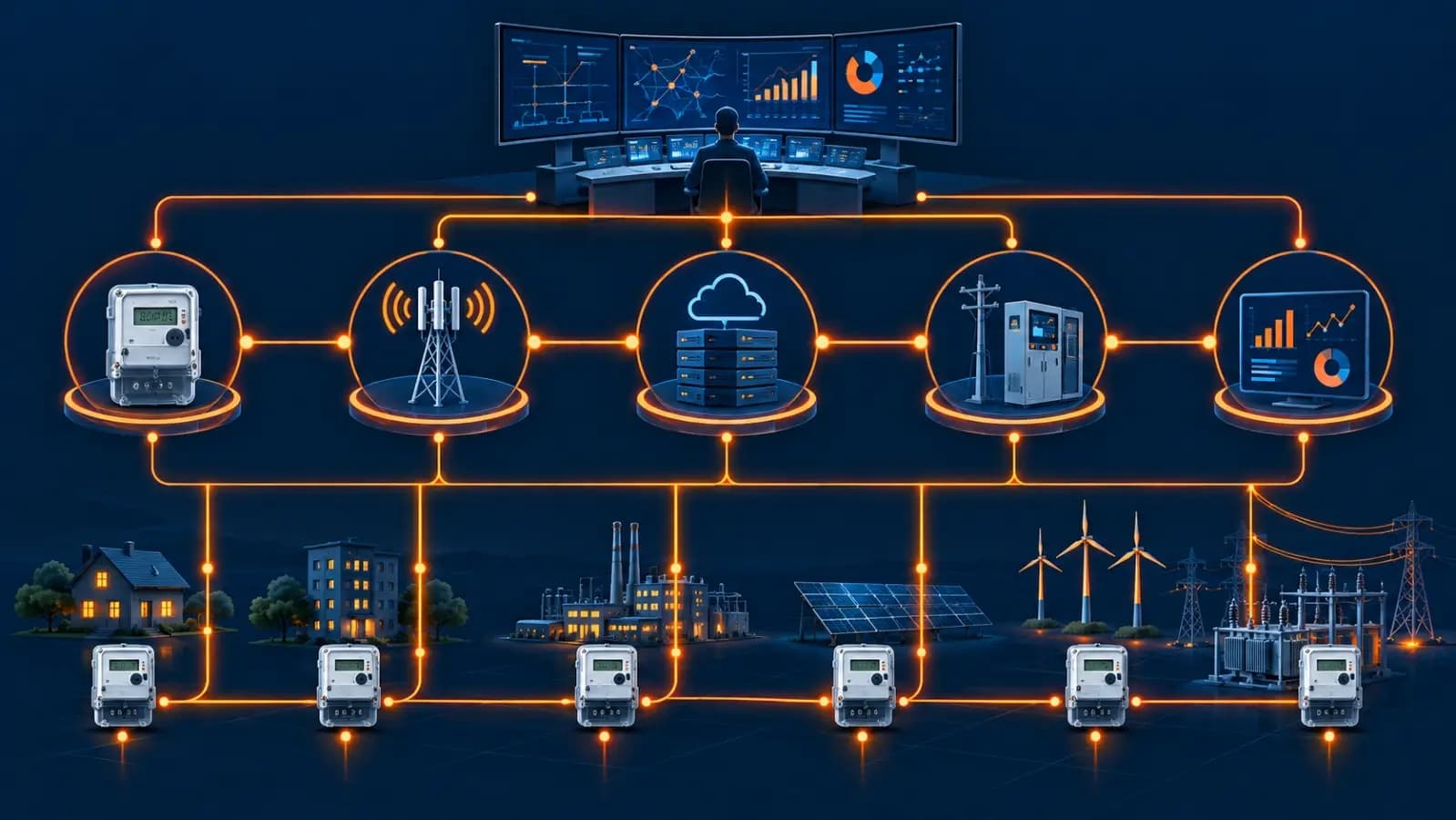
What are the components of a smart grid?
A smart grid is built from five core components: smart metering, advanced metering infrastructure (AMI), communication networks, grid automation and protection, and analytics software. Together they turn a one-way electricity network into a two-way system a utility can measure, monitor, and control in real time. No single component makes a grid "smart", it is how these layers work together that does.
This guide breaks down each component, what it does, and how it connects to the others, so you can see how a modern grid actually fits together.
1. Smart metering
Smart metering is the foundation, and the layer most utilities start with. Smart meters at every connection point measure consumption in near real time, detect tampering, and support remote connect and disconnect. They are the sensing edge of the grid: without accurate measurement at every point, nothing above them has reliable data to work with.
This covers both electricity and water. A smart energy meter captures voltage, current, demand, and load data and logs events, while a smart water meter brings the same intelligence to water networks. Accuracy and tamper resistance at this layer directly protect utility revenue.
2. Advanced Metering Infrastructure (AMI)
Individual smart meters become powerful when they are connected into a managed system. That system is advanced metering infrastructure, the two-way infrastructure that links every meter to the utility. AMI is itself made of sub-components: the meters, a communication network, a head end system that talks to the fleet, and a meter data management system that turns raw reads into billable, analysis-ready data.
AMI is where metering stops being about reading a number and starts being about controlling and understanding the network. It is the backbone that carries data both ways across the grid.
3. Communication networks
A smart grid depends on data moving reliably between field devices and the utility's systems. The communication layer carries it, using technologies such as RF Mesh, PLC over the power line, and cellular (4G, NB-IoT). Different parts of a network, dense urban, sparse rural, underground, need different communication methods, so a robust smart grid supports several. Underneath the physical link, open protocols like DLMS/COSEM keep the components interoperable, so a utility is not locked into one vendor.
4. Grid automation and protection
This component is what lets a smart grid respond, not just observe. Control and protection relays, automated switches, and controllers detect faults and reconfigure the network automatically, isolating a problem before it cascades into a wider outage. Where a traditional grid waits for a crew to find and fix a fault, an automated grid can reroute power in seconds. This is the layer that turns real-time visibility into real-time action.
5. Analytics and intelligence
The final component turns the flood of grid data into decisions. Analytics software provides load forecasting, AT&C and technical loss analysis, outage prediction, revenue assurance, and asset health monitoring. This is where the value of all the other layers is realised: accurate meters and fast communication only pay off if the data they produce is turned into insight a utility can act on.
How the components work together
The layers form a chain. Smart meters measure at the edge. AMI connects them into a managed, two-way system. Communication networks carry the data. Automation and protection act on the network in real time. Analytics turn everything into decisions. Remove any one layer and the grid stops being fully "smart": meters without AMI are islands, AMI without analytics is just data, automation without communication cannot coordinate.
Smart grid components at a glance
| Component | Role | Example |
|---|---|---|
| Smart metering | Measures consumption and events at the edge | Smart energy and water meters |
| Advanced Metering Infrastructure | Connects meters into a two-way managed system | Meters + HES + MDMS |
| Communication networks | Carries data across the grid | RF Mesh, PLC, 4G/NB-IoT |
| Automation and protection | Detects faults and reconfigures the network | Control and protection relays |
| Analytics and intelligence | Turns data into decisions | Loss analysis, load forecasting |
Building a smart grid in practice
Most utilities do not deploy every component at once. They typically start with smart metering and AMI, because accurate measurement and two-way connectivity deliver the fastest returns through reduced losses and automated billing, then add automation and deeper analytics over time. What matters is that the components are chosen to work together on a common platform, rather than assembled from mismatched systems that do not communicate cleanly.
Enerzolve builds these components as one integrated smart grid and automation platform, engineered and manufactured in India, covering full-stack metering, AMI, control and protection, and analytics, for energy and water on a single stack.
The takeaway
A smart grid is built from five components working as one: smart metering measures, AMI connects, communication networks carry the data, automation and protection act on the network, and analytics turn it all into decisions. The intelligence of the grid comes not from any single component but from how well they integrate, which is why choosing components designed to work together matters as much as the components themselves.
Frequently asked questions
The main components are smart metering, advanced metering infrastructure (AMI), communication networks, grid automation and protection, and analytics software. Smart meters measure at the edge, AMI connects them into a two-way system, communication networks carry the data, automation acts on the network, and analytics turn the data into decisions.
Smart metering refers to the meters themselves, which measure consumption and detect events. Advanced metering infrastructure (AMI) is the wider system that connects those meters into a managed, two-way network, including the communication layer, a head end system, and a meter data management system. Smart meters are one component of AMI.
Most utilities start with smart metering and AMI, because accurate measurement and two-way connectivity deliver the fastest returns through reduced losses and automated billing. Automation and deeper analytics are typically added over time, on a platform designed for all the components to work together.
Communication networks carry data between field devices and the utility's systems, so every other component depends on them. Without reliable communication, meters cannot report, automation cannot coordinate, and analytics have no current data. A smart grid usually supports several communication technologies to cover different network conditions.
Accurate smart metering reveals exactly where energy or water goes, AMI makes that data available in real time, automation detects and isolates faults quickly, and analytics pinpoint technical and commercial losses. Together these let a utility find and act on losses rather than only recording consumption, which is central to reducing AT&C losses.
Keep reading
What is a BESS? Battery Energy Storage Systems Explained
A BESS is a system of systems. The BMS protects the cells, the PCS converts the power, and the EMS decides what the whole thing should do.
HES vs MDMS: How the AMI Software Layer Works
The HES talks to the meters, the MDMS makes sense of the data. One collects, the other perfects — and a serious AMI rollout needs both.
Grid-Forming vs Grid-Following Inverters (What Grid-Forming Means)
A grid-following inverter is a passenger. A grid-forming inverter can be the driver — and as conventional generation retires, that difference matters more every year.
Ultrasonic vs AMR Water Meters: Which One Fits Your Network?
Accuracy, maintenance, communication, and cost — how the two technologies actually differ, and how to pick per application rather than per vendor.
Planning a metering or power conversion program?
Talk to the engineering team about specifications, standards, and deployment.
Contact Enerzolve