
Power Conversion System (PCS) Explained: 30kW to 2.5MW
What a power conversion system is, how a bidirectional PCS works in BESS and solar-plus-storage, ratings from 30kW to 2.5MW, and how Enerzolve builds PCS.
Enerzolve Smart Technologies·
What is a Power Conversion System (PCS)?
A Power Conversion System (PCS) is the device that sits between a battery, the grid, and often a solar array, and controls how power flows between them. It converts between the DC that batteries use and the AC that the grid runs on, in both directions, and decides moment to moment whether energy charges the battery, discharges to the grid, or supports the local load.
If a battery is the reservoir, the PCS is the pump and the valve. Without it, stored energy cannot move where and when it is needed. This guide explains what a PCS does, the difference between grid-forming and grid-following, the power ratings available, and where it is used.
What a PCS actually does
At its simplest, a PCS handles two jobs. It converts power between DC and AC, and it controls the direction and quality of that power.
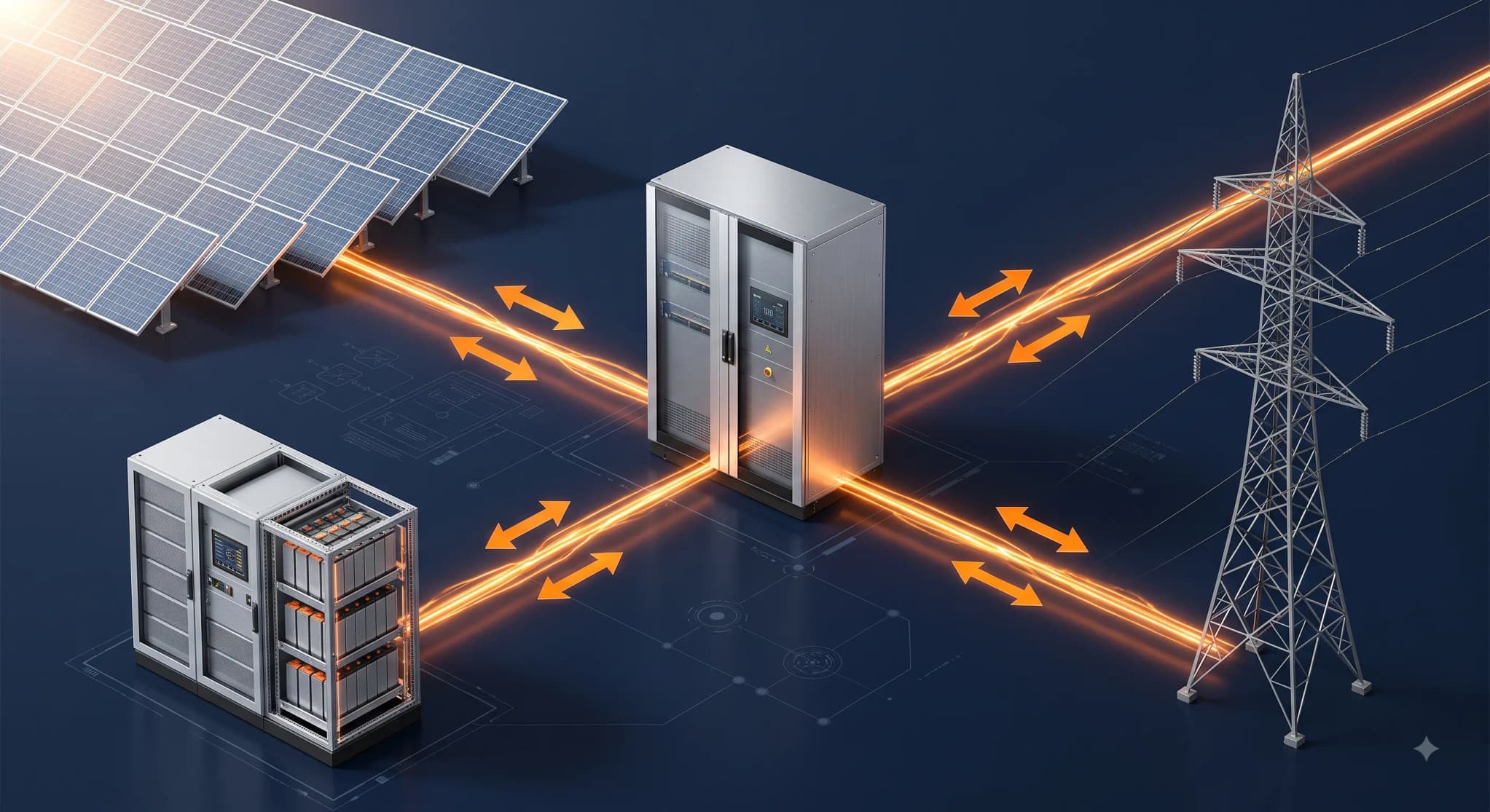
Because storage needs energy to flow both ways, a PCS is bidirectional. It rectifies AC into DC to charge the battery, and it inverts DC back into AC to discharge. A grid-tied PCS built for storage can interface a solar array, the utility grid, and the battery directly, which enables solar-to-battery, solar-to-grid, and battery-to-grid power flow through a single core.
That is why a PCS is central to any serious storage or hybrid renewable project. It is the point where solar, storage, the grid, and the load all meet.
Grid-following vs grid-forming
This is the distinction that matters most in modern power systems.
A grid-following PCS syncs to an existing grid. It needs the grid's voltage and frequency as a reference and feeds power in line with it. This is the traditional mode and works well when the grid is stable and present.
A grid-forming PCS can establish voltage and frequency itself. It can hold up a microgrid, ride through disturbances, and support black start, where the system helps bring power back after an outage without an external reference. As grids take on more renewables and more storage, grid-forming capability moves from optional to essential. We cover this fully in grid-forming vs grid-following inverters.
A capable PCS supports both modes and is built to meet grid codes such as IEEE 1547, CEA, and IEGC.
PCS power ratings: from 30kW to 2.5MW
Power conversion systems are specified by their power rating, from tens of kilowatts for commercial and industrial systems up to the megawatt class for utility-scale storage. A modular PCS reaches these ratings by paralleling standard power modules, so the topology, firmware, and protection stay identical from the smallest unit to the largest.
| PCS rating | Typical application |
|---|---|
| 30 kW | Small commercial and industrial storage, behind-the-meter |
| 100 kW | Commercial and industrial peak shaving, small microgrids |
| 500 kW | Large C&I, distributed storage, community-scale projects |
| 1 MW | Utility-scale storage blocks, solar-plus-storage |
| 2.5 MW | Large utility-scale BESS and renewable integration |
Choosing a rating is about matching the PCS to the project: the storage capacity, the grid connection, and how the system scales. Because a modular design parallels a common power block, a utility-scale plant is built from the same validated modules as a smaller system, which reduces risk and shortens delivery.
PCS for solar-plus-storage
In a solar-plus-storage plant, the PCS is what ties the solar array, the battery, and the grid together. Because it is bidirectional and can interface all three directly, a single PCS core enables the key power flows a hybrid plant needs: solar charging the battery, solar exporting to the grid, and the battery discharging to the grid when it is most valuable.
This is what makes solar-plus-storage work economically. Solar alone is variable, producing when the sun is out rather than when demand peaks. The PCS, together with the battery, lets a plant store surplus solar and dispatch it on demand, turning variable generation into firm, controllable power. For utility-scale solar projects adding storage, the PCS is the component that makes the hybrid plant behave as one coordinated system.
Why efficiency and topology matter
Every conversion loses a little energy as heat. Over a plant's life, small efficiency differences add up to real money and real cooling load, so topology and switching technology matter.
Modern PCS designs use silicon-carbide (SiC) switching and multilevel topologies such as three-level NPC to keep efficiency high across the full load range, not just at peak. Higher switching frequency also shrinks the magnetics and filters, which means more power fits in a smaller cabinet. Density is not vanity here. Less space and less cooling directly lower the cost of a project.
Modular and scalable design
A single fixed PCS rating forces you to design a new product for every project size. A modular approach solves this. Standard power modules are paralleled to reach the rating you need, while the topology, firmware, and protection stay identical across the range.
That brings two practical wins. First, N+1 redundancy and hot-swap: a module can be serviced while the system keeps running, so availability stays high. Second, one validated design serves many ratings, which shortens delivery and reduces risk.
Power conversion systems from Enerzolve
Enerzolve builds power conversion systems as part of its power electronics portfolio, engineered for battery storage and hybrid renewable plants.
The Enerzolve PCS is a bidirectional, grid-tied system with grid-to-battery and grid-forming control, active and reactive power support, and black-start capability, engineered to IEC 62477 and IEC 61000 standards. It interfaces solar PV, the utility grid, and battery storage directly, enabling PV-to-battery, PV-to-grid, and battery-to-grid power flow. Built on a modular, high-density platform, it scales across ratings by paralleling a common power block, and it is designed and manufactured in India.
Typical applications include utility-scale solar-plus-storage, grid-tied BESS, microgrids, renewable integration, and EV fast-charging hubs. If you are specifying a PCS for a storage or hybrid project, talk to our engineering team about your requirement.
Where a PCS is used
The same converter core shows up across a range of applications: utility-scale solar-plus-storage, grid-tied battery energy storage, microgrids, renewable integration, and EV fast-charging hubs. In each case the PCS is doing the same fundamental job, moving power in the right direction, at the right quality, at the right moment.
Storage is only as useful as the system that controls it. The PCS works alongside the battery management and energy management layers we cover in what is a BESS.
The takeaway
A PCS is not a supporting component. It is the control point of a storage system, the piece that decides how energy moves and whether the system can hold up a grid or only follow one. As renewables and storage grow, the PCS is where a lot of the intelligence of the future grid will live.
Frequently asked questions
A PCS converts power between the DC used by batteries and the AC used by the grid, and controls the direction and quality of that power. It is the core of a battery energy storage system, managing charging, discharging, and grid support.
A grid-following PCS synchronises to an existing grid and needs it as a reference. A grid-forming PCS can establish voltage and frequency itself, support microgrids, ride through disturbances, and enable black start. Grid-forming capability becomes essential as grids take on more renewables and storage.
An inverter converts DC to AC in one direction. A PCS is bidirectional and adds the control needed for storage, converting both ways and managing power flow between the battery, grid, solar, and load. Every PCS includes inverter functionality, but not every inverter is a PCS.
A modular PCS scales by paralleling standard power modules, covering ratings from around 30 kW for commercial and industrial systems up to 2.5 MW for utility-scale storage, including common ratings of 100 kW, 500 kW, and 1 MW. The topology, firmware, and protection stay the same across the range.
In a solar-plus-storage plant, the PCS interfaces the solar array, the battery, and the grid directly. Being bidirectional, it enables solar-to-battery, solar-to-grid, and battery-to-grid power flow, letting the plant store surplus solar and dispatch it on demand, turning variable solar into firm, controllable power.
Keep reading
What is a BESS? Battery Energy Storage Systems Explained
A BESS is a system of systems. The BMS protects the cells, the PCS converts the power, and the EMS decides what the whole thing should do.
HES vs MDMS: How the AMI Software Layer Works
The HES talks to the meters, the MDMS makes sense of the data. One collects, the other perfects — and a serious AMI rollout needs both.
Grid-Forming vs Grid-Following Inverters (What Grid-Forming Means)
A grid-following inverter is a passenger. A grid-forming inverter can be the driver — and as conventional generation retires, that difference matters more every year.
Ultrasonic vs AMR Water Meters: Which One Fits Your Network?
Accuracy, maintenance, communication, and cost — how the two technologies actually differ, and how to pick per application rather than per vendor.
Planning a metering or power conversion program?
Talk to the engineering team about specifications, standards, and deployment.
Contact Enerzolve