
AMI Security: How Smart Meter Data Is Protected
How advanced metering infrastructure (AMI) is secured, device identity, encryption, access control, and audit trails, and why security matters as utilities connect millions of meters.
Enerzolve Smart Grid Team··Smart Grid & Metering·7 min read
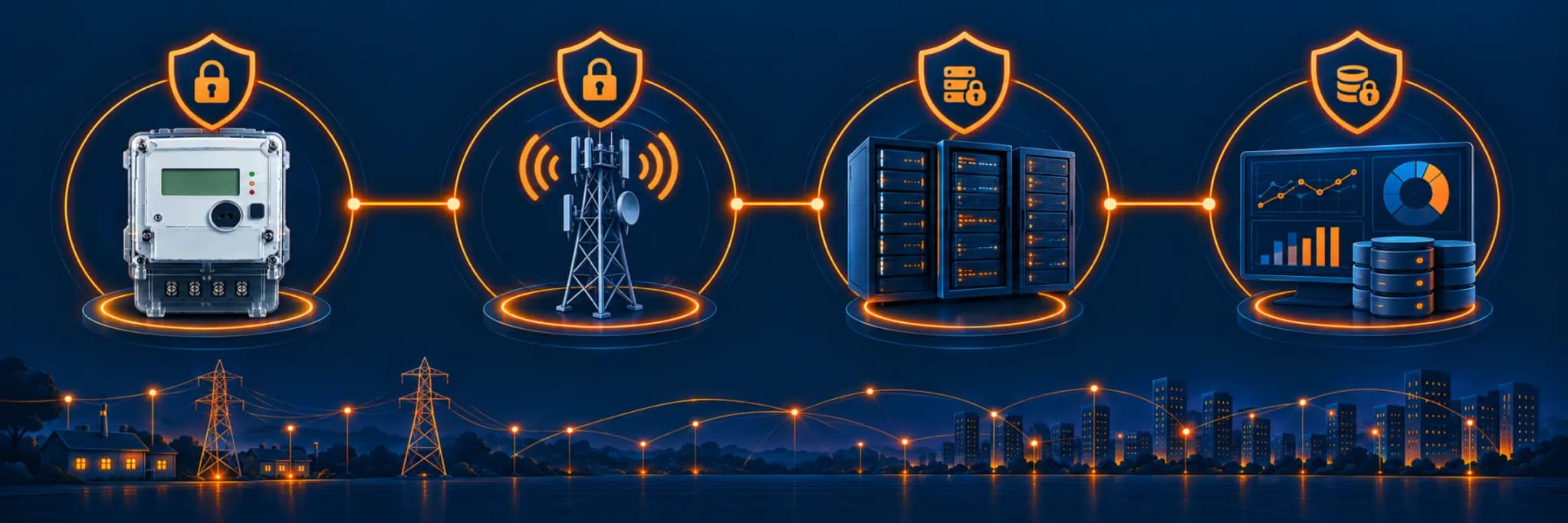
Why does AMI security matter?
An advanced metering infrastructure connects millions of smart meters to a utility's systems, carries sensitive consumption data, and accepts remote commands like connect and disconnect. That makes it a high-value target and a serious responsibility. A weakness anywhere in the chain, from the meter in the field to the data centre, can expose consumer data, allow billing manipulation, or disrupt supply. AMI security is what protects against all of that, and as smart metering scales nationally, it becomes part of the grid's overall resilience.
This guide explains how a well-designed AMI is secured, layer by layer, and what a utility should look for.
Security has to cover the whole chain
The key principle is that AMI security is not a single feature, it is end-to-end protection across every layer: the device, the communication network, the head end and data management systems, and the people and applications that access the data. A chain is only as strong as its weakest link, so a serious AMI secures all of them together. Here are the components that matter.
Device identity and authentication
Security starts at the meter. Every device needs a unique, verifiable identity, so the system knows each meter is genuine and not an imposter injected into the network. Strong device identity and authentication prevent rogue devices from joining the network or spoofing legitimate meters, which is the foundation everything else builds on.
Encryption and secure communication
Data moving between meters and the utility must be encrypted, so that even if it is intercepted, it cannot be read or altered. Secure communication protocols protect the data in transit across the RF, PLC, or cellular network, and encryption protects it at rest in the systems that store it. Together they ensure consumption data and commands stay confidential and tamper-proof from the meter all the way to the utility's applications.
Role-based access control
Not everyone in a utility should be able to do everything. Role-based access control (RBAC) ensures each user and system can access only what their role requires, an operator sees operational data, a billing clerk sees billing data, an administrator manages the system. This limits the damage a compromised account or an insider can do, and it is a basic expectation of any secure platform handling consumer data.
API security
Modern AMI integrates with billing, CIS, GIS, and other utility systems through APIs. Those interfaces are a potential entry point, so they must be secured, authenticated, authorised, and monitored, so that integration does not become a vulnerability. API security ensures the connections between systems are as protected as the systems themselves.
Audit trails and key management
Two more pillars round out the picture. Audit trails record who did what and when, so any action, a remote disconnect, a configuration change, a data access, can be traced and reviewed. This deters misuse and supports investigation if something goes wrong. Key management governs the encryption keys that secure the whole system, generating, storing, rotating, and retiring them safely, because encryption is only as strong as the protection of its keys.
Vulnerability monitoring and data protection
Security is not set-and-forget. Continuous vulnerability monitoring watches for emerging threats and weaknesses across the AMI ecosystem, so they can be addressed before they are exploited. And underpinning everything is data protection: ensuring consumer data is handled, stored, and processed responsibly and in line with expectations. Together these make security an ongoing discipline rather than a one-time checkbox.
AMI security at a glance
| Layer | What it protects | Mechanism |
|---|---|---|
| Device | The meter's authenticity | Device identity, authentication |
| Communication | Data in transit and at rest | Encryption, secure protocols |
| Access | Who can do what | Role-based access control |
| Integration | Connections to other systems | API security |
| Accountability | Traceability of actions | Audit trails |
| Encryption keys | The secrets that secure it all | Key management |
| Ongoing | Emerging threats and data handling | Vulnerability monitoring, data protection |
Why the manufacturer's security posture matters
A utility choosing an AMI is also choosing a security dependency, so the manufacturer's own security maturity matters as much as the product's features. Look for certifications that signal a disciplined, secure organisation, such as ISO 27001 for information security management and STQC for product security conformance. A vendor who builds the meter, the head end system, and the meter data management system together can secure the whole chain consistently, rather than leaving gaps at the seams between components from different suppliers.
Enerzolve builds end-to-end security across its advanced metering infrastructure, covering device identity, encryption, secure communication, role-based access control, API security, audit trails, key management, vulnerability monitoring, and data protection, with the organisation certified to ISO 27001 among other standards.
The takeaway
AMI security is end-to-end protection across the whole metering chain: verifiable device identity at the meter, encryption and secure communication for data in transit and at rest, role-based access control and API security for who and what can access the system, audit trails and key management for accountability, and continuous vulnerability monitoring and data protection to keep it all current. As utilities connect millions of meters, security becomes part of grid resilience, and the manufacturer's own security maturity matters as much as the features on the datasheet.
Frequently asked questions
An AMI connects millions of smart meters, carries sensitive consumption data, and accepts remote commands like connect and disconnect. A weakness anywhere in the chain could expose data, allow billing manipulation, or disrupt supply. Security protects against these risks, and as smart metering scales, it becomes part of the grid's overall resilience.
Smart meter data is protected through encryption in transit and at rest, secure communication protocols, verifiable device identity so only genuine meters join the network, role-based access control so users see only what their role permits, and audit trails that record every action. Continuous vulnerability monitoring keeps the protection current.
Role-based access control (RBAC) ensures each user and system can access only what their role requires, an operator sees operational data, a billing user sees billing data, and so on. This limits the damage a compromised account or insider can cause and is a basic expectation of any secure metering platform.
Encryption is only as strong as the protection of its keys. Key management governs how encryption keys are generated, stored, rotated, and retired safely. Poor key management undermines even strong encryption, which is why it is a core pillar of a secure AMI.
A utility should look for end-to-end security features across the device, communication, and software layers, and for organisational certifications such as ISO 27001 for information security and STQC for product security. A vendor who builds the meter, HES, and MDMS together can secure the whole chain consistently.
Keep reading
What is a BESS? Battery Energy Storage Systems Explained
A BESS is a system of systems. The BMS protects the cells, the PCS converts the power, and the EMS decides what the whole thing should do.
HES vs MDMS: How the AMI Software Layer Works
The HES talks to the meters, the MDMS makes sense of the data. One collects, the other perfects — and a serious AMI rollout needs both.
Grid-Forming vs Grid-Following Inverters (What Grid-Forming Means)
A grid-following inverter is a passenger. A grid-forming inverter can be the driver — and as conventional generation retires, that difference matters more every year.
Ultrasonic vs AMR Water Meters: Which One Fits Your Network?
Accuracy, maintenance, communication, and cost — how the two technologies actually differ, and how to pick per application rather than per vendor.
Planning a metering or power conversion program?
Talk to the engineering team about specifications, standards, and deployment.
Contact Enerzolve