
AMR vs AMI: What's the Difference?
AMR vs AMI explained: how automatic meter reading differs from advanced metering infrastructure, when to use each, and how to move from AMR to AMI.
Enerzolve Smart Technologies·
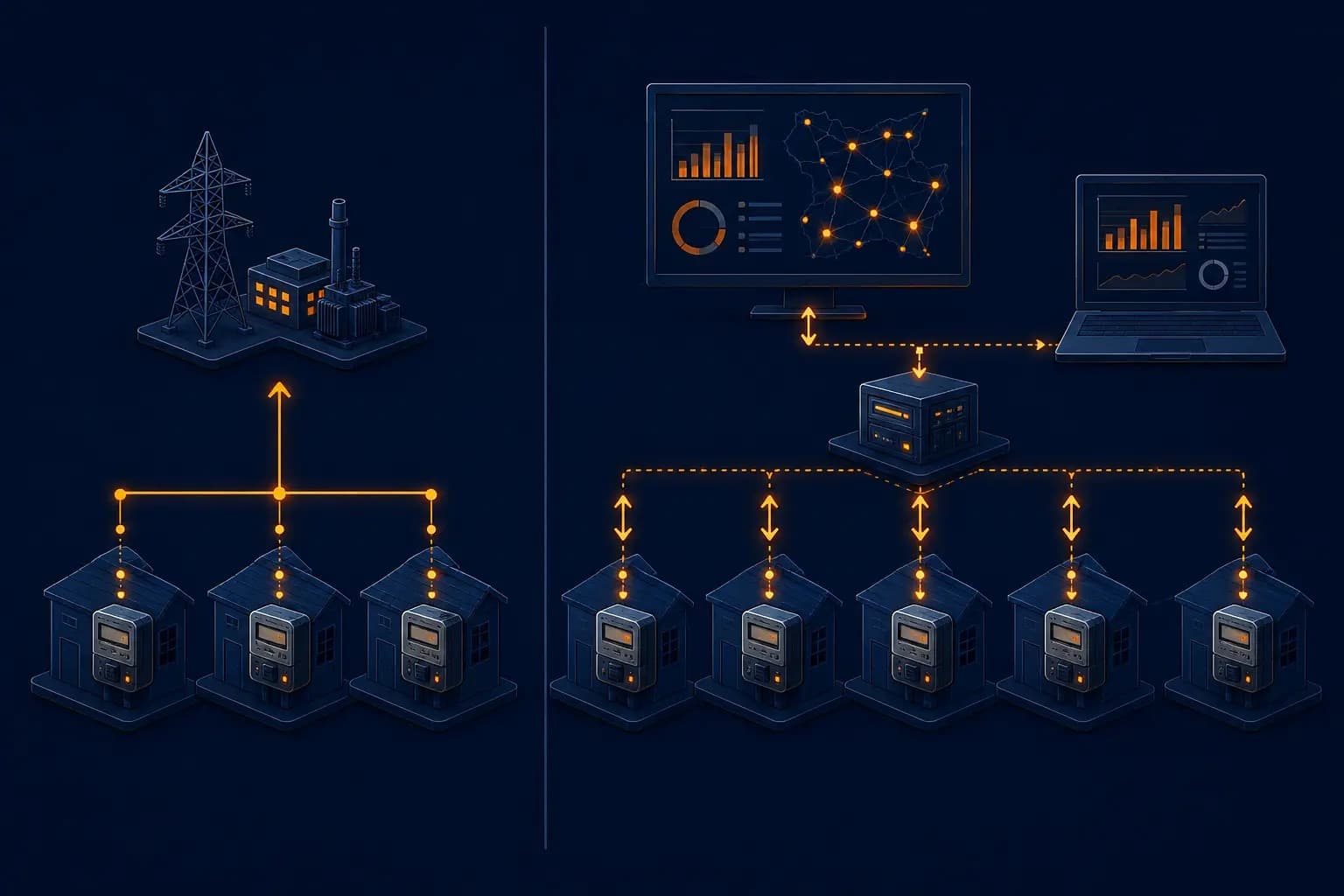
AMR vs AMI: what's the difference?
The core difference is direction. AMR (Automatic Meter Reading) is one-way: it automatically collects readings from a meter and sends them to the utility. AMI (Advanced Metering Infrastructure) is two-way: it collects readings and lets the utility send commands back to the meter, such as remote disconnect, firmware updates, and configuration changes. AMR reads the meter. AMI reads and controls it.
That single distinction drives everything else, cost, capability, and what a utility can do with the system. This guide breaks down both, shows where each fits, and explains how utilities move from one to the other.
What is AMR?
Automatic Meter Reading (AMR) was the first step away from manual meter reading. Instead of sending a person to note each meter, AMR captures the reading electronically and transmits it to the utility, often by radio, handheld, or drive-by collection.
AMR solved the biggest early problem, the cost and error of manual reads, but it is one-directional. The meter talks to the utility, not the other way round. It sends consumption data, and that is largely where its capability ends. There is no remote control, no live event alerting, and no firmware updates over the air.
What is AMI?
Advanced Metering Infrastructure (AMI) is the two-way successor to AMR. It is a full system: smart meters, a communication network, a head end system, and a meter data management system, all connected so data flows both ways.
Because it is two-way, AMI does far more than read the meter. It supports remote connect and disconnect, over-the-air firmware updates, real-time event and tamper alerts, interval data for load analysis, and prepaid billing. It turns the meter into a live, controllable node on the grid rather than a device that simply reports a number. For the full architecture, see our guide on what Advanced Metering Infrastructure is.
AMR vs AMI: side by side
| Feature | AMR | AMI |
|---|---|---|
| Communication | One-way (meter to utility) | Two-way (meter and utility) |
| Remote connect/disconnect | No | Yes |
| Firmware updates over the air | No | Yes |
| Real-time alerts and events | Limited | Yes |
| Interval and load data | Basic | Detailed |
| Prepaid billing support | No | Yes |
| Outage detection | No | Yes |
| System scope | Meter reading only | Full metering infrastructure |
The pattern is clear: AMR automates one task, reading. AMI is an infrastructure that manages the entire metering operation.
When does each make sense?
AMR still has a place. Where the only goal is to remove manual reading at low cost, and advanced control is not needed, AMR can be a reasonable, economical choice, particularly for smaller or simpler deployments.
AMI is the right choice wherever a utility needs more than reads: remote control to cut truck rolls, tamper and theft detection to recover revenue, interval data to manage load, and the ability to scale into a smart grid. For utilities and DISCOMs focused on reducing AT&C losses and modernising the network, AMI is the standard, because the value comes from control and data, not just automated reading.
Moving from AMR to AMI
Many utilities are on this path now, upgrading legacy AMR to full AMI. The transition is worth planning around one principle: interoperability. Choosing meters and systems built on open standards like DLMS/COSEM means the AMI investment stays flexible and avoids vendor lock-in as it scales.
The move also does not have to be all at once. A utility can deploy AMI in priority zones, high-loss areas or bulk points first, and expand over time, as long as the platform underneath supports the full two-way capability from the start.
AMI solutions from Enerzolve
Enerzolve builds the full AMI stack as one integrated platform, so utilities moving beyond AMR get two-way capability from meter to billing. The Enerzolve smart energy meter is AMI-ready with DLMS/COSEM support, remote connect and disconnect, and tamper detection, backed by a real-time Head End System and Meter Data Management System. Because the same platform serves both energy and water metering, a utility can run its entire metering operation on one system.
If you are planning an AMR to AMI upgrade or a new AMI rollout, talk to our engineering team about your network.
The takeaway
AMR and AMI both automate meter reading, but AMR is one-way and stops at reading, while AMI is two-way and manages the entire metering operation, with remote control, real-time data, and the ability to grow into a smart grid. AMR can suit simple, cost-driven deployments; AMI is the standard wherever control, loss reduction, and scalability matter.
Frequently asked questions
AMR (Automatic Meter Reading) is one-way: it automatically collects meter readings and sends them to the utility. AMI (Advanced Metering Infrastructure) is two-way: it collects readings and lets the utility send commands back to the meter, such as remote disconnect, firmware updates, and configuration. AMR reads the meter; AMI reads and controls it.
AMI is more capable, offering remote control, real-time alerts, interval data, prepaid billing, and outage detection that AMR cannot. AMR is simpler and can be cheaper for basic automated reading. For utilities that need control, loss reduction, and scalability, AMI is the better fit.
Yes. Many utilities upgrade legacy AMR to full AMI. The transition is smoother when meters and systems use open standards like DLMS/COSEM, which keep the deployment interoperable and avoid vendor lock-in as it scales. AMI can also be rolled out in stages, starting with priority zones.
AMI is the successor to AMR and provides everything AMR does plus two-way control and data management. AMR still exists in simpler or cost-driven deployments, but for network modernisation and loss reduction, AMI is the direction utilities are moving.
AMI, because reducing AT&C losses depends on capabilities AMR lacks: remote disconnect, tamper and theft detection, real-time alerts, and detailed interval data. These let a utility find and act on losses rather than only recording consumption.
Keep reading
What is a BESS? Battery Energy Storage Systems Explained
A BESS is a system of systems. The BMS protects the cells, the PCS converts the power, and the EMS decides what the whole thing should do.
HES vs MDMS: How the AMI Software Layer Works
The HES talks to the meters, the MDMS makes sense of the data. One collects, the other perfects — and a serious AMI rollout needs both.
Grid-Forming vs Grid-Following Inverters (What Grid-Forming Means)
A grid-following inverter is a passenger. A grid-forming inverter can be the driver — and as conventional generation retires, that difference matters more every year.
Ultrasonic vs AMR Water Meters: Which One Fits Your Network?
Accuracy, maintenance, communication, and cost — how the two technologies actually differ, and how to pick per application rather than per vendor.
Planning a metering or power conversion program?
Talk to the engineering team about specifications, standards, and deployment.
Contact Enerzolve