
Data Centre Power Infrastructure: UPS and Conversion Explained
A clear guide to data centre power: the challenges, UPS and conversion requirements, power quality, redundancy, and how Enerzolve supports reliable data centre power.
Enerzolve Smart Technologies·
What is data centre power infrastructure?
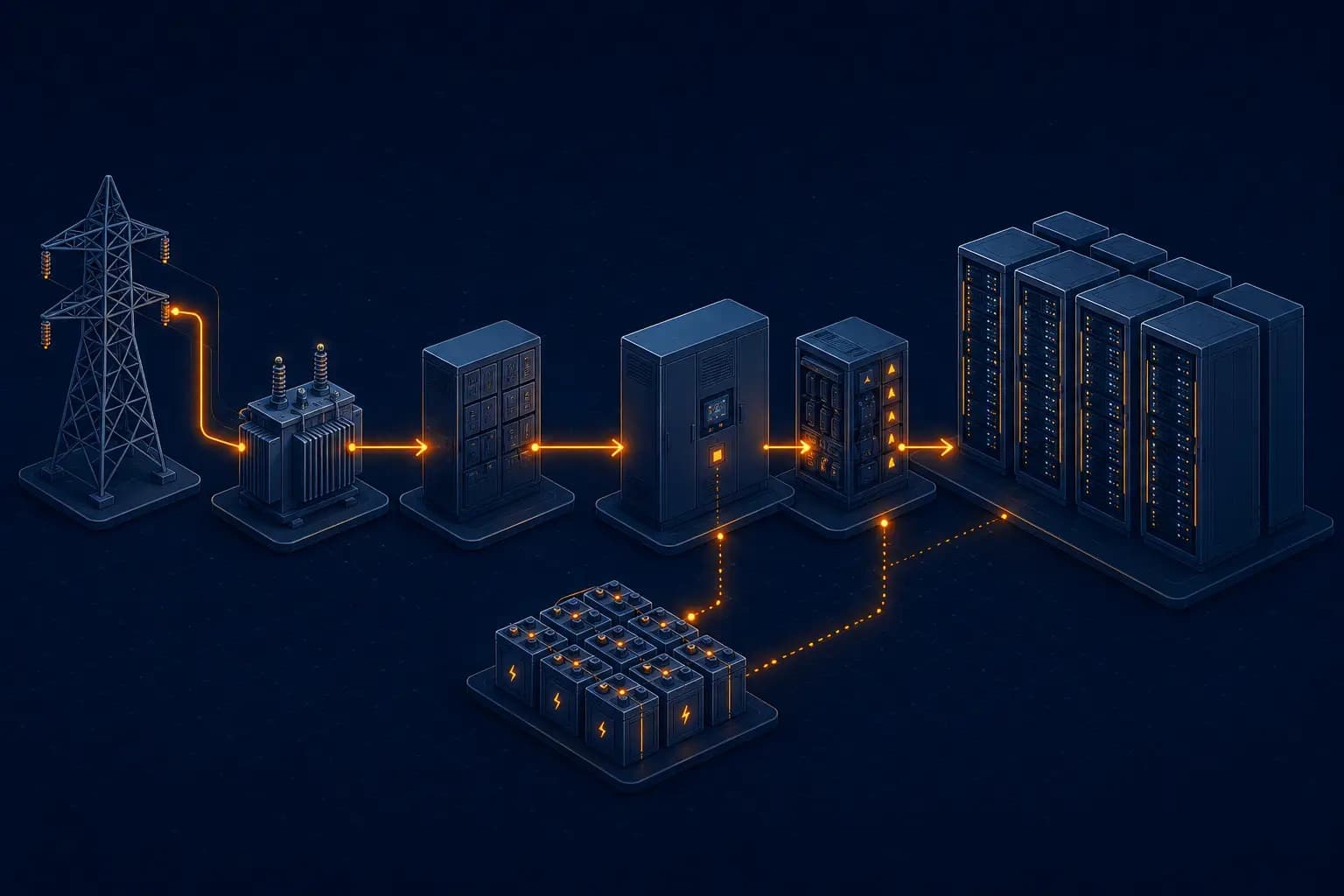
Data centre power infrastructure is the complete system that delivers clean, uninterrupted, high-density electricity to IT equipment. It covers the path from the utility supply through conversion, uninterruptible power supply (UPS), and distribution, all the way to the server rack, and it is engineered so that the load never sees an interruption or a disturbance, even during a mains failure.
Power is the single most critical dependency in a data centre. A server can tolerate almost anything except losing power, so the infrastructure around it is built for continuity above all else. This guide explains the core challenges, the role of UPS and power conversion, and what makes a data centre power system reliable.
Why data centre power is uniquely demanding
Data centres place demands on power that ordinary buildings never do. Three things make them different.
Continuity is non-negotiable. A momentary interruption that a normal facility would shrug off can crash servers, corrupt data, and breach uptime commitments. Data centre power must be genuinely uninterrupted, not just backed up.
Density is rising fast. Traditional racks drew a few kilowatts each. AI and high-performance computing workloads have pushed rack densities toward 30 to 100 kW, which concentrates enormous power in a small footprint and raises the stakes for every part of the chain.
Power quality must be near-perfect. Sensitive IT hardware needs a clean, stable waveform. Voltage sags, harmonics, and frequency variation that other equipment tolerates can degrade or damage servers, so the power delivered has to be conditioned and precise.
The role of UPS in a data centre
The uninterruptible power supply is the heart of data centre continuity. The type that matters here is the online double-conversion UPS.
In a double-conversion UPS, incoming AC is converted to DC and back to AC continuously, so the load is always fed from the UPS, never directly from the mains. This delivers two things a data centre needs: zero transfer time when the utility fails, because the load is already running through the UPS, and full isolation from mains disturbances, because the output waveform is rebuilt regardless of what the input is doing. The battery bridges the gap until generators take over during an outage.
This is why data centres specify online double-conversion UPS rather than simpler standby designs. It is the only topology that guarantees both instant transfer and clean power.
Redundancy: how data centres stay always-on
A single UPS is a single point of failure, so data centres build in redundancy. The common configurations:
| Configuration | Meaning | Resilience |
|---|---|---|
| N | Exactly the capacity needed, no spare | No redundancy |
| N+1 | One spare module beyond what is needed | Survives one module failure or allows live servicing |
| 2N | Fully duplicated, two independent systems | Survives a full system failure |
| 2N+1 | Duplicated plus a spare | Highest resilience |
Redundancy links directly to the Uptime Institute's tier standard. Higher tiers require configurations that let the facility be maintained or survive faults without dropping the load, which is why N+1 and 2N architectures are standard in serious data centres.
Power conversion and the shift toward DC
Beyond the UPS, data centres depend on power conversion at several stages, stepping voltage down and conditioning it for distribution. A growing trend is DC power distribution: because servers ultimately run on DC, delivering a clean DC bus can cut conversion losses and improve efficiency.
This is where advanced conversion technology matters. A solid state transformer, for example, can convert medium-voltage AC directly into a regulated low-voltage DC bus, feeding DC loads and storage without a separate rectifier stage. As efficiency (measured by PUE, power usage effectiveness) becomes a competitive and regulatory priority, this kind of high-density, controllable conversion becomes more valuable.
Data centre power in India
India is in the middle of a data centre boom, with major capacity being built across Mumbai, Chennai, Hyderabad, and other hubs, driven by data localisation rules, cloud demand, and now AI workloads. That growth places heavy demand on reliable, high-density power infrastructure engineered for Indian grid conditions, where supply quality and continuity cannot be taken for granted. Locally engineered UPS and conversion systems, built and supported in India, are increasingly important to that expansion.
Data centre power solutions from Enerzolve
Enerzolve builds the power conversion and UPS technology behind reliable data centre operations, as part of its power electronics portfolio.
At the core is an online double-conversion industrial UPS that ensures zero transfer time and superior power quality, with battery and hybrid storage support, built on a modular architecture that scales with N+1 redundancy and hot-swap so critical loads never see an interruption during service. Alongside it, Enerzolve's high-density power conversion platform supports the compact, efficient conversion that modern high-density and DC-oriented data centres need. All of it is engineered and manufactured in India.
If you are planning or upgrading data centre power infrastructure, talk to our engineering team about your requirement.
The takeaway
Data centre power infrastructure is built around one goal: clean, uninterrupted, high-density power to the rack. That means online double-conversion UPS for zero-transfer-time continuity, N+1 or 2N redundancy for resilience, and high-quality power conversion to protect sensitive IT loads. As rack densities climb and efficiency becomes critical, the conversion and UPS layer is where data centre reliability is won or lost.
Frequently asked questions
It is the complete system that delivers clean, uninterrupted, high-density electricity to IT equipment, covering conversion, UPS, and distribution from the utility supply to the server rack. It is engineered so the load never experiences an interruption or a power disturbance, even during a mains failure.
Data centres use online double-conversion UPS. In this design the load is always fed through the UPS rather than directly from the mains, which gives zero transfer time when the utility fails and full isolation from mains disturbances, delivering the continuity and clean power that servers require.
N+1 means the power system has one spare module beyond the capacity actually needed. This lets the data centre survive a single module failure, or service a module, without dropping the critical load. Higher configurations like 2N fully duplicate the system for greater resilience.
Sensitive IT hardware needs a stable, clean waveform. Voltage sags, harmonics, and frequency variation that ordinary equipment tolerates can degrade or damage servers. Data centre power systems condition and regulate the supply so IT equipment receives precise, high-quality power.
Servers ultimately run on DC, so distributing a clean DC bus can reduce conversion losses and improve efficiency, measured by PUE. Advanced conversion technology such as solid state transformers can deliver a regulated DC bus directly, which suits the rising density and efficiency demands of modern data centres.
Keep reading
What is a BESS? Battery Energy Storage Systems Explained
A BESS is a system of systems. The BMS protects the cells, the PCS converts the power, and the EMS decides what the whole thing should do.
HES vs MDMS: How the AMI Software Layer Works
The HES talks to the meters, the MDMS makes sense of the data. One collects, the other perfects — and a serious AMI rollout needs both.
Grid-Forming vs Grid-Following Inverters (What Grid-Forming Means)
A grid-following inverter is a passenger. A grid-forming inverter can be the driver — and as conventional generation retires, that difference matters more every year.
Ultrasonic vs AMR Water Meters: Which One Fits Your Network?
Accuracy, maintenance, communication, and cost — how the two technologies actually differ, and how to pick per application rather than per vendor.
Planning a metering or power conversion program?
Talk to the engineering team about specifications, standards, and deployment.
Contact Enerzolve