What is a Solid State Transformer (SST)?
A clear guide to the solid state transformer: what an SST is, how MV-to-LV conversion with high-frequency isolation works, its two configurations, and its applications.
Enerzolve Smart Technologies·
What is a solid state transformer (SST)?
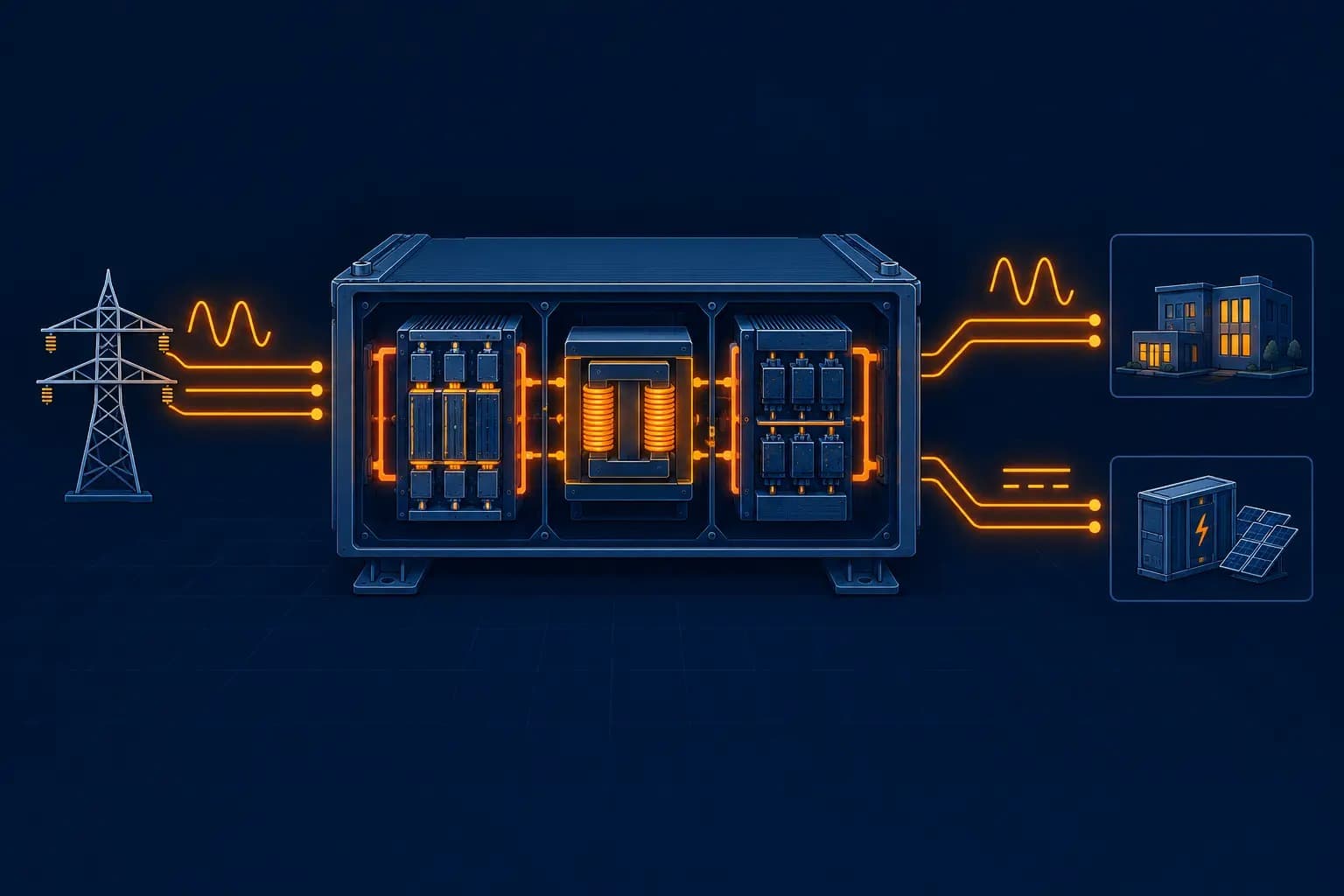
A solid state transformer (SST) is a power-electronics device that converts medium-voltage electricity to low voltage using high-frequency isolation instead of a conventional iron core. It performs the same voltage step-down as a traditional transformer, but adds voltage regulation, power-quality control, and a far smaller footprint. An SST is also called a smart transformer.
That combination is why the SST is seen as a building block of the smart grid. Where a conventional transformer only changes voltage, an SST changes voltage and actively controls the power flowing through it. This guide explains how it works, its two main configurations, and where it is used.
How a solid state transformer works
A conventional transformer uses a large iron core operating at grid frequency (50 or 60 Hz), which is why it is heavy and bulky. An SST replaces that with a three-stage power-electronics process. It first converts the incoming medium-voltage AC to high-frequency AC, passes it through a small high-frequency isolation transformer, then converts it to the required low-voltage output.
The key is frequency. Operating at high frequency (often tens of kilohertz) lets the isolation transformer be dramatically smaller and lighter, because transformer size falls as frequency rises. Modern SSTs use silicon-carbide (SiC) switching to reach these frequencies efficiently. The result is a compact device that also regulates voltage and conditions power quality, which a passive transformer cannot do.
The two configurations of a solid state transformer
An SST is built in two main output configurations, depending on whether the load needs AC or DC.
| Configuration | What it does | Typical applications |
|---|---|---|
| MV AC to LV AC | Steps medium-voltage AC (11 to 33 kV) down to low-voltage AC (up to 1000 V) through high-frequency isolation, replacing bulky line-frequency transformers while adding voltage regulation and power-quality control | Industrial and commercial distribution, renewable collection substations, traction and rail auxiliary supply, smart-grid interconnection |
| MV AC to LV DC | Converts medium-voltage AC directly into a regulated, fully isolated low-voltage DC bus, removing the need for a separate rectifier stage to feed DC loads and storage | EV fast-charging hubs, BESS DC-coupling, data-centre DC power, DC microgrids, electrolyser supplies |
The DC configuration is increasingly important, because so much modern infrastructure (batteries, EV chargers, data centres) runs natively on DC. An SST can feed those loads a clean DC bus directly, skipping a conversion stage.
Solid state transformer vs conventional transformer
The difference comes down to what each one can do beyond changing voltage.
| Feature | Conventional transformer | Solid state transformer |
|---|---|---|
| Core | Iron core at grid frequency | High-frequency electronic conversion |
| Size and weight | Large and heavy | Compact and light |
| Voltage regulation | None (passive) | Active, built in |
| Power-quality control | None | Yes |
| DC output | Not possible directly | Yes, via the MV AC to LV DC configuration |
| Smart-grid integration | Limited | Native |
A conventional transformer is simpler and cheaper for basic voltage step-down. An SST earns its place where the extra control, compactness, DC capability, and grid intelligence matter.
Applications of solid state transformers
Solid state transformers are used wherever voltage conversion needs to be compact, controllable, or DC-capable:
Renewable collection substations that gather power from solar and wind. Traction and rail auxiliary supply, where weight and space are constrained. Smart-grid interconnection points that need active control. EV fast-charging hubs that require a high-power DC bus. Battery energy storage systems using DC-coupling. Data-centre DC power distribution. And DC microgrids and electrolyser supplies for green hydrogen.
Solid state transformers from Enerzolve
Enerzolve develops solid state transformers as part of its power electronics portfolio, engineered for medium-voltage to low-voltage conversion with high-frequency isolation.
Enerzolve's SST is offered in both configurations, MV AC to LV AC and MV AC to LV DC, handling medium-voltage input from 11 kV to 33 kV AC and delivering low-voltage output up to 1000 V AC or a regulated DC bus. It is built on the same modular, high-density power conversion platform Enerzolve uses across its product lines, and shares its control and topology approach with the power conversion systems used in storage and renewable integration. The result is a compact, grid-ready transformer designed and manufactured in India.
If you are evaluating solid state transformers for distribution, renewable collection, rail, EV charging, or DC infrastructure, talk to our engineering team about your requirement.
The takeaway
A solid state transformer converts medium voltage to low voltage using high-frequency power electronics rather than a conventional iron core. It matches a traditional transformer's voltage step-down while adding voltage regulation, power-quality control, DC output capability, and a much smaller footprint. Available in MV AC to LV AC and MV AC to LV DC configurations, the SST is a core building block for renewable integration, EV charging, DC infrastructure, and the smart grid.
Frequently asked questions
A solid state transformer is a device that converts medium-voltage electricity to low voltage using high-frequency power electronics instead of a conventional iron core. It does the same job as a normal transformer but is smaller, and it can also regulate voltage, control power quality, and provide a DC output.
A conventional transformer uses a heavy iron core at grid frequency and only changes voltage. A solid state transformer uses high-frequency electronic conversion, so it is far more compact and can also regulate voltage, condition power quality, and output DC. Conventional transformers are cheaper for basic step-down; SSTs add control and intelligence.
Common applications include renewable collection substations, traction and rail auxiliary supply, smart-grid interconnection, EV fast-charging hubs, battery energy storage DC-coupling, data-centre DC power, and DC microgrids.
Yes. In its MV AC to LV DC configuration, a solid state transformer converts medium-voltage AC directly into a regulated, fully isolated low-voltage DC bus, which removes the need for a separate rectifier stage to feed DC loads such as EV chargers, batteries, and data centres.
Unlike passive transformers, solid state transformers actively regulate voltage and control power flow, and they integrate DC sources and loads directly. This makes them well suited to grids with high levels of solar, storage, and EV charging, where active control and DC capability matter.
Keep reading
What is a BESS? Battery Energy Storage Systems Explained
A BESS is a system of systems. The BMS protects the cells, the PCS converts the power, and the EMS decides what the whole thing should do.
HES vs MDMS: How the AMI Software Layer Works
The HES talks to the meters, the MDMS makes sense of the data. One collects, the other perfects — and a serious AMI rollout needs both.
Grid-Forming vs Grid-Following Inverters (What Grid-Forming Means)
A grid-following inverter is a passenger. A grid-forming inverter can be the driver — and as conventional generation retires, that difference matters more every year.
Ultrasonic vs AMR Water Meters: Which One Fits Your Network?
Accuracy, maintenance, communication, and cost — how the two technologies actually differ, and how to pick per application rather than per vendor.
Planning a metering or power conversion program?
Talk to the engineering team about specifications, standards, and deployment.
Contact Enerzolve