
Data Centre UPS: Types and How to Choose
A guide to data centre UPS systems: the main types, why online double-conversion is the standard, N+1 and 2N redundancy, and how to choose the right configuration.
Enerzolve Smart Technologies·
What type of UPS does a data centre use?
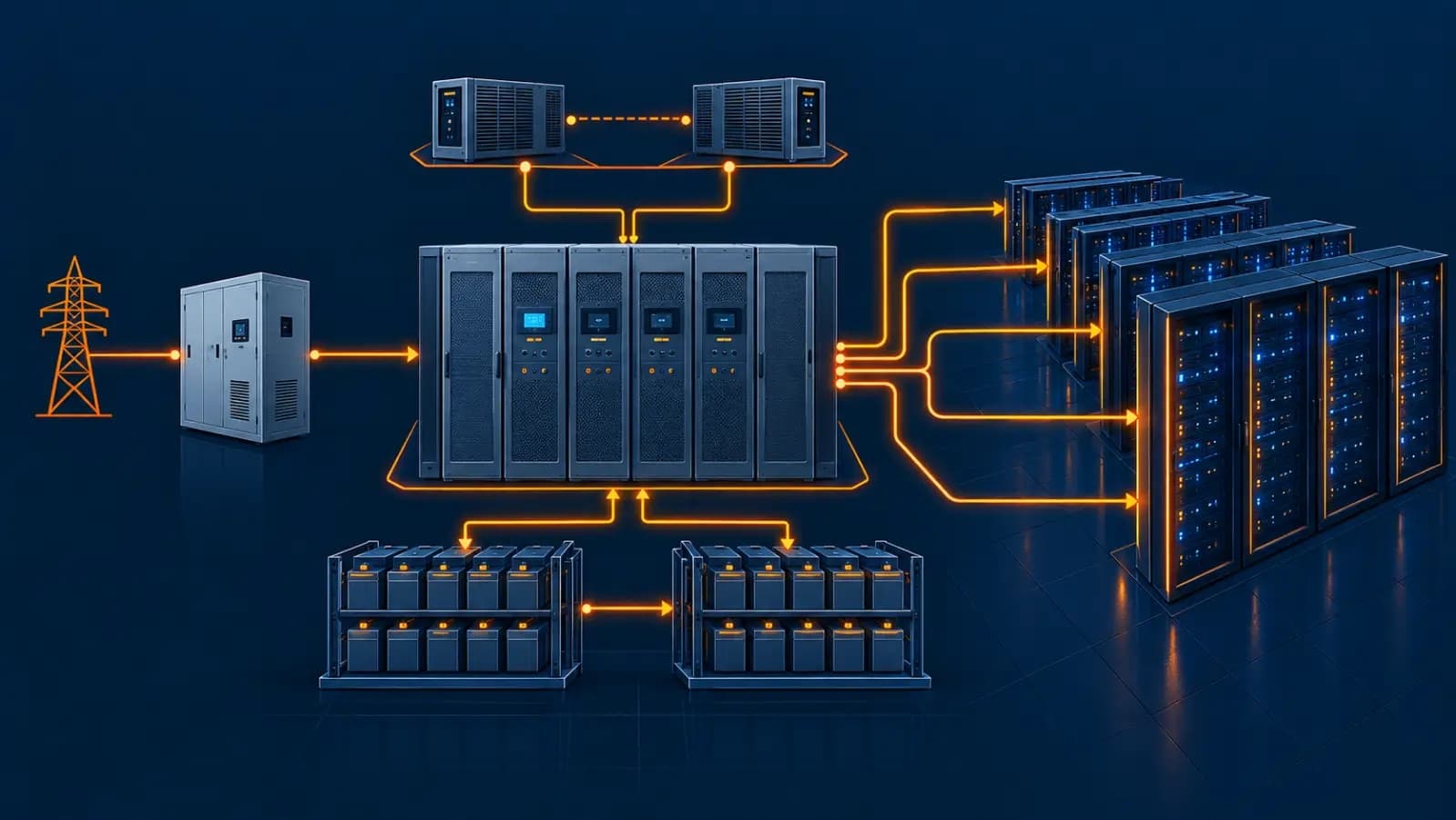
Data centres use online double-conversion UPS systems, because they are the only type that delivers both zero transfer time and full isolation from mains disturbances. In a data centre, a momentary power interruption can crash servers and corrupt data, so the UPS is not a backup that switches on when the power fails, it is always in the path, continuously conditioning power to the load.
This guide covers the main UPS types, why double-conversion is the data centre standard, how redundancy configurations work, and how to choose.
The three main UPS topologies
There are three basic UPS designs, and they differ in how much they protect the load.
Standby (offline) UPS. The load runs directly from the mains, and the UPS switches to battery only when power fails. It is cheap and simple, but there is a brief transfer time and no conditioning of the incoming power. Fine for a home PC, not for a data centre.
Line-interactive UPS. Adds automatic voltage regulation to smooth minor sags and surges without going to battery. Better for small server rooms and network closets, but still not the continuous protection a data centre needs.
Online double-conversion UPS. The load is always fed through the UPS. Incoming AC is converted to DC and back to AC continuously, so the output is completely rebuilt regardless of what the input is doing. This is what data centres use.
Why data centres need online double-conversion
Two properties make double-conversion the standard.
First, zero transfer time. Because the load already runs through the UPS, there is no switchover delay when the mains fails, the battery simply continues feeding the inverter. Sensitive IT hardware never sees an interruption.
Second, full power conditioning. Since the output waveform is regenerated continuously, the load is isolated from every disturbance on the input, sags, surges, harmonics, and frequency variation. Servers receive clean, stable power no matter how poor the incoming supply is. In a data centre, where uptime commitments are contractual and hardware is sensitive, both properties are non-negotiable.
Redundancy: keeping the UPS itself from being a single point of failure
A single UPS, however good, is one thing that can fail. Data centres build in redundancy so the loss of one module never drops the load.
| Configuration | Meaning | Resilience |
|---|---|---|
| N | Exactly the capacity needed | No redundancy |
| N+1 | One spare module beyond need | Survives one module failure or allows live service |
| 2N | Fully duplicated systems | Survives a full system failure |
| 2N+1 | Duplicated plus a spare | Highest resilience |
The configuration links directly to the data centre's tier level. Higher tiers require architectures that let the facility be maintained, or survive a fault, without ever dropping the critical load, which is why N+1 and 2N are standard in serious data centres.
Modular vs monolithic UPS
Beyond topology and redundancy, there is the question of build. A monolithic UPS is a single large unit sized for the full load. A modular UPS is built from smaller power modules that combine to reach the required capacity, and can be serviced or expanded live, one module at a time. Modular designs make N+1 redundancy and hot-swap straightforward, and let a data centre scale capacity as demand grows rather than over-buying upfront. For modern, growing data centres, modular is increasingly the preferred approach.
How to choose a data centre UPS
Work through it in this order: confirm you need online double-conversion (for any real data centre, you do), size the capacity to your current and near-future load, choose a redundancy level that matches your uptime commitment (N+1 as a baseline, 2N for critical facilities), and decide between modular and monolithic based on how much you expect to scale. Then weigh efficiency, because a UPS runs continuously and its losses show up directly in your PUE and running costs, and factor in battery type and runtime to bridge until generators take over.
Enerzolve builds online double-conversion industrial UPS as part of its power electronics portfolio, on a modular architecture with N+1 redundancy and hot-swap so critical loads never see an interruption during service. For the wider power picture, including conversion and DC distribution, see our guide on data centre power infrastructure.
The takeaway
Data centres run on online double-conversion UPS because it delivers zero transfer time and full power conditioning, the two things sensitive IT loads cannot do without. Layer the right redundancy on top, N+1 as a baseline and 2N for critical sites, and choose modular where you expect to scale. The UPS is one of the few components in a data centre that runs every second of every day, so topology, redundancy, and efficiency all matter.
Frequently asked questions
Data centres use online double-conversion UPS. The load is always fed through the UPS, which converts incoming AC to DC and back to AC continuously. This delivers zero transfer time when the mains fails and full isolation from power disturbances, both of which sensitive IT equipment requires.
A line-interactive UPS runs the load from the mains and regulates voltage, switching to battery when power fails, with a brief transfer time. An online double-conversion UPS always feeds the load through the UPS, so there is no transfer time and the output is fully conditioned. Data centres require the online type.
N+1 means the UPS system has one spare module beyond the capacity actually needed. This lets the data centre survive a single module failure, or service a module, without dropping the critical load. Higher configurations like 2N fully duplicate the system for greater resilience.
A modular UPS is built from smaller power modules that combine to reach the required capacity and can be serviced or expanded live, one module at a time. This makes N+1 redundancy and hot-swap straightforward and lets a data centre scale capacity as demand grows rather than over-provisioning upfront.
A UPS runs continuously, so any energy it loses as heat adds directly to running costs and to the data centre's PUE (power usage effectiveness). A more efficient UPS lowers both the electricity bill and the cooling load, which is why efficiency is a key selection criterion alongside topology and redundancy.
Keep reading
What is a BESS? Battery Energy Storage Systems Explained
A BESS is a system of systems. The BMS protects the cells, the PCS converts the power, and the EMS decides what the whole thing should do.
HES vs MDMS: How the AMI Software Layer Works
The HES talks to the meters, the MDMS makes sense of the data. One collects, the other perfects — and a serious AMI rollout needs both.
Grid-Forming vs Grid-Following Inverters (What Grid-Forming Means)
A grid-following inverter is a passenger. A grid-forming inverter can be the driver — and as conventional generation retires, that difference matters more every year.
Ultrasonic vs AMR Water Meters: Which One Fits Your Network?
Accuracy, maintenance, communication, and cost — how the two technologies actually differ, and how to pick per application rather than per vendor.
Planning a metering or power conversion program?
Talk to the engineering team about specifications, standards, and deployment.
Contact Enerzolve