
Defence Power Supply: Ruggedized Power for Mission-Critical Systems
A guide to defence power supplies: what they are, the standards and ruggedization they require, applications in radar and communications, and how Enerzolve builds them.
Enerzolve Smart Technologies·
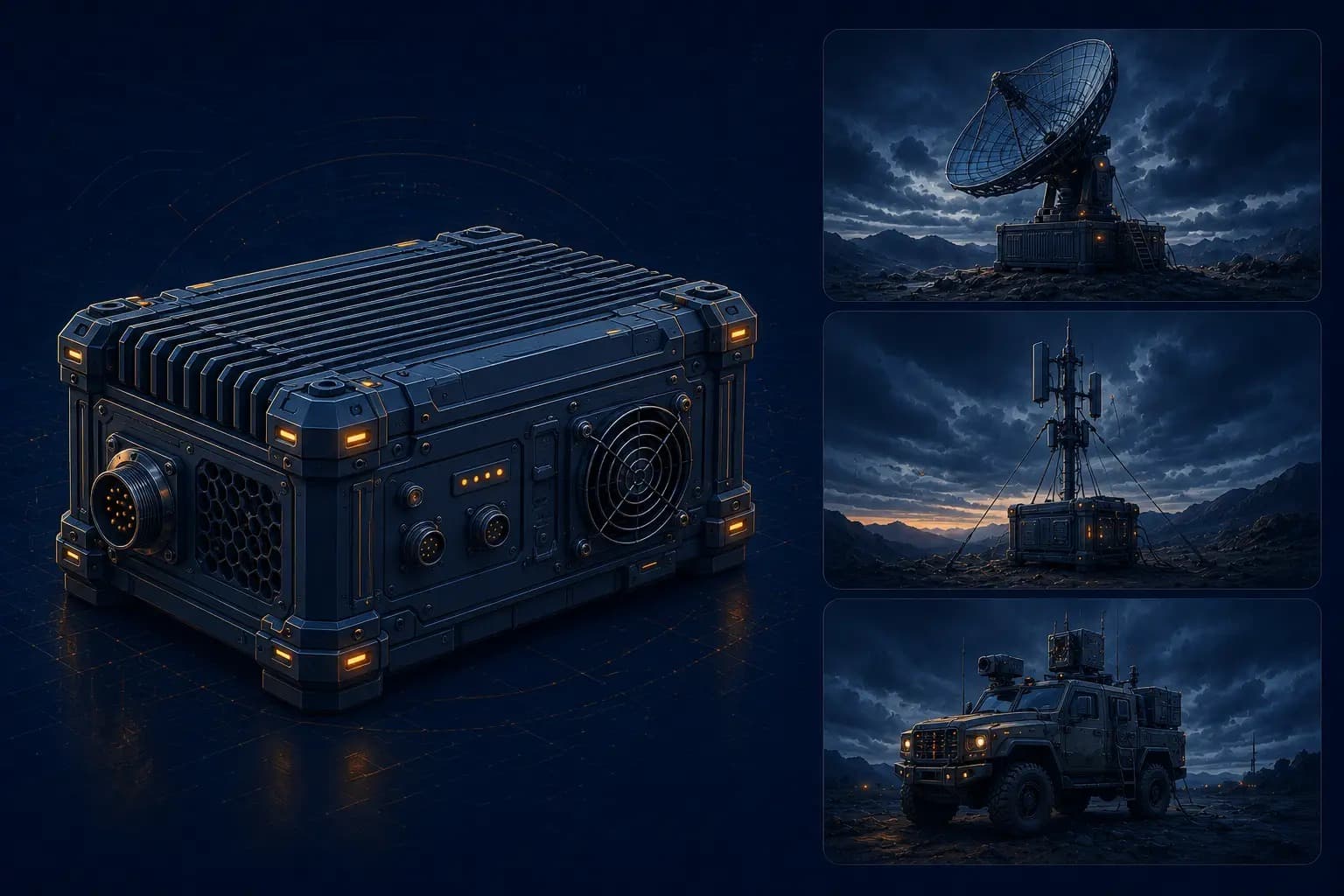
What is a defence power supply?
A defence power supply is a ruggedized power conversion unit engineered to deliver reliable electrical power to mission-critical military systems such as radar, communications, and electronic warfare equipment. It must operate through shock, vibration, temperature extremes, and electromagnetic interference while meeting strict defence standards, because in the field a power failure can compromise a mission or a life.
That reliability under hostile conditions is what defines a defence power supply. This guide explains what these units must withstand, the standards they meet, the systems they power, and what separates them from ordinary power supplies.
What makes defence power different
Military systems place demands on power that commercial and even industrial equipment rarely face. A defence power supply has to deliver on several fronts at once.
Survival in harsh field conditions. Shock from transport and combat, constant vibration on mobile platforms, and temperature extremes from arctic to desert. The unit must keep delivering clean power throughout.
Electromagnetic compatibility. Defence electronics operate in dense electromagnetic environments and must not emit interference that betrays position or disrupts other systems, nor be disrupted by external interference. EMI/EMC compliance is critical.
Absolute reliability under load. These systems are mission-critical. Radar, communications, and electronic warfare cannot lose power at a decisive moment, so redundancy, fault tolerance, and rigorous qualification are built in.
Ruggedized construction. Reinforced enclosures, conformal coating against moisture and dust, and designs that tolerate the physical abuse of field deployment.
Standards and compliance
Defence power supplies are governed by military standards that define both performance and survivability. Common ones include MIL-STD-810 for environmental testing (shock, vibration, temperature, humidity), MIL-STD-461 for electromagnetic interference and compatibility, and MIL-STD-704 where aircraft electrical power is involved.
Compliance is what qualifies a supply for deployment. Meeting these standards is a specialised engineering discipline, and it is the reason defence power design cannot be treated as a variation on commercial power supply work.
Defence power supply vs standard power supply
The contrast makes the requirement clear.
| Requirement | Standard power supply | Defence power supply |
|---|---|---|
| Environment | Controlled or sheltered | Shock, vibration, temperature extremes, field abuse |
| EMI/EMC | Basic compliance | Strict military EMI/EMC (MIL-STD-461) |
| Construction | Standard enclosure | Ruggedized, conformal-coated, reinforced |
| Standards | Commercial | MIL-STD-810, 461, 704 and similar |
| Reliability | Important | Mission critical |
A standard supply optimises for cost and general use. A defence supply optimises for survival and certainty in the most demanding operational conditions.
Applications
Defence power supplies power the systems militaries depend on:
Radar systems, where continuous, clean, high-reliability power is essential to detection and tracking. Tactical communications, keeping command and field communications running under any conditions. Electronic warfare systems, which demand stable, high-quality power and strict EMI control. And mobile military platforms, from vehicles to portable field systems, where ruggedness and reliability are decisive.
Defence power supplies from Enerzolve
Enerzolve develops mission-critical defence power supplies as part of its power electronics portfolio, engineered for the reliability and ruggedness military systems require.
The supplies are built for radar, communication, and electronic warfare systems, rugged, reliable, and compliant with defence standards, and engineered on the same modular power conversion platform Enerzolve uses across its product lines. They are designed and manufactured in India at a facility in the Hitech Defence and Aerospace Park, aligning with India's drive for indigenous defence manufacturing and supply-chain security. For airborne and naval requirements, Enerzolve also builds a dedicated aerospace power supply.
If you need a ruggedized power supply for a radar, communications, electronic warfare, or mobile defence application, talk to our engineering team about your requirement.
The takeaway
A defence power supply is a ruggedized, mission-critical power conversion unit built to deliver reliable power under shock, vibration, temperature extremes, and electromagnetic interference, while meeting standards such as MIL-STD-810, 461, and 704. Powering radar, tactical communications, electronic warfare, and mobile platforms, it is a specialised discipline where reliability under the harshest conditions is non-negotiable.
Frequently asked questions
It is a ruggedized power conversion unit that delivers reliable electrical power to mission-critical military systems such as radar, communications, and electronic warfare equipment. It is engineered to operate through shock, vibration, temperature extremes, and electromagnetic interference while meeting strict defence standards.
Common standards include MIL-STD-810 for environmental testing such as shock, vibration, and temperature, MIL-STD-461 for electromagnetic interference and compatibility, and MIL-STD-704 where aircraft electrical power is involved. Compliance with these standards qualifies a supply for military deployment.
A standard power supply is optimised for cost and general use in controlled environments. A defence power supply is ruggedized to survive field conditions, meets strict military EMI/EMC standards, uses reinforced and conformal-coated construction, and is engineered for mission-critical reliability.
They power radar systems, tactical communications, electronic warfare systems, and mobile military platforms such as vehicles and portable field equipment, all of which require continuous, clean, and highly reliable power.
Defence electronics operate in dense electromagnetic environments. A power supply must not emit interference that could disrupt other systems or reveal position, and must resist external interference, which is why strict EMI/EMC compliance under standards like MIL-STD-461 is essential.
Keep reading
What is a BESS? Battery Energy Storage Systems Explained
A BESS is a system of systems. The BMS protects the cells, the PCS converts the power, and the EMS decides what the whole thing should do.
HES vs MDMS: How the AMI Software Layer Works
The HES talks to the meters, the MDMS makes sense of the data. One collects, the other perfects — and a serious AMI rollout needs both.
Grid-Forming vs Grid-Following Inverters (What Grid-Forming Means)
A grid-following inverter is a passenger. A grid-forming inverter can be the driver — and as conventional generation retires, that difference matters more every year.
Ultrasonic vs AMR Water Meters: Which One Fits Your Network?
Accuracy, maintenance, communication, and cost — how the two technologies actually differ, and how to pick per application rather than per vendor.
Planning a metering or power conversion program?
Talk to the engineering team about specifications, standards, and deployment.
Contact Enerzolve