
EMS vs BMS: What's the Difference?
EMS vs BMS explained: how an Energy Management System differs from a Battery Management System, what each controls in a BESS, and how they work together.
Enerzolve Smart Technologies·
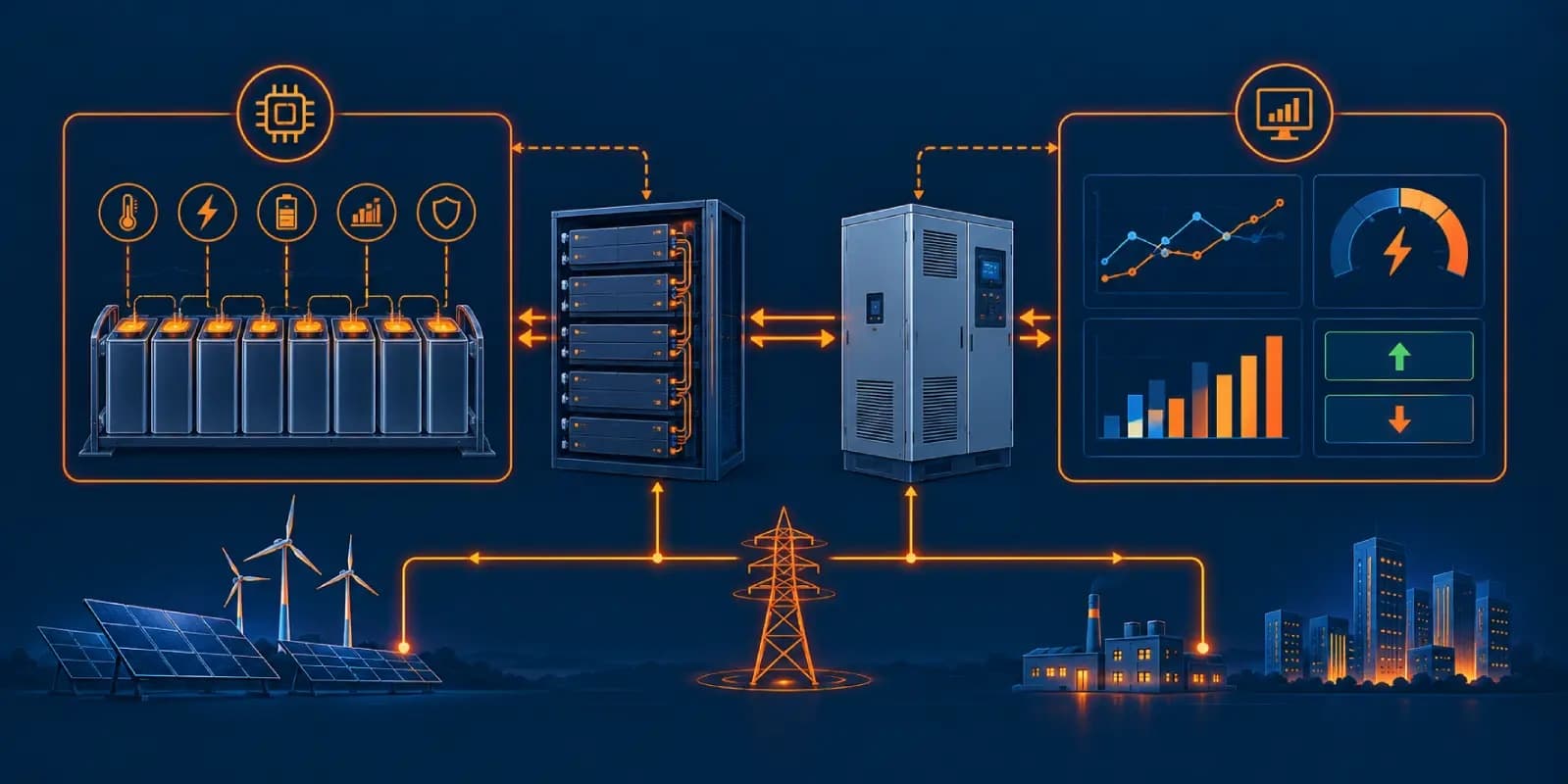
EMS vs BMS: what's the difference?
The difference is scope. A Battery Management System (BMS) protects the battery cells, it monitors and safeguards the battery itself. An Energy Management System (EMS) makes decisions for the whole system, it decides when to charge, discharge, or provide a grid service, based on prices, demand, and grid signals. In short, the BMS keeps the battery safe; the EMS decides what the system does. In a battery energy storage system they work together, but they are not interchangeable.
This guide explains what each one does, where they overlap, and how they combine inside a BESS.
What a BMS does
The Battery Management System is the layer closest to the cells, and its job is safety and health. It continuously monitors the voltage, current, and temperature of every cell, balances charge across them so no cell is overworked, and enforces safe operating limits. It also calculates state of charge (how full the battery is) and state of health (how much life it has left).
If a cell drifts outside safe limits, the BMS is what detects it and acts, disconnecting if necessary. Without a BMS, a large lithium battery is a safety risk; with one, it operates safely for years. The BMS is the guardian of the battery.
What an EMS does
The Energy Management System operates at a higher level. It does not manage individual cells, it manages energy flows across the whole system. The EMS looks at inputs like electricity prices, grid signals, solar generation, site load, and the battery's state of charge, then decides the best action: charge now while power is cheap, discharge into a demand peak, hold reserve, or provide a grid service.
The EMS is the decision-maker. It turns a storage system from a passive battery into an asset that actively earns its value by acting at the right moments.
EMS vs BMS at a glance
| Aspect | BMS (Battery Management System) | EMS (Energy Management System) |
|---|---|---|
| Scope | The battery cells | The whole energy system |
| Job | Safety, health, cell balancing | Decisions on charge, discharge, grid services |
| Monitors | Cell voltage, current, temperature | Prices, demand, generation, state of charge |
| Answers | Is the battery safe and healthy? | What should the system do, and when? |
| Analogy | The guardian | The brain |
How they work together in a BESS
In a battery energy storage system, the BMS and EMS are two of three control layers, the third being the power conversion system (PCS), which physically moves the power. Here is the chain: the EMS decides to charge because power is cheap, and sends that instruction to the PCS, which converts grid AC to DC and feeds the battery, while the BMS watches every cell throughout, keeping the process within safe limits and reporting state of charge back up to the EMS.
So the EMS decides, the PCS executes, and the BMS protects, each working within the boundaries the others set. For the full picture of how all three combine, see our guide on what is a BESS.
Why the distinction matters
Confusing the two leads to poor system design. A strong BMS with a weak EMS gives you a safe battery that earns little, because nothing is optimising when it charges and discharges. A clever EMS with a weak BMS is dangerous, because the decision-making has no reliable safety layer beneath it. A well-built BESS needs both done well, and integrated cleanly so they communicate, which is why the quality of integration matters as much as the quality of each layer. Enerzolve builds these control layers together as part of its power electronics and energy storage platform, so the EMS, BMS, and PCS work as one system.
The takeaway
The BMS and EMS operate at different levels: the BMS protects the battery cells, monitoring and safeguarding the battery, while the EMS makes decisions for the whole system, choosing when to charge, discharge, or provide grid services. They are not alternatives, a battery energy storage system needs both, working with the power conversion system, each within the limits the others define.
Frequently asked questions
A Battery Management System (BMS) protects the battery cells, monitoring voltage, temperature, and charge balance and enforcing safe limits. An Energy Management System (EMS) makes decisions for the whole system, deciding when to charge, discharge, or provide grid services based on prices, demand, and grid signals. The BMS keeps the battery safe; the EMS decides what the system does.
Yes. A battery energy storage system needs both. The BMS ensures the battery operates safely, while the EMS optimises when and how the stored energy is used. A strong BMS without a capable EMS earns little value; a capable EMS without a reliable BMS is unsafe.
The BMS protects the battery cells, the EMS decides the system's strategy, and the PCS (power conversion system) physically converts and moves the power between DC and AC. In a BESS, the EMS decides, the PCS executes, and the BMS protects.
Neither, they do different jobs and both are essential. The BMS is critical for safety and battery life; the EMS is critical for making the storage system economically valuable. A well-designed BESS requires both, integrated so they communicate cleanly.
They are distinct functions and are usually separate layers, because they operate at different levels, one on the cells, one on the whole system. What matters most is that they are well integrated and communicate, so the EMS makes decisions within the safe limits the BMS enforces.
Keep reading
What is a BESS? Battery Energy Storage Systems Explained
A BESS is a system of systems. The BMS protects the cells, the PCS converts the power, and the EMS decides what the whole thing should do.
HES vs MDMS: How the AMI Software Layer Works
The HES talks to the meters, the MDMS makes sense of the data. One collects, the other perfects — and a serious AMI rollout needs both.
Grid-Forming vs Grid-Following Inverters (What Grid-Forming Means)
A grid-following inverter is a passenger. A grid-forming inverter can be the driver — and as conventional generation retires, that difference matters more every year.
Ultrasonic vs AMR Water Meters: Which One Fits Your Network?
Accuracy, maintenance, communication, and cost — how the two technologies actually differ, and how to pick per application rather than per vendor.
Planning a metering or power conversion program?
Talk to the engineering team about specifications, standards, and deployment.
Contact Enerzolve