
What is an Energy Management System (EMS)?
A clear guide to the energy management system: what an EMS is, how it controls BESS and hybrid plants, its key functions, and how Enerzolve builds EMS solutions.
Enerzolve Smart Technologies·
What is an energy management system (EMS)?
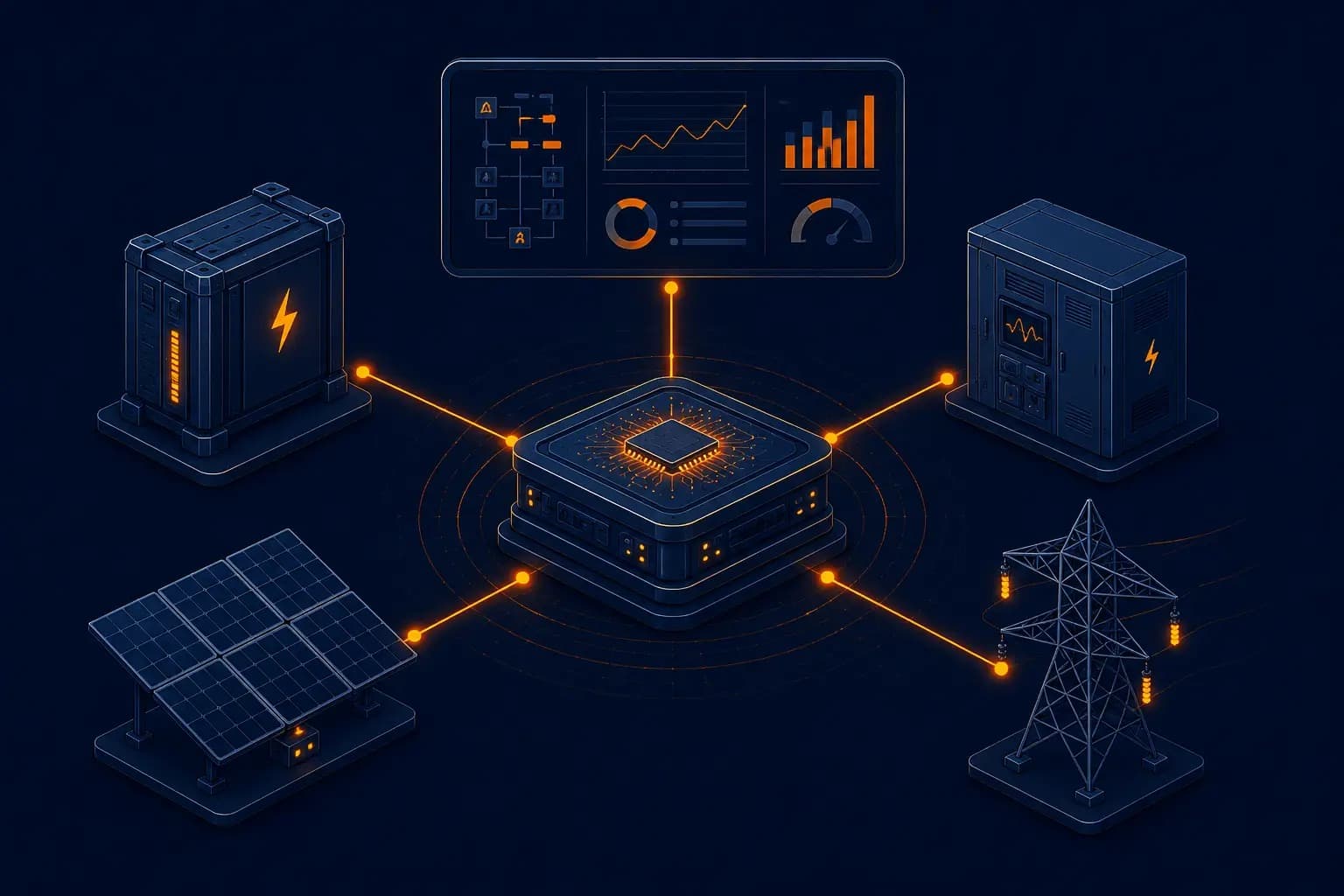
An energy management system (EMS) is the software and control layer that decides how energy flows across a power system in real time. In a battery storage or hybrid renewable plant, the EMS is the brain: it monitors prices, demand, generation, and battery state, then decides when to charge, discharge, hold, or provide a grid service, so the system delivers the most value and stays within safe limits.
Where a battery stores energy and a converter moves it, the EMS is what makes the decisions. This guide explains what an EMS does, how it fits with the other control layers, its core functions, and where it is used.
What an EMS actually does
The job of an EMS is decision-making and orchestration. It takes in a stream of inputs, electricity prices and tariffs, grid signals, solar or wind generation, site load, and the battery's state of charge, and it continuously decides the best action right now.
Should the system charge while power is cheap? Discharge into a demand peak to cut costs? Hold reserve for a grid service? Export to the grid? The EMS answers these questions moment to moment, turning a passive collection of hardware into an asset that actively earns its keep. It is what separates a storage system that simply sits there from one that optimises against real conditions.
How the EMS fits with BMS and PCS
An EMS does not work alone. In a battery energy storage system it sits above two other control layers and coordinates them.
| Layer | Role | Simple description |
|---|---|---|
| BMS (Battery Management System) | Protects the battery cells | The guardian: monitors voltage, temperature, and charge balance, enforces safe limits |
| PCS (Power Conversion System) | Converts and moves power | The gateway: converts DC to AC and back, controls power quality |
| EMS (Energy Management System) | Decides what the system does | The brain: sets strategy and sends targets to the PCS within the BMS's safe limits |
The EMS sends dispatch targets to the power conversion system, which executes them, while the battery management system keeps every action inside safe boundaries. Three layers, one coordinated system. The EMS is the one that decides; the others carry out and protect.
Core functions of an EMS
A capable EMS typically handles:
Real-time monitoring and control, tracking the state of the battery, converters, generation, and load across the site. Dispatch optimization, deciding charge and discharge schedules against prices, demand, and grid needs. Grid services, enabling functions like peak shaving, frequency response, and load shifting. Forecasting, using generation and demand predictions to plan ahead. And reporting and analytics, giving operators visibility into performance and value delivered.
Together these turn raw storage capacity into optimised, dispatchable energy.
Where an EMS is used
Energy management systems appear wherever energy flows need active, intelligent control:
Battery energy storage systems, where the EMS runs charge and discharge strategy. Solar-plus-storage and hybrid plants, coordinating generation and storage to firm up variable renewables. Commercial and industrial sites, cutting peak demand charges and managing on-site generation. And microgrids, where the EMS balances multiple sources and loads to keep the system stable and economical.
Energy management systems from Enerzolve
Enerzolve develops energy management systems as part of its integrated approach to power electronics and energy storage, designed to work as one platform rather than as a control layer bolted on afterward.
Because Enerzolve builds the conversion and control layers together, the EMS, PCS, and battery management integrate cleanly, which is what makes a storage system perform predictably and safely. The EMS provides the real-time monitoring, dispatch optimisation, and grid-service control that turn storage capacity into value, engineered for Indian grid conditions and built in India.
If you are planning a battery storage, hybrid, or microgrid project and need an integrated EMS, talk to our engineering team about your requirement.
The takeaway
An energy management system is the decision-making brain of a modern power system. It monitors prices, demand, generation, and battery state, then orchestrates the PCS and works within the BMS's limits to charge, discharge, or provide grid services at the most valuable moment. In BESS, hybrid plants, and microgrids, the EMS is what turns stored energy into an optimised, dispatchable asset.
Frequently asked questions
An EMS is the software and control layer that decides how energy flows across a power system in real time. In battery storage and hybrid plants it monitors prices, demand, generation, and battery state, then decides when to charge, discharge, or provide grid services, optimising value while keeping the system within safe limits.
A BMS protects the battery cells, monitoring voltage, temperature, and charge balance and enforcing safe limits. An EMS is the decision-making layer that decides when to charge, discharge, or provide grid services based on prices, demand, and grid signals. The BMS protects; the EMS decides.
In a BESS, the EMS decides the charge and discharge strategy. It reads inputs such as electricity prices, load, and state of charge, then sends dispatch targets to the power conversion system while the battery management system keeps every action within safe limits, turning stored energy into optimised, dispatchable power.
Core functions include real-time monitoring and control, dispatch optimisation, grid services such as peak shaving and frequency response, generation and demand forecasting, and reporting and analytics.
They are used in battery energy storage systems, solar-plus-storage and hybrid plants, commercial and industrial sites managing peak demand, and microgrids that balance multiple sources and loads.
Keep reading
What is a BESS? Battery Energy Storage Systems Explained
A BESS is a system of systems. The BMS protects the cells, the PCS converts the power, and the EMS decides what the whole thing should do.
HES vs MDMS: How the AMI Software Layer Works
The HES talks to the meters, the MDMS makes sense of the data. One collects, the other perfects — and a serious AMI rollout needs both.
Grid-Forming vs Grid-Following Inverters (What Grid-Forming Means)
A grid-following inverter is a passenger. A grid-forming inverter can be the driver — and as conventional generation retires, that difference matters more every year.
Ultrasonic vs AMR Water Meters: Which One Fits Your Network?
Accuracy, maintenance, communication, and cost — how the two technologies actually differ, and how to pick per application rather than per vendor.
Planning a metering or power conversion program?
Talk to the engineering team about specifications, standards, and deployment.
Contact Enerzolve