How to Choose a Head End System (HES) for Smart Metering
A buyer's guide to the head end system (HES): what it does, the features that matter, and how to choose an HES provider for a smart metering or AMI rollout.
Enerzolve Smart Grid Team··Smart Grid & Metering·6 min read
How to choose a head end system (HES) for smart metering
A head end system (HES) is the software that connects a utility to its smart meters: it collects reads, manages the communication network, and sends commands to the meter fleet. Choosing the right HES provider comes down to interoperability (DLMS/COSEM), scalability, real-time fleet management, security, and how cleanly it integrates with the MDMS. This guide explains what an HES does and how to evaluate one.
What is a head end system (HES)?
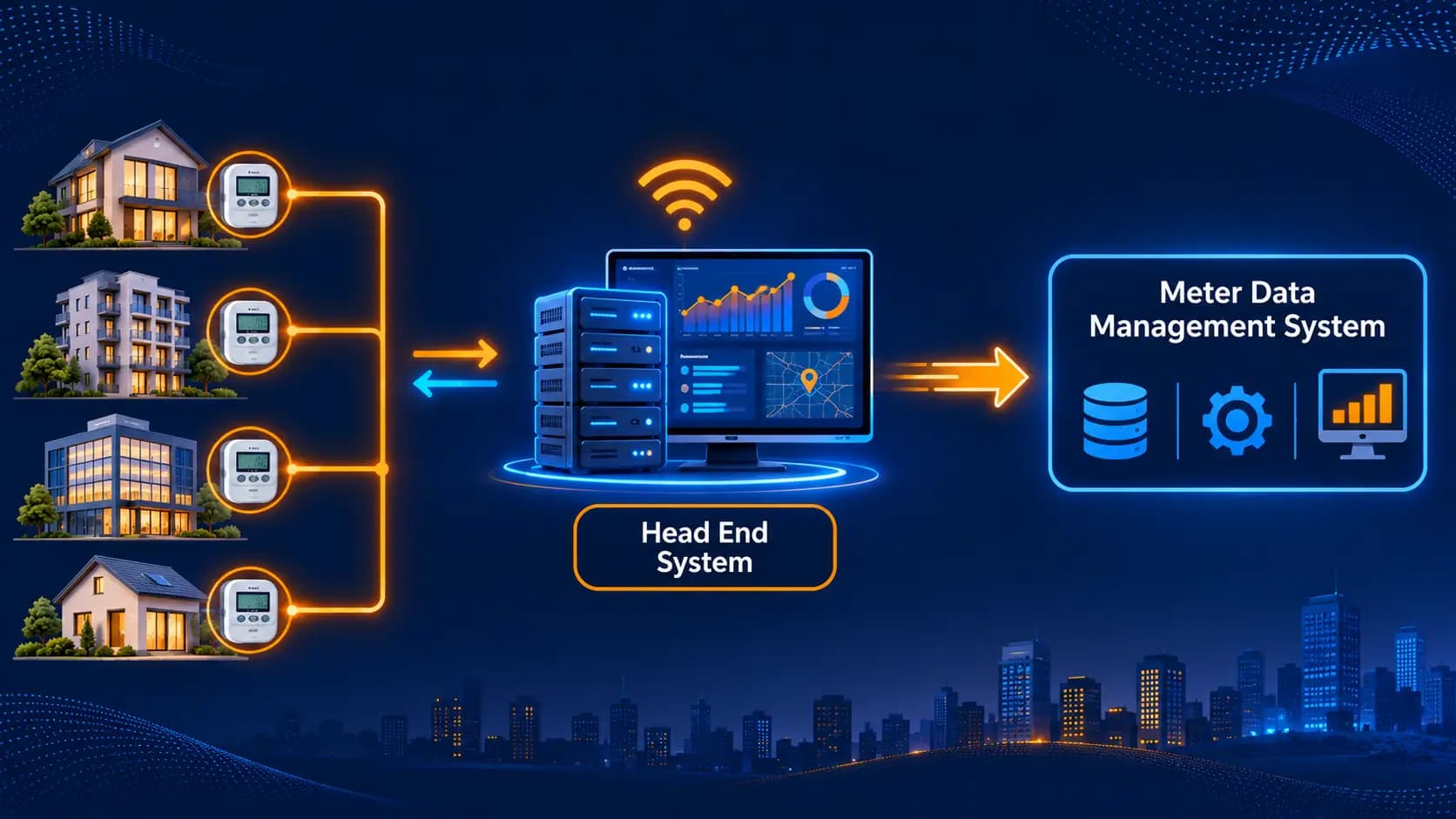
The head end system is where the communication network meets the meters. It is the platform that talks to every meter, collects their data, manages communication sessions, pushes firmware, and monitors the health of the fleet in real time. For the full solution view, see our head end system page.
What does a head end system do?
An HES handles four core jobs:
Data collection: gathering reads from every meter across the network.
Communication management: handling DLMS sessions and the RF, cellular or PLC links.
Command and control: remote connect and disconnect, prepaid actions, and firmware updates.
Fleet monitoring: showing which meters are online, which missed a read, and the health of the network in real time.
HES vs MDMS: where the HES fits
The HES talks to the meters; the MDMS makes sense of the data. The HES collects the reads and manages the fleet, then the MDMS validates that data and turns it into billing-ready determinants. Together they are the software backbone of an advanced metering infrastructure. For a full comparison, see HES vs MDMS.
What to look for in a head end system
When evaluating an HES, weigh these criteria:
DLMS/COSEM interoperability so you are not locked into one meter vendor.
Scalability to millions of meters and multiple utility zones.
Real-time fleet monitoring and communication session management.
Remote firmware updates and command control (connect, disconnect, prepaid).
Security: encryption, role-based access and an audit trail.
Clean integration with the MDMS and the billing or CIS system.
Support for both energy and water meters on one platform.
A proven deployment track record, ideally with RDSS experience and local support.
How to choose a head end system provider
A sound selection process runs in five steps: match the HES to your meter fleet and communication protocols; check scalability and ask for live references at your scale; confirm clean integration with your MDMS and billing; assess security and compliance; and evaluate local support and RDSS deployment experience. An HES built on open standards and engineered together with the MDMS removes most of the integration risk before it starts.
Head end system from Enerzolve
Enerzolve's head end system is a real-time platform that manages the meter fleet as part of one integrated AMI stack, with DLMS/COSEM support, remote firmware and command control, and a single platform for energy and water metering, built and supported in India. Because the HES and MDMS layers are engineered together, a utility avoids the integration gaps that come from stitching separate vendors together.
Conclusion
The head end system is the utility's live connection to every meter in the field, and the quality of that connection decides how well an AMI rollout performs. Choose an HES that is interoperable, scalable, secure and cleanly integrated with the MDMS, and the meter fleet becomes something you can actually manage. To see an HES built as part of one integrated AMI platform, explore Enerzolve's head end system.
Frequently asked questions
A head end system is the software that connects a utility to its smart meters. It collects reads, manages the communication network, and sends commands such as remote connect or disconnect and firmware updates to the meter fleet.
It collects data from every meter, manages communication sessions, pushes firmware, monitors the health of the fleet in real time, and sends control commands. It is the utility's gateway to the meters.
The HES talks to the meters, collecting reads and managing the fleet. The MDMS processes that data, running VEE and producing billing-ready determinants. The HES collects, the MDMS perfects.
DLMS/COSEM interoperability, scalability to millions of meters, real-time fleet monitoring, remote firmware and command control, strong security, clean MDMS and billing integration, and proven local deployment experience.
Yes. A capable HES can manage both energy and water meters on one platform, so a utility runs its entire metering operation through a single system.
Keep reading
What is a BESS? Battery Energy Storage Systems Explained
A BESS is a system of systems. The BMS protects the cells, the PCS converts the power, and the EMS decides what the whole thing should do.
HES vs MDMS: How the AMI Software Layer Works
The HES talks to the meters, the MDMS makes sense of the data. One collects, the other perfects — and a serious AMI rollout needs both.
Grid-Forming vs Grid-Following Inverters (What Grid-Forming Means)
A grid-following inverter is a passenger. A grid-forming inverter can be the driver — and as conventional generation retires, that difference matters more every year.
Ultrasonic vs AMR Water Meters: Which One Fits Your Network?
Accuracy, maintenance, communication, and cost — how the two technologies actually differ, and how to pick per application rather than per vendor.
Planning a metering or power conversion program?
Talk to the engineering team about specifications, standards, and deployment.
Contact Enerzolve