
What Is Meter Data Management (MDMS)? A Guide for Utilities
Meter data management (MDMS) explained: what an MDMS does, the VEE process, how it differs from an HES, and how utilities turn smart meter data into billing-ready insight.
Enerzolve Smart Grid Team··Smart Grid & Metering·6 min read
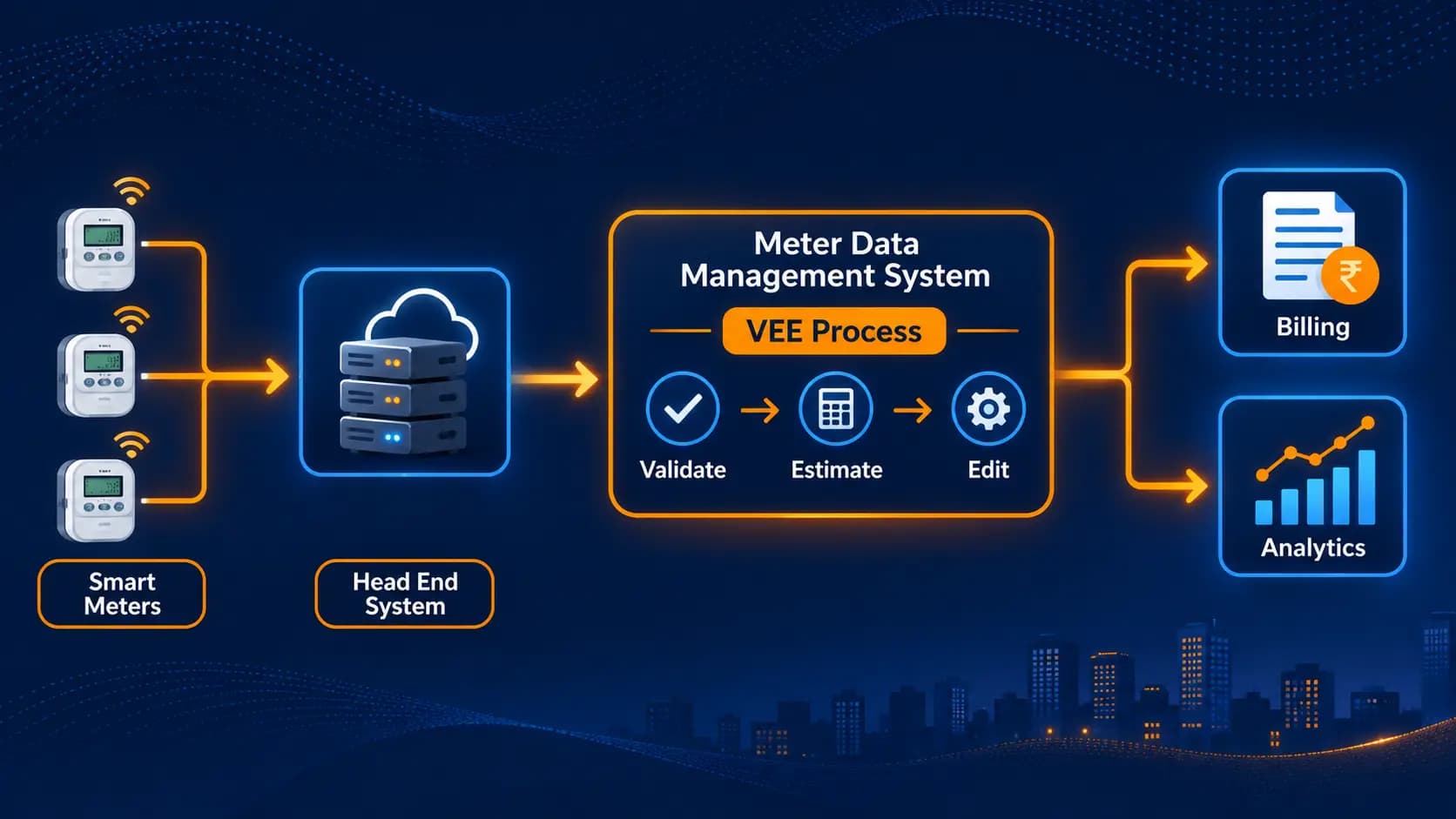
What is meter data management (MDMS)?
Meter data management (MDMS) is the software layer that turns raw smart meter reads into accurate, billable, analysable data. It validates, estimates and edits every read (the VEE process), stores it, and feeds clean determinants to billing and analytics. In an advanced metering infrastructure, the MDMS is where meter reads become revenue and grid insight.
What is a meter data management system (MDMS)?
A meter data management system is the central data platform in a smart metering deployment. Smart meters produce a constant stream of reads, but those reads are never perfectly clean: some go missing, communication drops, and some values look wrong. The MDMS takes that raw stream, checks and corrects it, stores it, and hands clean, tariff-framed data to the systems that bill customers and analyse the network. It sits on top of the head end system, which collects the reads the MDMS then perfects.
What does an MDMS do?
A capable MDMS handles five core jobs:
Validation, estimation and editing (VEE) of every read.
Long-term storage of interval and register data.
Production of billing determinants for the billing or CIS system.
Exception handling, flagging anomalies for review.
Analytics and reporting on load, loss and revenue.
The VEE process explained
VEE is the heart of meter data management. Validation checks each read against rules to catch errors and anomalies. Estimation fills in missing or failed reads using historical patterns. Editing corrects or flags exceptions for review. The output is a clean, complete, auditable data set a utility can bill on with confidence.
MDMS vs HES: what is the difference?
The head end system talks to the meters, collecting reads and managing the fleet. The MDMS makes sense of that data, running VEE and producing billing-ready determinants. The HES collects, the MDMS perfects. Together they form the software backbone of an advanced metering infrastructure. For a full comparison, see HES vs MDMS.
Why utilities need an MDMS
Without an MDMS, a utility has a pile of raw numbers. With one, it has revenue assurance. An MDMS removes estimated bills and the disputes that follow, surfaces technical and commercial loss from granular interval data, and provides the clean foundation for prepaid billing, outage analysis and demand forecasting. For distribution utilities, that directly supports lower AT&C losses and RDSS compliance.
What to look for in meter data management software
When evaluating MDMS software, utilities should weigh:
Scalability to millions of meters and multiple utility zones.
A configurable VEE engine with automatic exception handling.
Clean integration with the HES and the billing or CIS system.
Support for both energy and water metering on one platform.
Security, role-based access and a full audit trail.
Choosing software built on open standards keeps the deployment flexible as it scales. See how smart meter data flows end to end.
Meter data management with Enerzolve
Enerzolve's meter data management system is built and supported in India as part of one integrated AMI platform, with a VEE engine, loss and revenue analytics, and automated billing extract, processing energy and water data on a single system. Because the HES and MDMS layers are engineered together, a utility runs its entire metering operation on one platform.
Conclusion
Meter data management is the difference between a pile of meter reads and trustworthy revenue. By validating, storing and analysing every read, an MDMS turns smart metering into accurate billing, loss reduction and grid insight. To run meter data management on one integrated, India-built platform, explore Enerzolve's MDMS.
Frequently asked questions
An MDMS is the software that turns raw smart meter reads into accurate, billable data. It validates, estimates and edits reads (VEE), stores them, and feeds clean determinants to billing and analytics.
VEE stands for validation, estimation and editing. The MDMS validates each read, estimates missing or failed reads, and edits or flags exceptions, so billing runs on clean, complete data.
The HES collects reads from and sends commands to the meters. The MDMS processes that data, running VEE and producing billing-ready determinants. The HES collects, the MDMS perfects.
No. The MDMS produces clean, tariff-framed determinants and passes them to the billing or CIS system, which issues the bills.
It is the application that runs meter data management: a configurable VEE engine, data storage, billing-determinant output, and analytics, usually serving a full smart metering deployment.
Keep reading
What is a BESS? Battery Energy Storage Systems Explained
A BESS is a system of systems. The BMS protects the cells, the PCS converts the power, and the EMS decides what the whole thing should do.
HES vs MDMS: How the AMI Software Layer Works
The HES talks to the meters, the MDMS makes sense of the data. One collects, the other perfects — and a serious AMI rollout needs both.
Grid-Forming vs Grid-Following Inverters (What Grid-Forming Means)
A grid-following inverter is a passenger. A grid-forming inverter can be the driver — and as conventional generation retires, that difference matters more every year.
Ultrasonic vs AMR Water Meters: Which One Fits Your Network?
Accuracy, maintenance, communication, and cost — how the two technologies actually differ, and how to pick per application rather than per vendor.
Planning a metering or power conversion program?
Talk to the engineering team about specifications, standards, and deployment.
Contact Enerzolve