
Smart Meter Data: How It's Collected, Managed, and Protected
How smart meter data is collected, managed, and protected: the journey from meter to bill through HES, MDMS, and the VEE process, and how the data stays secure.
Enerzolve Smart Grid Team··Smart Grid & Metering·7 min read
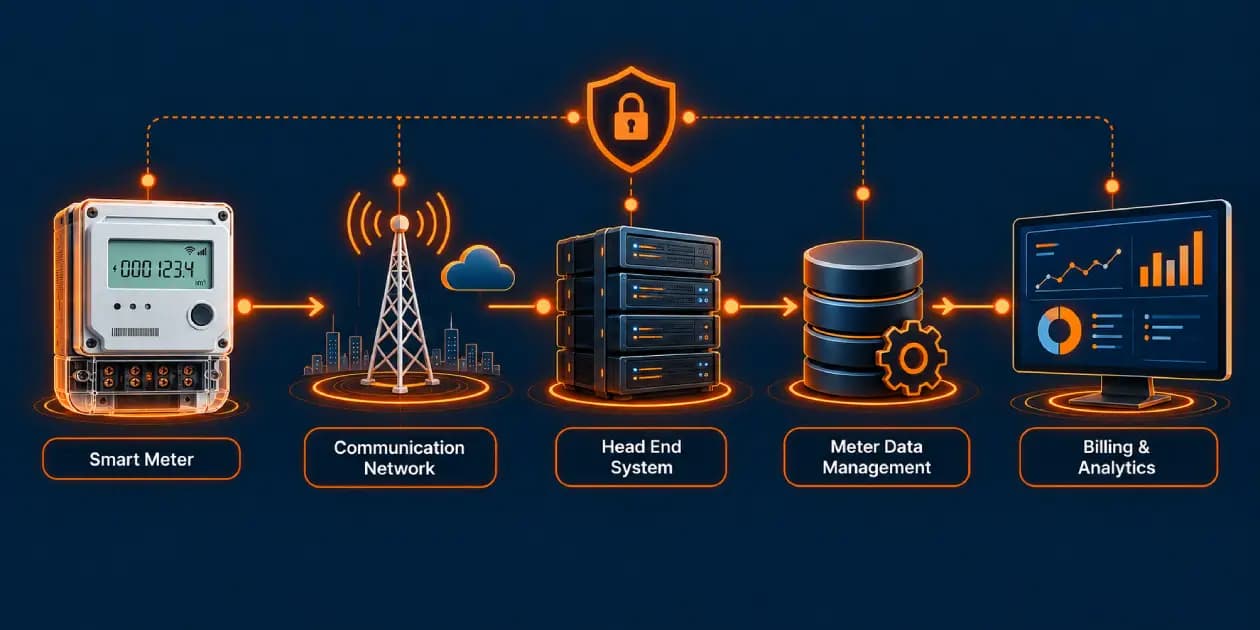
How is smart meter data collected and managed?
Smart meter data travels a clear path: the meter records consumption and events, a communication network carries the data to the utility, a head end system collects it, and a meter data management system validates it and turns it into billable, analysis-ready information, all protected by security at every step. Understanding this journey, from the meter to the bill, is how you understand what makes smart metering valuable and what keeps it trustworthy.
This guide follows smart meter data through each stage: how it is collected, how it is managed into usable information, what analytics it enables, and how it is kept secure.
What data does a smart meter capture?
A smart meter records far more than a single consumption figure. It captures interval consumption data (readings at regular intervals through the day), voltage and current, maximum demand, power factor, and time-of-use registers. It also logs events, tamper attempts, power outages, and communication status. This granular data is what separates a smart meter from a basic one: instead of a single monthly number, the utility gets a detailed picture of how, when, and how much energy is used at every point on the network.
Stage 1: Collection, the data leaves the meter
The data has to get from the meter to the utility, which is the job of the communication network and the head end system.
Smart meters communicate over technologies such as RF Mesh, PLC, and cellular (4G, NB-IoT), using the open DLMS/COSEM protocol so meters and systems from different vendors can interoperate. The head end system is the platform that talks to every meter, collecting reads on schedule, managing the communication sessions, and monitoring which meters are online. At this stage the data is raw, accurate as captured, but not yet clean or billable.
Stage 2: Management, raw data becomes usable information
Raw meter data is never perfectly clean. Reads go missing, communication drops, and occasional values look wrong. Turning that raw data into something a utility can bill on and analyse is the job of the meter data management system.
The MDMS runs the VEE process, validation, estimation, and editing, checking every read, estimating any gaps, and flagging exceptions for review. From that clean data it produces the tariff-framed determinants that billing needs, and feeds the analytics that reveal patterns and losses. If you want the distinction between the collection and management layers, our guide on HES vs MDMS covers it in full.
Stage 3: Analytics, data becomes insight
Once the data is clean, it becomes one of a utility's most valuable assets. Analytics on smart meter data enable:
Loss and theft detection, pinpointing where energy goes unbilled. Load forecasting and profiling, understanding demand patterns to plan the network. Outage analysis, detecting and locating supply failures. Revenue assurance, ensuring billed energy matches delivered energy. And exception management, flagging anomalies for action. This is where the value of all the earlier stages is realised: accurate collection and clean management only pay off when the data is turned into decisions.
The smart meter data journey at a glance
| Stage | What happens | System |
|---|---|---|
| Capture | Meter records consumption and events | Smart meter |
| Collection | Data carried to the utility | Communication network + HES |
| Management | Raw data validated into billable form | MDMS (VEE process) |
| Analytics | Clean data turned into insight | Analytics layer |
| Billing | Determinants sent to billing system | Billing / CIS |
Stage 4: Security, protecting the data throughout
Smart meter data is sensitive, it reveals consumption patterns and carries remote-control capability, so it must be protected at every stage. End-to-end security means verifiable device identity so only genuine meters join the network, encryption of data in transit and at rest, role-based access control so users see only what their role permits, secure APIs for integration, audit trails for accountability, and key management underpinning the encryption. Data protection is not a single feature but a discipline applied across the whole chain. We cover this in depth in our guide on AMI security.
Why managing smart meter data well matters
A smart meter fleet can generate an enormous volume of data, and that data is only as valuable as the systems that collect, clean, secure, and analyse it. Poorly managed data means inaccurate bills, undetected losses, and security risk; well-managed data means accurate billing, loss reduction, network visibility, and trust. This is why utilities should treat the data layer, the HES, MDMS, analytics, and security, as seriously as the meters themselves. The meter captures the data; the platform behind it determines whether that data becomes value.
Smart meter data with Enerzolve
Enerzolve manages smart meter data end to end as part of one integrated platform: the head end system collects it, the meter data management system validates and processes it through a VEE engine, analytics turn it into insight, and end-to-end security protects it throughout. Because the same platform handles both energy and water metering, a utility manages all its meter data on one system. Explore the full advanced metering infrastructure, or talk to our engineering team about your metering data.
The takeaway
Smart meter data travels from the meter, through the communication network and head end system, into the meter data management system where the VEE process turns it into billable information, then into analytics that reveal losses and patterns, all protected by end-to-end security. The meter captures the data, but the platform behind it, collection, management, analytics, and security, is what turns that data into accurate billing, loss reduction, and network visibility.
Frequently asked questions
A smart meter captures interval consumption data, voltage and current, maximum demand, power factor, and time-of-use registers, and logs events such as tamper attempts, outages, and communication status. This gives the utility a detailed picture of how, when, and how much energy is used, rather than a single monthly figure.
Smart meter data is collected by a head end system over a communication network using the DLMS/COSEM protocol, then managed by a meter data management system that validates, estimates, and edits the reads through the VEE process and turns them into billable determinants. Analytics then convert the clean data into insight such as loss detection and load forecasting.
Meter data management is the process, handled by a meter data management system (MDMS), of turning raw meter reads into trustworthy, billable, analysis-ready data. It validates and estimates reads, flags exceptions through the VEE process, produces tariff-framed billing determinants, and feeds loss and revenue analytics.
Smart meter data is protected by end-to-end security: verifiable device identity so only genuine meters join the network, encryption of data in transit and at rest, role-based access control, secure APIs, audit trails, and key management. Data protection is applied across the whole chain, from the meter to the utility's systems.
Utilities use smart meter data for loss and theft detection, load forecasting and profiling, outage analysis, revenue assurance, and exception management. Clean, well-managed data lets a utility find and act on losses, plan the network, and bill accurately, turning the data into one of its most valuable assets.
Keep reading
What is a BESS? Battery Energy Storage Systems Explained
A BESS is a system of systems. The BMS protects the cells, the PCS converts the power, and the EMS decides what the whole thing should do.
HES vs MDMS: How the AMI Software Layer Works
The HES talks to the meters, the MDMS makes sense of the data. One collects, the other perfects — and a serious AMI rollout needs both.
Grid-Forming vs Grid-Following Inverters (What Grid-Forming Means)
A grid-following inverter is a passenger. A grid-forming inverter can be the driver — and as conventional generation retires, that difference matters more every year.
Ultrasonic vs AMR Water Meters: Which One Fits Your Network?
Accuracy, maintenance, communication, and cost — how the two technologies actually differ, and how to pick per application rather than per vendor.
Planning a metering or power conversion program?
Talk to the engineering team about specifications, standards, and deployment.
Contact Enerzolve