
Smart Energy Meter Certifications Explained
A guide to smart energy meter certifications, BIS, STQC, MTCTE, ISO, and NABL type testing, what each one means, and why they matter when choosing a meter.
Enerzolve Smart Grid Team··Smart Grid & Metering·6 min read
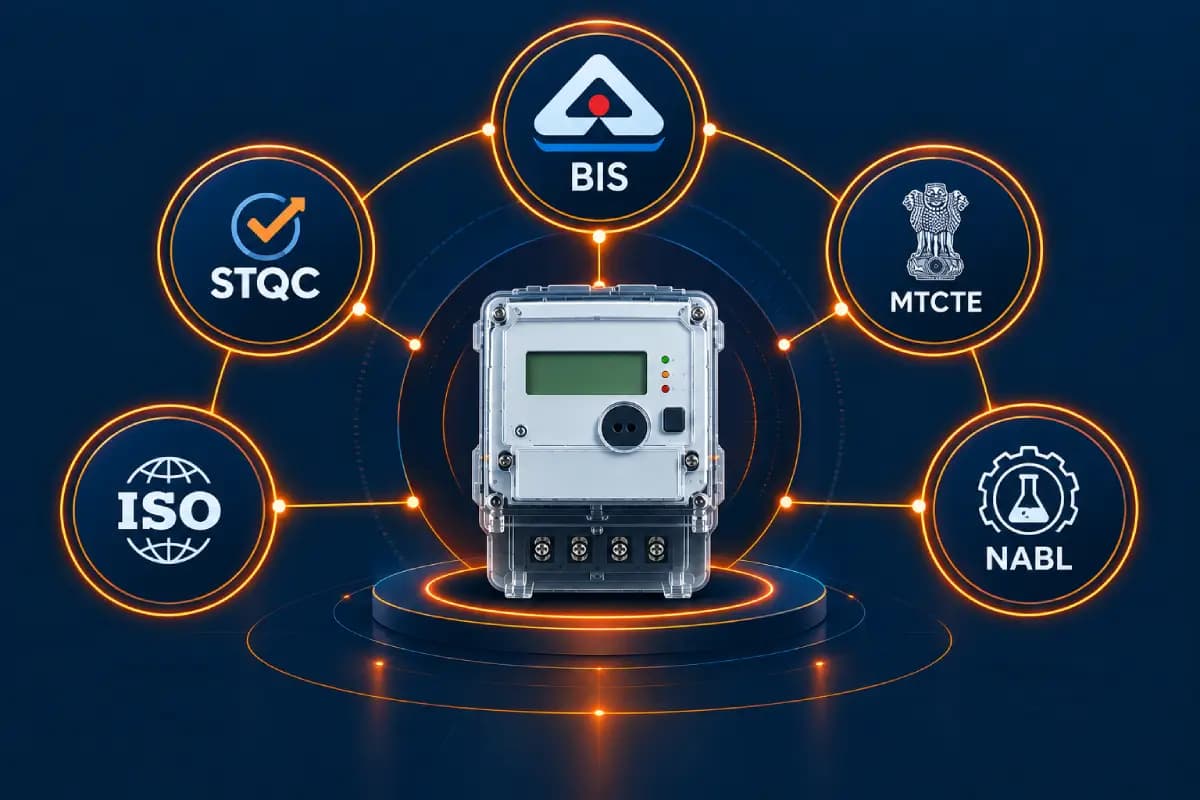
Why do smart energy meter certifications matter?
Certifications are how a utility knows a smart meter will actually perform, safely, accurately, and securely, before a single unit is installed. A meter that carries the right certifications has been independently tested against national and international standards, which removes guesswork from procurement and protects the utility from field failures, billing disputes, and security gaps. For any tender, certifications are a shortlisting filter: a meter without them does not get considered.
This guide explains the key certifications a smart energy meter should carry, what each one verifies, and why it matters.
The certifications that matter, and what each verifies
BIS (Bureau of Indian Standards). BIS certification confirms the meter meets the relevant Indian Standards, including IS 16444 for smart meters. It is the baseline for deployment in India, verifying accuracy, functionality, and safety.
STQC (Standardisation Testing and Quality Certification). A Government of India body that tests and certifies electronic products. STQC certification for a smart meter validates its security and functional conformance, which matters increasingly as meters become networked devices carrying sensitive data.
MTCTE (Mandatory Testing and Certification of Telecom Equipment). Because smart meters communicate over telecom networks, their communication modules must be tested and certified under MTCTE. This confirms the meter's connectivity meets India's telecom equipment requirements.
ISO management system certifications. These certify the manufacturer's processes: ISO 9001 covers quality, ISO 14001 environmental management, ISO 27001 information security, and ISO 45001 occupational health and safety.
NABL-accredited type testing. Type testing puts the meter design through the full set of standard tests. When the laboratory is NABL-accredited, the results carry independent, recognised weight.
| Certification | What it verifies | Type |
|---|---|---|
| BIS | Meets Indian Standards (incl. IS 16444) | Product |
| STQC | Security and functional conformance | Product |
| MTCTE | Telecom/communication module compliance | Product |
| NABL type testing | Independent design verification | Product |
| ISO 9001 | Quality management | Process |
| ISO 14001 | Environmental management | Process |
| ISO 27001 | Information security | Process |
| ISO 45001 | Health and safety | Process |
| CMMI Level 3 | Software/engineering maturity | Process |
Product certification vs process certification
It helps to separate two kinds of certification, because they answer different questions.
Product certifications (BIS, STQC, MTCTE, type testing) tell you the meter itself has been tested and meets the standard. They answer: is this meter good?
Process certifications (the ISO management systems, CMMI) tell you the company that makes the meter runs mature, controlled, secure processes. They answer: is this manufacturer reliable?
A strong supplier has both. Product certifications prove the meter; process certifications prove the organisation behind it will deliver, support, and secure it over the life of a deployment.
Why security certifications are increasingly important
A modern smart meter is a networked device that carries consumption data and accepts remote commands. That makes security certifications, ISO 27001 for the organisation, STQC for the product, more than a formality. As advanced metering infrastructure connects millions of meters, the security posture of both the device and the manufacturer becomes part of the grid's overall resilience. A utility choosing a meter is also choosing a security dependency.
Enerzolve certifications
Enerzolve's smart energy meter is certified to a broad set of standards spanning both product and process. The meters are type-tested in a NABL-accredited laboratory and certified to BIS, along with STQC and MTCTE, and the manufacturing and engineering processes carry ISO 9001, ISO 14001, ISO 27001, and ISO 45001, plus CMMI Level 3. Because Enerzolve owns the engineering across the meter, the head end system, and the meter data management system, these certifications extend across the whole platform, not just the device.
The takeaway
Certifications are how a utility verifies a smart meter before deployment. Product certifications, BIS, STQC, MTCTE, and NABL type testing, prove the meter meets the standards; process certifications, the ISO management systems and CMMI, prove the manufacturer runs mature, secure processes. The strongest suppliers carry both, and as meters become networked, security certifications matter as much as accuracy. When evaluating a meter, treat the certification list as a genuine measure of quality and reliability, not a formality.
Frequently asked questions
A smart energy meter should carry BIS certification (confirming it meets Indian Standards including IS 16444), and depending on its features, STQC and MTCTE for security and telecom compliance, plus NABL-accredited type testing. The manufacturer should also hold process certifications such as ISO 9001, ISO 27001, and CMMI, which signal a mature, secure supplier.
STQC (Standardisation Testing and Quality Certification) is a Government of India certification that tests and validates electronic products. For a smart meter, STQC certification confirms its security and functional conformance, which is increasingly important as meters become networked devices handling sensitive data.
MTCTE (Mandatory Testing and Certification of Telecom Equipment) certifies telecom equipment used in India. Because smart meters communicate over telecom networks, their communication modules must be MTCTE-certified to confirm they meet the country's telecom equipment requirements.
Type testing puts a meter design through the full set of standard tests. When performed in a NABL-accredited laboratory, the results carry independent, recognised weight, because NABL accreditation means the laboratory is certified competent to perform those tests.
Product certifications (BIS, STQC, MTCTE, type testing) verify that the meter itself meets the standards. Process certifications (ISO management systems, CMMI) verify that the manufacturer runs mature, controlled, and secure processes. A strong supplier holds both, proving the meter and the organisation behind it.
Keep reading
What is a BESS? Battery Energy Storage Systems Explained
A BESS is a system of systems. The BMS protects the cells, the PCS converts the power, and the EMS decides what the whole thing should do.
HES vs MDMS: How the AMI Software Layer Works
The HES talks to the meters, the MDMS makes sense of the data. One collects, the other perfects — and a serious AMI rollout needs both.
Grid-Forming vs Grid-Following Inverters (What Grid-Forming Means)
A grid-following inverter is a passenger. A grid-forming inverter can be the driver — and as conventional generation retires, that difference matters more every year.
Ultrasonic vs AMR Water Meters: Which One Fits Your Network?
Accuracy, maintenance, communication, and cost — how the two technologies actually differ, and how to pick per application rather than per vendor.
Planning a metering or power conversion program?
Talk to the engineering team about specifications, standards, and deployment.
Contact Enerzolve