
What is a Smart Grid? Components and How It Works
A clear guide to the smart grid: what it is, its core components, how metering and automation modernise the grid, and how Enerzolve builds smart grid solutions.
Enerzolve Smart Technologies·
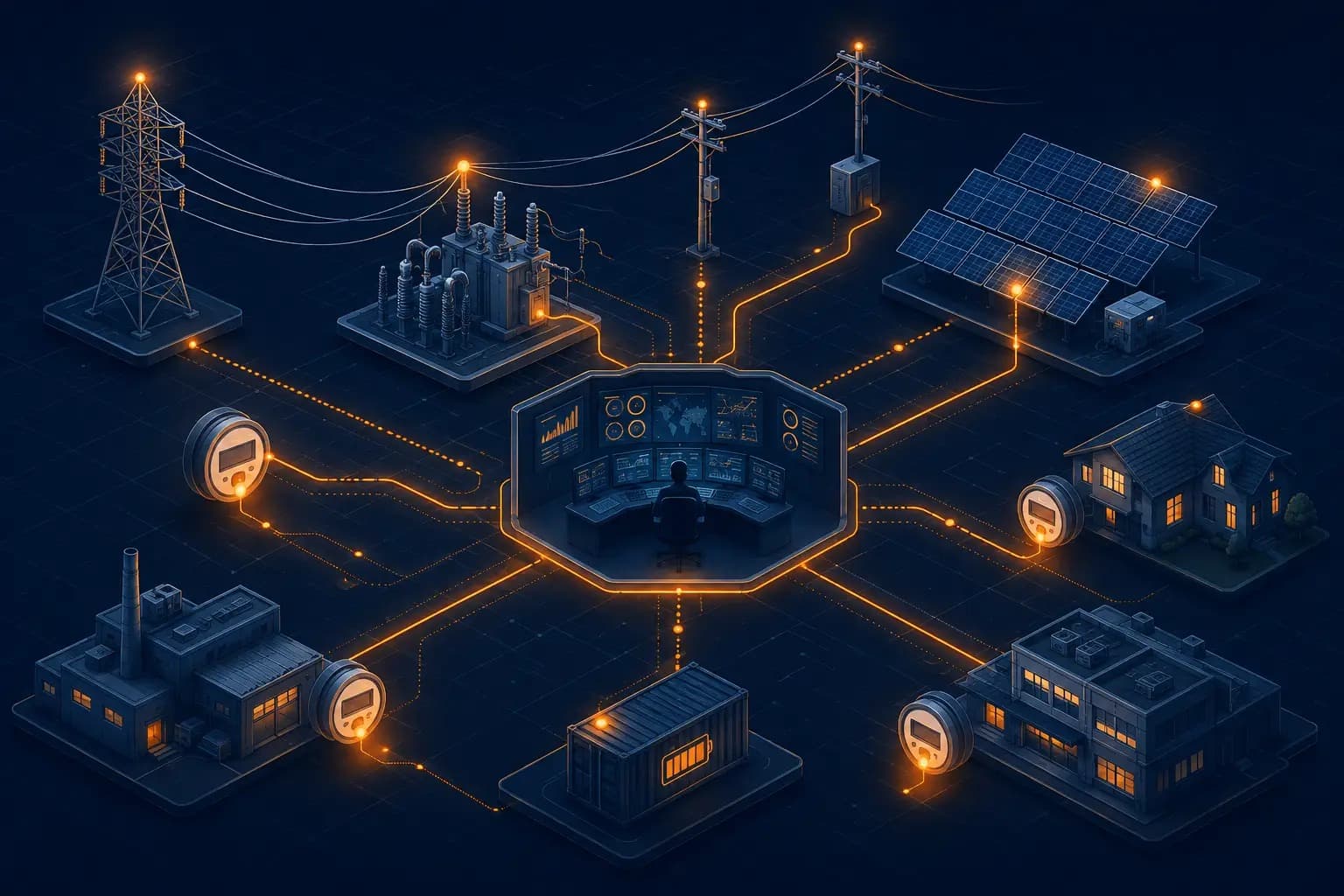
What is a smart grid?
A smart grid is an electricity network that uses digital sensing, communication, and control to manage the flow of power in real time. Where a traditional grid pushes electricity one way and stays largely blind to what happens downstream, a smart grid adds two-way data flow, so utilities can see, measure, and control the network as conditions change.
That visibility is what makes everything else possible: accurate billing, fast fault detection, integration of solar and storage, and far lower losses. This guide explains the components that make a grid “smart,” why the shift is happening now, and how those pieces fit together.
Why the grid is becoming smart
For most of its history, the grid was built for one job: move power from large central plants to consumers. It worked when generation was predictable and flow went one direction.
That assumption is breaking down. Rooftop solar and large renewable plants feed power back into the network. Battery storage charges and discharges through the day. Electric vehicles add heavy, variable load. Demand is rising and the mix is getting more complex. A grid that cannot see or respond to any of this in real time cannot manage it. The smart grid is the response, adding the intelligence layer the old grid never had.
The core components of a smart grid
A smart grid is not a single product. It is several layers working together.
Smart metering. The foundation. Smart meters at every connection point measure consumption in near real time, detect tampering, and support remote connect and disconnect. This is where most utilities begin, because accurate measurement is the base everything else builds on. It covers both smart energy meters and smart water meters.
Advanced Metering Infrastructure. The system that connects all those meters into a managed network, with a head end system and meter data management layer turning raw reads into billable, analysable data. If you want the full picture, we cover it in what Advanced Metering Infrastructure is.
Grid automation and protection. Control and protection relays, switches, and controllers that detect faults and reconfigure the network automatically, isolating a problem before it cascades into a wider outage.
Communication networks. The connective layer, RF, cellular, and fibre, that carries data between field devices and the utility's systems, fast and reliably.
Analytics and intelligence. The software layer that turns the flood of grid data into decisions: load forecasting, loss analysis, outage prediction, and asset health monitoring.
Together, these turn a passive network into one that senses, decides, and acts.
What a smart grid delivers
The benefits follow directly from that intelligence. Utilities cut technical and commercial losses because they can finally see where energy goes, litre to litre and unit to unit. Outages are detected and isolated faster. Renewables and storage integrate cleanly because the grid can balance variable generation. Billing becomes accurate and automated. And the whole network becomes something a utility manages actively, rather than reacts to.
For Indian utilities and DISCOMs specifically, this maps directly to reducing AT&C losses, one of the clearest measures of distribution health.
The smart grid in India
India's grid is modernising at scale. Rising renewable capacity, national metering programmes, and pressure to cut distribution losses are all pushing utilities toward smart grid technology. National initiatives are driving smart metering across energy and water, and DISCOMs are under real pressure to bring losses down.
The challenge is that much of the available technology was designed for other markets and other conditions. India needs smart grid systems engineered for its own grid, its own regulations, and its own operating environment. That gap is exactly where locally engineered infrastructure matters.
Smart grid solutions from Enerzolve
Enerzolve builds smart grid and automation technology engineered in India, for Indian grid conditions. Rather than supplying isolated devices, Enerzolve delivers the connected layers that make a grid smart:
Full-stack metering, covering AMI-ready smart energy meters and smart water meters, backed by a real-time Head End System and Meter Data Management System. Control and protection relays for grid automation. Grid intelligence and analytics to turn network data into decisions. And the embedded engineering and design-led manufacturing behind it, so the hardware and software are built to work together.
Because the metering, software, and automation layers are designed as one platform, a utility can run its entire smart grid operation, energy and water, on a single stack rather than stitching together parts from different vendors.
If you are planning a smart grid or metering rollout, talk to our engineering team about your network.
The takeaway
A smart grid is the electricity network made intelligent: digital metering, advanced metering infrastructure, automation, communication, and analytics working together so utilities can see and control power in real time. As renewables, storage, and rising demand reshape the grid, that intelligence moves from optional to essential, and it starts with accurate metering at every point on the network.
Frequently asked questions
A smart grid is an electricity network that uses digital sensors, communication, and control to manage power in real time. It adds two-way data flow to the grid, so utilities can measure, see, and control the network as conditions change, rather than pushing power one way and staying blind to what happens downstream.
The core components are smart metering, advanced metering infrastructure, grid automation and protection, communication networks, and analytics software. Together they let a utility sense conditions across the network and respond automatically.
A traditional grid moves power in one direction with little visibility downstream. A smart grid adds two-way communication, real-time measurement, and automated control, so it can integrate renewables and storage, detect faults quickly, and reduce losses.
By measuring consumption accurately at every point and analysing the data, a smart grid reveals where technical and commercial losses occur. Utilities can then detect tampering, spot faults, and manage the network actively, which is central to reducing AT&C losses.
India's grid is modernising rapidly with rising renewables, national metering programmes, and pressure to cut distribution losses. Smart grid technology engineered for local conditions helps utilities and DISCOMs measure accurately, integrate clean energy, and improve financial health.
Keep reading
What is a BESS? Battery Energy Storage Systems Explained
A BESS is a system of systems. The BMS protects the cells, the PCS converts the power, and the EMS decides what the whole thing should do.
HES vs MDMS: How the AMI Software Layer Works
The HES talks to the meters, the MDMS makes sense of the data. One collects, the other perfects — and a serious AMI rollout needs both.
Grid-Forming vs Grid-Following Inverters (What Grid-Forming Means)
A grid-following inverter is a passenger. A grid-forming inverter can be the driver — and as conventional generation retires, that difference matters more every year.
Ultrasonic vs AMR Water Meters: Which One Fits Your Network?
Accuracy, maintenance, communication, and cost — how the two technologies actually differ, and how to pick per application rather than per vendor.
Planning a metering or power conversion program?
Talk to the engineering team about specifications, standards, and deployment.
Contact Enerzolve