What is a Static Converter? Types, Working, and Uses
What a static converter is, how it works, the main types including static frequency converters, and where they are used across power and industrial systems.
Enerzolve Power Electronics Team··Power Electronics & Storage·6 min read
What is a static converter?
A static converter is a power electronics device that changes electrical power from one form to another, between AC and DC, or between different voltages or frequencies, using solid-state components with no moving parts. The word "static" is the key: unlike older rotary converters that used motor-generator sets with spinning machinery, a static converter does everything electronically. That makes it smaller, more efficient, more precise, and effectively maintenance-free.
Static converters are the building blocks of modern power systems, from the power supply in a device to megawatt-scale grid and industrial equipment. This guide explains how they work, the main types, and where they are used.
How a static converter works
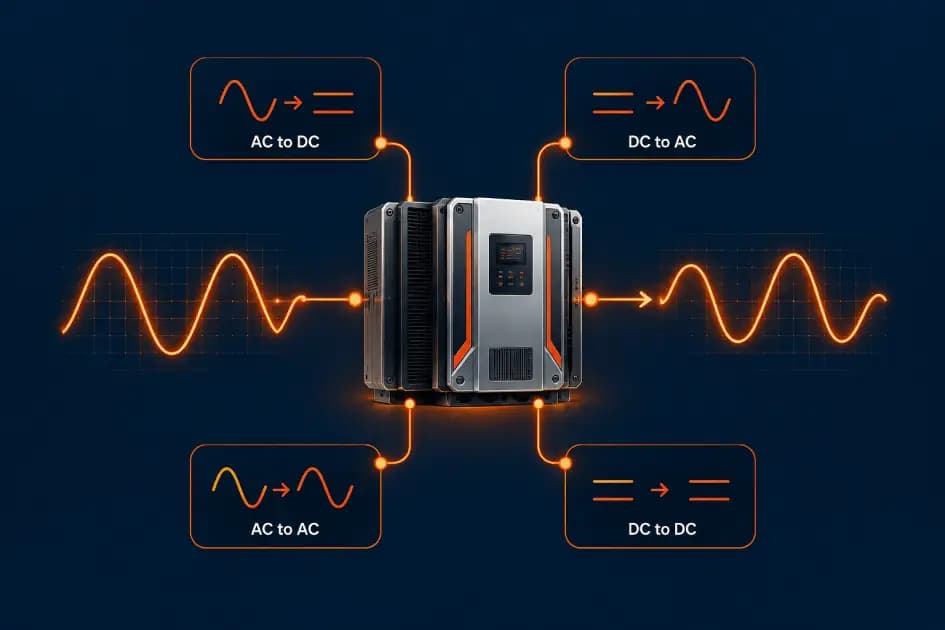
A static converter uses semiconductor switches, such as IGBTs or silicon-carbide devices, to control the flow of power electronically. By switching very rapidly and precisely, it reshapes the input power into the required output: converting AC to DC, DC to AC, one voltage to another, or one frequency to another.
Because the conversion is done by fast electronic switching rather than by a rotating machine, a static converter can regulate its output tightly, respond almost instantly, and condition the power quality along the way. This is why static converters have largely replaced the older rotary converters they are named in contrast to.
Static converter vs rotary converter
The distinction is worth making clear, because it explains the name and the advantage.
| Feature | Rotary converter | Static converter |
|---|---|---|
| Technology | Motor-generator set (rotating) | Solid-state electronics (no moving parts) |
| Size and weight | Large and heavy | Compact and light |
| Efficiency | Lower | Higher |
| Maintenance | Regular (mechanical wear) | Minimal |
| Output control | Limited | Precise, fast regulation |
A rotary converter uses a motor to drive a generator, physically converting power through rotation. A static converter does the same job electronically. For almost every modern application, the static approach wins on size, efficiency, and reliability.
Types of static converters
Static converters are grouped by the kind of conversion they perform.
Rectifier (AC to DC). Converts alternating current into direct current. Used anywhere DC is needed from an AC supply, from device power supplies to battery charging.
Inverter (DC to AC). Converts direct current into alternating current. Essential in solar systems, battery storage, and UPS, where stored DC must be turned into usable AC.
AC to AC converter. Changes AC power from one form to another. This includes voltage conversion and, importantly, frequency conversion, which is where the static frequency converter comes in.
DC to DC converter. Steps DC voltage up or down, used extensively in electronics and renewable systems.
A static frequency converter is a specific and common type of AC-to-AC static converter that changes the frequency of the supply, for example 50 Hz to 60 Hz, or mains to 400 Hz for aerospace. We cover it in detail in our guide on static frequency converters.
Applications of static converters
Static converters appear wherever power needs to be converted or conditioned:
Industrial systems, driving motors, processes, and equipment that need regulated or converted power. Renewable energy, where inverters turn solar and battery DC into grid AC. Power supplies, in virtually every electronic device and data centre. Aerospace, marine, and defence, where frequency conversion (such as 400 Hz) and ruggedized, precise power are essential. And grid and utility systems, where static converters support power quality, conversion, and integration of renewables.
In each case, the static converter provides clean, controllable power without the size, losses, and maintenance of rotating machinery.
Static converters at a glance
| Type | Conversion | Typical use |
|---|---|---|
| Rectifier | AC to DC | Power supplies, battery charging |
| Inverter | DC to AC | Solar, storage, UPS |
| AC to AC (incl. frequency) | AC to AC | Frequency conversion, voltage change |
| DC to DC | DC to DC | Electronics, renewables |
Static converters from Enerzolve
Enerzolve designs and manufactures static converters as part of its power electronics portfolio, built on a modular, high-density platform using modern silicon-carbide switching for high efficiency and compact size. The range includes static frequency converters for aerospace ground power, marine, and industrial fleets, engineered and manufactured in India for demanding, real-world conditions. If you need a static converter for a specific application, talk to our engineering team.
The takeaway
A static converter changes electrical power from one form to another, AC to DC, DC to AC, or one voltage or frequency to another, using solid-state electronics with no moving parts. That makes it smaller, more efficient, more precise, and far lower-maintenance than the rotary converters it replaced. The main types are rectifiers, inverters, AC-to-AC converters (including static frequency converters), and DC-to-DC converters, and together they power everything from a phone charger to a megawatt industrial drive.
Frequently asked questions
A static converter is a power electronics device that changes electrical power from one form to another, between AC and DC, or between different voltages or frequencies, using solid-state components with no moving parts. Because it has no rotating machinery, it is compact, efficient, precise, and effectively maintenance-free.
A rotary converter uses a motor-generator set with rotating machinery to convert power, while a static converter does the same job electronically using semiconductor switches. Static converters are smaller, more efficient, more precise, and need far less maintenance, which is why they have largely replaced rotary converters.
The main types are rectifiers (AC to DC), inverters (DC to AC), AC-to-AC converters including static frequency converters, and DC-to-DC converters. Each performs a specific kind of power conversion, from charging batteries to turning solar DC into grid AC to changing supply frequency.
A static frequency converter is a type of AC-to-AC static converter that changes the frequency of the power supply, such as 50 Hz to 60 Hz, or mains to 400 Hz for aircraft ground power. It is widely used in aerospace, marine, and industrial applications.
Static converters are used in industrial systems, renewable energy such as solar and storage inverters, power supplies for electronics and data centres, aerospace, marine and defence equipment, and grid and utility systems, anywhere power needs to be converted or conditioned cleanly and efficiently.
Keep reading
What is a BESS? Battery Energy Storage Systems Explained
A BESS is a system of systems. The BMS protects the cells, the PCS converts the power, and the EMS decides what the whole thing should do.
HES vs MDMS: How the AMI Software Layer Works
The HES talks to the meters, the MDMS makes sense of the data. One collects, the other perfects — and a serious AMI rollout needs both.
Grid-Forming vs Grid-Following Inverters (What Grid-Forming Means)
A grid-following inverter is a passenger. A grid-forming inverter can be the driver — and as conventional generation retires, that difference matters more every year.
Ultrasonic vs AMR Water Meters: Which One Fits Your Network?
Accuracy, maintenance, communication, and cost — how the two technologies actually differ, and how to pick per application rather than per vendor.
Planning a metering or power conversion program?
Talk to the engineering team about specifications, standards, and deployment.
Contact Enerzolve