
Is a Smart Meter Prepaid or Postpaid? How Smart Meter Billing Works
Is a smart meter prepaid or postpaid? How smart meter billing works, how it differs from a standard or prepaid meter, and how utilities switch between modes.
Enerzolve Smart Grid Team··Smart Grid & Metering·6 min read
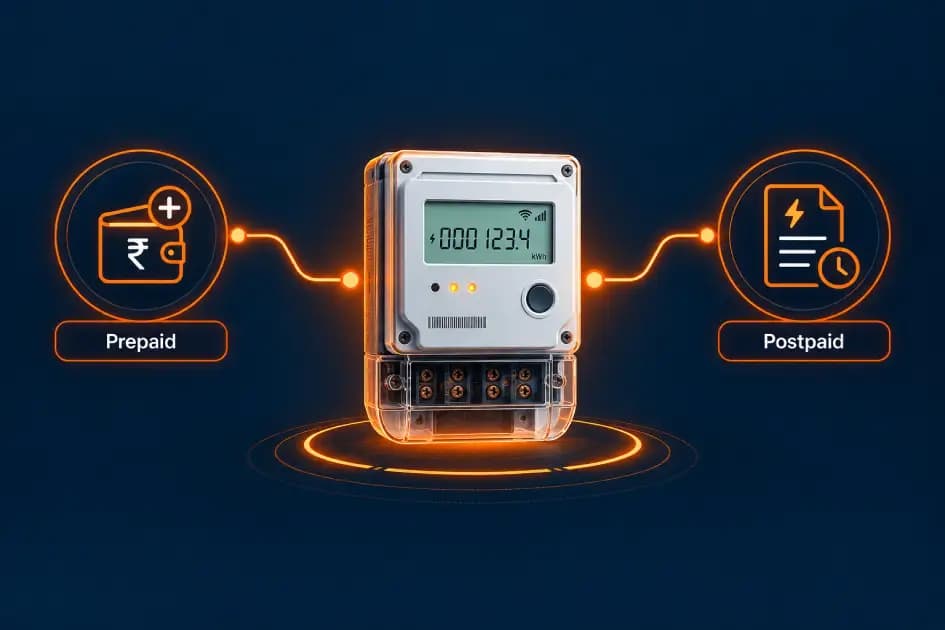
Is a smart meter prepaid or postpaid?
A smart meter can be either prepaid or postpaid, it is not limited to one. "Smart" refers to the meter's technology, its ability to be read and controlled remotely, not to the billing model. The same smart meter can run in prepaid mode, where the consumer pays first and the balance is drawn down as energy is used, or in postpaid mode, where the consumer uses energy through a billing cycle and pays afterwards. Many modern smart meters support both and can be switched between them remotely.
This is the key point people miss: prepaid and postpaid describe how you pay, while "smart" describes what the meter can do. This guide explains how smart meter billing works, how a smart meter differs from a basic prepaid meter, and why the distinction matters.
Why people confuse "smart" with "prepaid"
The confusion is understandable. In many regions, the rollout of smart meters has gone hand in hand with a push toward prepaid billing, because prepaid helps utilities improve cash flow and reduce losses. So people often see a smart meter being installed in prepaid mode and assume "smart meter" means "prepaid meter." It does not. The meter is smart because of its technology; prepaid is just the billing mode it happens to be running.
How smart meter billing works
A smart meter measures consumption continuously and communicates with the utility remotely, which is what makes either billing mode fully automated.
In postpaid mode, the meter records consumption across the billing cycle and the utility bills the consumer afterwards, automatically and accurately, with no manual reading and no estimated bills.
In prepaid mode, the consumer recharges a balance, and the meter draws it down in real time as energy is used. When the balance runs low, the meter warns the consumer; if it reaches zero, the meter can disconnect supply remotely and reconnect automatically once recharged.
Because the meter is smart, both modes are managed remotely through the utility's systems, no site visits, no manual intervention.
Smart meter vs prepaid meter vs standard meter
It helps to separate three things people often mix up.
| Meter type | What it means |
|---|---|
| Standard (analog) meter | Basic meter, read manually, postpaid billing only |
| Prepaid meter | Pay-first billing; may or may not be smart |
| Smart meter | Advanced meter, read and controlled remotely; can run prepaid OR postpaid |
A basic prepaid meter supports pay-first billing but may lack remote communication and control. A smart meter adds the intelligence, remote reading, remote connect and disconnect, tamper detection, and can operate in either billing mode. So a smart meter is not a type of prepaid meter; a prepaid smart meter is a smart meter running in prepaid mode.
Can a smart meter switch between prepaid and postpaid?
Yes. One of the advantages of a smart meter that supports both modes is that a utility can switch a consumer between prepaid and postpaid remotely, without changing the hardware or sending a technician. This lets the utility apply the right billing model to each consumer segment, prepaid for loss-prone or high-risk connections, postpaid where billing-cycle payment is preferred, all on the same meter fleet. The switching is handled through the utility's head end and meter data management systems.
Why this matters for utilities and consumers
For utilities, a smart meter that supports both modes is flexible and future-proof: the billing strategy can change without replacing meters. Prepaid improves cash flow and cuts commercial losses; postpaid suits commercial and industrial connections. For consumers, a prepaid smart meter gives real-time visibility and control over spending, while a postpaid smart meter removes estimated bills and disputes through accurate automated reading. Either way, the "smart" part, remote, accurate, controllable metering, is the benefit that stays constant.
For a full comparison of the two billing models, including tariffs and net metering, see our guide on prepaid vs postpaid smart meters.
Enerzolve smart meters
Enerzolve's smart energy meter supports both prepaid and postpaid billing per IS 16444, and because it is part of a complete metering platform, a utility can switch a consumer between the two modes remotely, manage tariffs centrally, and run the whole fleet without site visits. The meter is AMI-ready, with remote connect and disconnect, over-the-air firmware upgrades, and tamper detection built in.
The takeaway
A smart meter is not inherently prepaid or postpaid, it can be either, because "smart" refers to the meter's remote, intelligent technology, not its billing model. The same smart meter can run prepaid (pay first, balance drawn down) or postpaid (pay after the billing cycle), and many support both and switch between them remotely. A smart meter differs from a basic prepaid meter by adding remote reading, control, and tamper detection, with the billing mode being a configurable choice on top.
Frequently asked questions
A smart meter can be either. Smart refers to the meter's technology, its ability to be read and controlled remotely, not to how you pay. The same smart meter can run in prepaid mode (pay first, balance drawn down) or postpaid mode (pay after the billing cycle), and many support both and switch between them remotely.
A prepaid meter supports pay-first billing but may lack remote communication and control. A smart meter adds intelligence, remote reading, remote connect and disconnect, and tamper detection, and can operate in either prepaid or postpaid mode. A prepaid smart meter is simply a smart meter running in prepaid mode.
Yes. A smart meter that supports both modes can be switched between prepaid and postpaid remotely, without changing the hardware, through the utility's head end and meter data management systems. This lets a utility apply the right billing model to each consumer using the same meter fleet.
Not necessarily. A smart meter can be configured as prepaid or postpaid. If it is set to prepaid, you recharge a balance that is drawn down as you use energy. If it is set to postpaid, you are billed after the cycle. The meter being smart does not by itself determine the billing mode.
A smart meter is more capable: it adds remote reading, remote control, and tamper detection, and can run in either billing mode. A basic prepaid meter only supports pay-first billing. A smart meter running in prepaid mode gives you the benefits of both.
Keep reading
What is a BESS? Battery Energy Storage Systems Explained
A BESS is a system of systems. The BMS protects the cells, the PCS converts the power, and the EMS decides what the whole thing should do.
HES vs MDMS: How the AMI Software Layer Works
The HES talks to the meters, the MDMS makes sense of the data. One collects, the other perfects — and a serious AMI rollout needs both.
Grid-Forming vs Grid-Following Inverters (What Grid-Forming Means)
A grid-following inverter is a passenger. A grid-forming inverter can be the driver — and as conventional generation retires, that difference matters more every year.
Ultrasonic vs AMR Water Meters: Which One Fits Your Network?
Accuracy, maintenance, communication, and cost — how the two technologies actually differ, and how to pick per application rather than per vendor.
Planning a metering or power conversion program?
Talk to the engineering team about specifications, standards, and deployment.
Contact Enerzolve