
How to Size a PCS for a Commercial BESS
A practical guide to sizing a power conversion system (PCS) for a commercial battery storage system: power vs energy, C-rate, voltage window, derating and worked examples.
Enerzolve Power Electronics Team··Power Electronics & Storage·7 min read
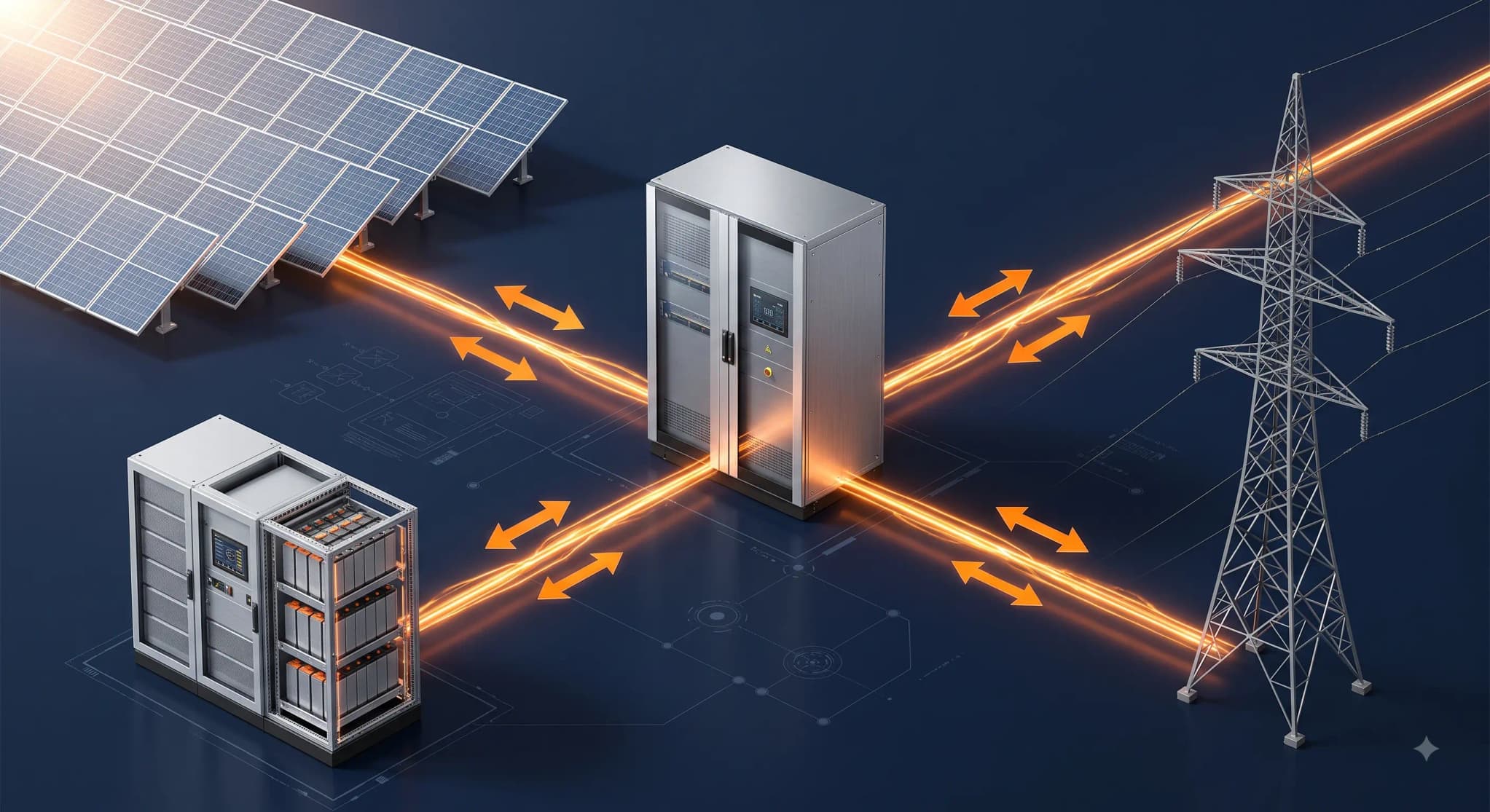
How to size a PCS for a commercial BESS
Sizing a PCS for a commercial battery energy storage system (BESS) means matching the power conversion system's rating (kW or MW) to the site's peak power need and the battery's energy and C-rate. In short, the battery's energy (kWh) sets how long the system runs, and the PCS (kW) sets how hard it can push. Size the PCS to the larger of the site's peak demand or export limit, confirm it against the battery's C-rate and DC voltage window, then add 10 to 15 percent headroom.
Power versus energy: the key distinction
This is where most sizing errors start. Battery energy, measured in kWh, decides how long a system can run. PCS power, measured in kW, decides how fast it can charge or discharge. The two are linked by the C-rate, which is power divided by energy. You size the battery for duration and the PCS for power, and the C-rate has to make sense for both. For the fundamentals, see what a power conversion system is.
Step 1: Determine the power you need (kW)
Set the PCS rating from the job the system has to do. For peak shaving, use the size of the demand peak you want to cut. For export or import limiting, use the grid connection limit. For grid services, use the committed power. When a site has more than one of these, size to the largest.
Step 2: Check the battery energy and C-rate
Once you know the power and the duration, the C-rate falls out. A PCS must be able to deliver the chosen C-rate for the installed battery energy.
| Battery energy | C-rate | PCS power | Approx duration |
|---|---|---|---|
| 1 MWh | 0.25C | 250 kW | about 4 hours |
| 1 MWh | 0.5C | 500 kW | about 2 hours |
| 1 MWh | 1C | 1 MW | about 1 hour |
Peak-shaving systems often sit around 0.5C; fast-response or grid-service systems may need 1C or more, which raises the PCS rating for the same battery.
Step 3: Match the DC voltage window
The PCS DC input range has to cover the battery string voltage across its full state of charge. If the battery can drop below or rise above the PCS window, the PCS derates or trips, so you lose usable power exactly when you need it. Confirm the string design and the PCS window together, not separately.
Step 4: Apply derating and headroom
Real conditions reduce output. Temperature, altitude, auxiliary and parasitic loads, and conversion losses all eat into the nameplate rating. Add roughly 10 to 15 percent above the calculated power, then round up to the nearest standard module rating. A modular PCS makes this easy, because you reach the rating by paralleling standard blocks.
Worked example: a commercial peak-shaving site
A commercial site wants to shave a 600 kW peak for 2 hours.
Energy: 600 kW times 2 hours equals 1,200 kWh usable. Allowing for depth-of-discharge margin, specify around 1,300 to 1,400 kWh of battery.
Power: the PCS must be at least 600 kW.
C-rate: 600 kW divided by 1,200 kWh is 0.5C, comfortable for most lithium-ion.
Headroom: add 10 to 15 percent, so target roughly 660 to 700 kW, then round up to the nearest standard block.
Result: specify a PCS of about 700 kW with a DC window that covers the battery string. The BESS control layers (BMS, PCS and EMS) then operate it, with the energy management system dispatching against the site's demand.
Grid-forming or grid-following for a commercial BESS
If the site needs backup power or islanding, or sits on a weak grid, specify a grid-forming PCS so it can establish voltage and frequency on its own. For a grid-tied system that only follows the grid, grid-following is enough. A PCS that supports both is the most flexible. See grid-forming vs grid-following inverters.
Common sizing mistakes to avoid
Sizing the PCS to energy instead of power. Ignoring the C-rate the application actually needs. Overlooking the DC voltage window. Leaving no headroom for losses and auxiliaries. Oversizing, which wastes money, or undersizing, which cannot meet the peak. Picking a fixed rating when a modular design would let the system scale later.
Enerzolve PCS for commercial storage
Enerzolve builds power conversion systems as part of its power electronics portfolio, on a modular, high-density platform that scales across ratings by paralleling a common power block. That means a commercial system can be sized precisely today and scaled later without redesigning it. If you are specifying a PCS for a storage project, talk to our engineering team about your power, energy and grid requirements.
Conclusion
Sizing a PCS for a commercial BESS comes down to separating power from energy, honouring the C-rate and voltage window, and leaving sensible headroom. Get those right and the system meets its peak, runs for its full duration, and has room to grow. To size and specify a PCS for a commercial storage project, talk to the Enerzolve team.
Frequently asked questions
Size the PCS to the larger of the site's peak demand or grid export limit, confirm it against the battery's energy and C-rate (a 1 MWh battery at 1C needs about 1 MW), match the DC voltage window, then add 10 to 15 percent headroom.
Battery energy (kWh) sets how long the system can run; PCS power (kW) sets how fast it can charge or discharge. The C-rate links them: power divided by energy.
Most commercial lithium-ion systems run at 0.25C to 1C. Peak-shaving systems often sit around 0.5C, while fast-response or grid-service systems may need 1C or more, which raises the PCS rating for the same battery energy.
If the site needs backup power or islanding, or sits on a weak grid, specify a grid-forming PCS. For a grid-tied system that only follows the grid, grid-following is enough. A PCS that supports both is the most flexible.
Add roughly 10 to 15 percent above the calculated power to cover conversion losses, auxiliary loads and future expansion, then round up to the nearest standard module rating.
Keep reading
What is a BESS? Battery Energy Storage Systems Explained
A BESS is a system of systems. The BMS protects the cells, the PCS converts the power, and the EMS decides what the whole thing should do.
HES vs MDMS: How the AMI Software Layer Works
The HES talks to the meters, the MDMS makes sense of the data. One collects, the other perfects — and a serious AMI rollout needs both.
Grid-Forming vs Grid-Following Inverters (What Grid-Forming Means)
A grid-following inverter is a passenger. A grid-forming inverter can be the driver — and as conventional generation retires, that difference matters more every year.
Ultrasonic vs AMR Water Meters: Which One Fits Your Network?
Accuracy, maintenance, communication, and cost — how the two technologies actually differ, and how to pick per application rather than per vendor.
Planning a metering or power conversion program?
Talk to the engineering team about specifications, standards, and deployment.
Contact Enerzolve