
How to Choose an AMI System: A Utility Buyer's Guide
A practical guide for utilities and DISCOMs on how to choose an advanced metering infrastructure (AMI) system: what to evaluate across meters, HES, MDMS, and interoperability.
Enerzolve Smart Technologies·
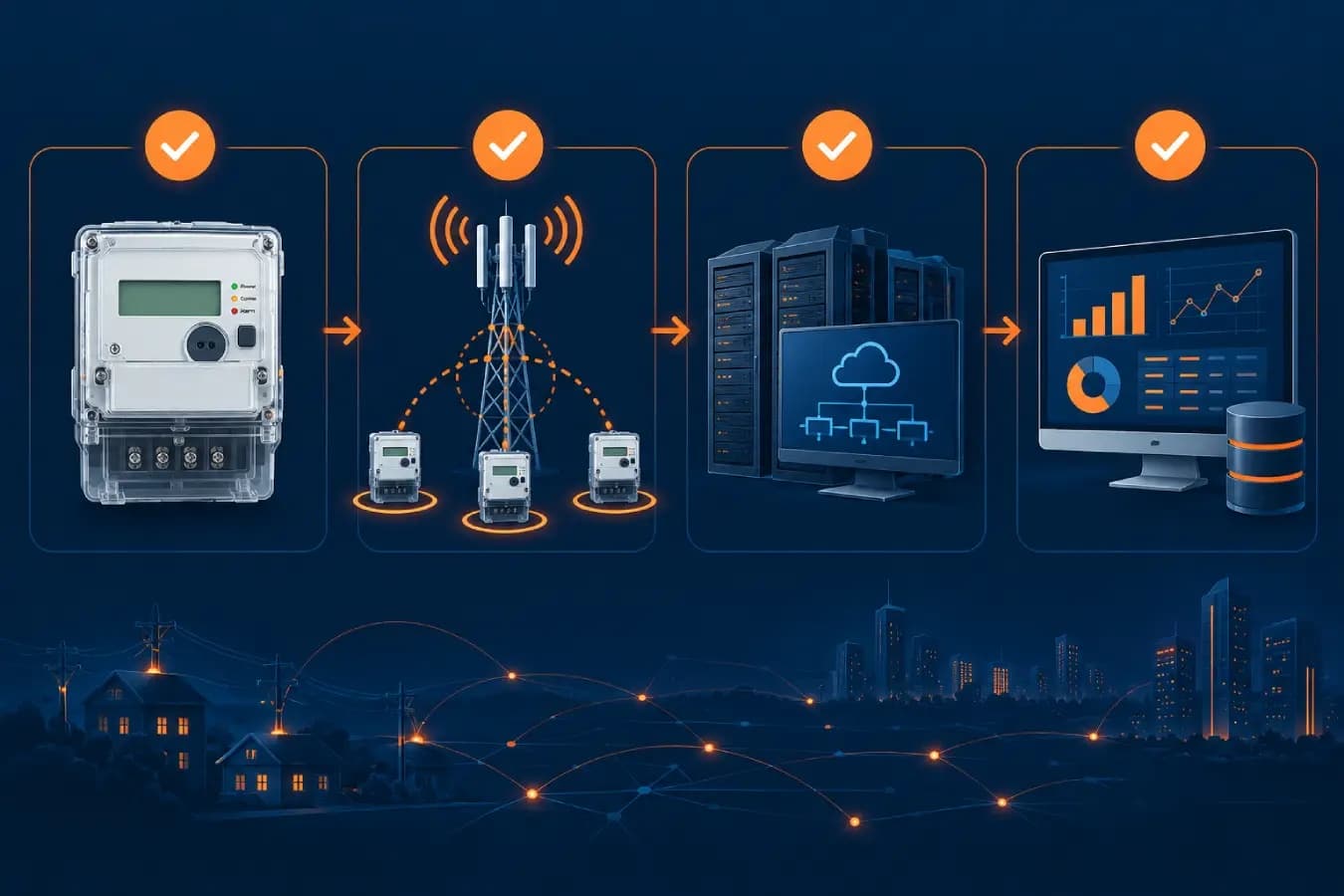
How do you choose the right AMI system?
Choosing an advanced metering infrastructure (AMI) system comes down to evaluating four things together: the smart meters, the communication network, the head end system, and the meter data management system, plus how well they interoperate and scale. The most common mistake is treating AMI as a meter purchase. The meter is the easy part. The value, and the risk, lives in the software and integration around it.
This guide walks through what a utility or DISCOM should actually evaluate before committing to an AMI deployment, in the order that matters.
Start with the outcome, not the meter
Before comparing products, be clear on what the deployment must achieve. For most Indian utilities and DISCOMs the priorities are reducing AT&C losses, ending estimated billing, cutting truck rolls, and gaining real-time visibility of the network. Every evaluation criterion below should be judged against those outcomes. A system that scores well on paper but does not move your loss numbers is the wrong system.
If you are still deciding whether to move from basic automatic meter reading to full AMI, our comparison of AMR vs AMI covers that decision first.
1. Evaluate the smart meters
The meter is the sensing point, so its specifications set the ceiling on everything above it.
Look for utility-grade accuracy (Class 1.0 for single phase billing), low starting current so small loads are captured, strong surge and magnetic immunity for Indian grid conditions, and comprehensive tamper detection. Just as important is that the meter is genuinely AMI-ready: remote connect and disconnect, over-the-air firmware upgrades, and support for the DLMS/COSEM protocol. A capable smart energy meter is the foundation; if you want the full checklist, see our guide to smart energy meter specifications.
2. Assess the communication network
A meter is only useful if its data reliably reaches you. Evaluate which communication technologies the system supports, RF Mesh, PLC, and cellular such as 4G and NB-IoT, and whether the vendor can match the right technology to your terrain. Dense urban areas, sparse rural feeders, and basements all behave differently. A system locked to one communication method will struggle somewhere in your network. Flexibility here is a sign of a mature platform.
3. Scrutinise the Head End System (HES)
This is where many evaluations fall short. The head end system is the platform that talks to every meter, collects reads, manages communication sessions, pushes firmware, and shows fleet health in real time. Ask hard questions: How many meters can one instance manage? Can it show you, live, which meters are online and which missed a read? How does it handle firmware rollouts across a large fleet? A weak HES turns a good meter fleet into a black box.
4. Examine the Meter Data Management System (MDMS)
Raw reads are not billable data. The meter data management system is what validates, estimates, and edits reads through the VEE process, flags exceptions, and produces the tariff-framed determinants your billing system needs. Evaluate the strength of its VEE engine, how it handles missing reads, whether it integrates cleanly with your existing CIS or billing platform, and what analytics it provides for loss and revenue assurance. The difference between the HES and MDMS is worth understanding fully; we cover it in HES vs MDMS.
5. Demand interoperability and open standards
This is the criterion that protects you for the next decade. Insist on DLMS/COSEM support and open standards throughout. A closed, proprietary system locks you into one vendor for every future expansion, upgrade, and spare. An interoperable advanced metering infrastructure lets you scale, mix technologies, and negotiate, rather than being captive. Ask directly whether the system can work with third-party meters and head end systems.
6. Check scalability and integration
An AMI pilot of a few thousand meters behaves very differently from a rollout of millions. Ask how the system scales, whether it supports multi-tenant deployment across zones, and how it integrates with the systems you already run: billing, CIS, GIS, and outage management. A system that cannot integrate becomes an island.
7. Weigh the vendor, support, and local presence
Finally, evaluate the vendor, not just the product. Local manufacturing and support matter for lead times, spares, and on-ground help during a rollout. Ask about deployment references, support SLAs, and whether the vendor owns the full stack or resells parts of it. A vendor that engineers the meters, HES, and MDMS as one platform can be held accountable for the whole system, rather than pointing between suppliers when something breaks.
An AMI evaluation checklist
| Layer | Key questions to ask |
|---|---|
| Smart meters | Accuracy class? Tamper detection? DLMS/COSEM? Remote connect/disconnect? |
| Communication | RF, PLC, and cellular options? Matched to your terrain? |
| Head End System | Scale per instance? Real-time fleet health? OTA firmware? |
| MDMS | VEE engine strength? CIS integration? Loss analytics? |
| Interoperability | DLMS/COSEM? Works with third-party systems? |
| Scalability | Handles millions of meters? Multi-tenant? Integrates with CIS/GIS? |
| Vendor | Full-stack ownership? Local support and manufacturing? References? |
Why the full-stack approach wins
The strongest AMI outcomes come from systems where the meters, communication, HES, and MDMS are designed to work together. When these come from different vendors and are stitched together, the seams are where deployments fail: reads that do not reconcile, firmware that will not roll out, data that will not validate. A single integrated platform removes those seams and gives you one party accountable for the result. Enerzolve builds the complete advanced metering infrastructure as one platform, engineered and manufactured in India, for energy and water on a single stack.
The takeaway
Choosing an AMI system is not about picking the best meter. It is about evaluating the whole stack, meters, communication, HES, and MDMS, against your loss-reduction and billing goals, insisting on interoperability so you stay flexible, and choosing a vendor who can be held accountable for the full system. Judge every option against the outcomes you need, and favour the platform that removes the integration seams where deployments usually fail.
Frequently asked questions
A utility should evaluate the smart meters, the communication network, the head end system, and the meter data management system together, along with interoperability, scalability, and vendor support. The most important principle is to judge every option against the outcomes needed, such as reducing AT&C losses and ending estimated billing, rather than focusing on the meter alone.
An integrated, single-vendor platform where the meters, HES, and MDMS are designed to work together avoids the integration seams where multi-vendor deployments often fail, and gives one party accountable for the whole system. What matters most is that the system uses open standards like DLMS/COSEM so you are not locked in for future expansion.
DLMS/COSEM is the open international protocol that keeps an AMI system interoperable. Choosing it means you can scale, mix technologies, and work with third-party systems in future, rather than being captive to a single proprietary vendor for every upgrade and spare.
The head end system communicates with the meters and manages the fleet in real time, handling collection, firmware, and fleet health. The meter data management system processes those reads into validated, billable data. When evaluating AMI, assess both, since a weak layer in either undermines the whole system.
Moving from automatic meter reading to full AMI is best planned around interoperability and phasing. Choose meters and systems built on open standards, and roll out in priority zones such as high-loss areas first, expanding over time on a platform that supports full two-way capability from the start.
Keep reading
What is a BESS? Battery Energy Storage Systems Explained
A BESS is a system of systems. The BMS protects the cells, the PCS converts the power, and the EMS decides what the whole thing should do.
HES vs MDMS: How the AMI Software Layer Works
The HES talks to the meters, the MDMS makes sense of the data. One collects, the other perfects — and a serious AMI rollout needs both.
Grid-Forming vs Grid-Following Inverters (What Grid-Forming Means)
A grid-following inverter is a passenger. A grid-forming inverter can be the driver — and as conventional generation retires, that difference matters more every year.
Ultrasonic vs AMR Water Meters: Which One Fits Your Network?
Accuracy, maintenance, communication, and cost — how the two technologies actually differ, and how to pick per application rather than per vendor.
Planning a metering or power conversion program?
Talk to the engineering team about specifications, standards, and deployment.
Contact Enerzolve