
How AI Data Centres Are Reshaping Power Infrastructure
AI is driving a surge in data-centre power demand. See why AI workloads strain the grid, and how battery storage (BESS), smart UPS and power electronics keep them running.
Enerzolve Power Electronics Team··Industry & Applications·6 min read
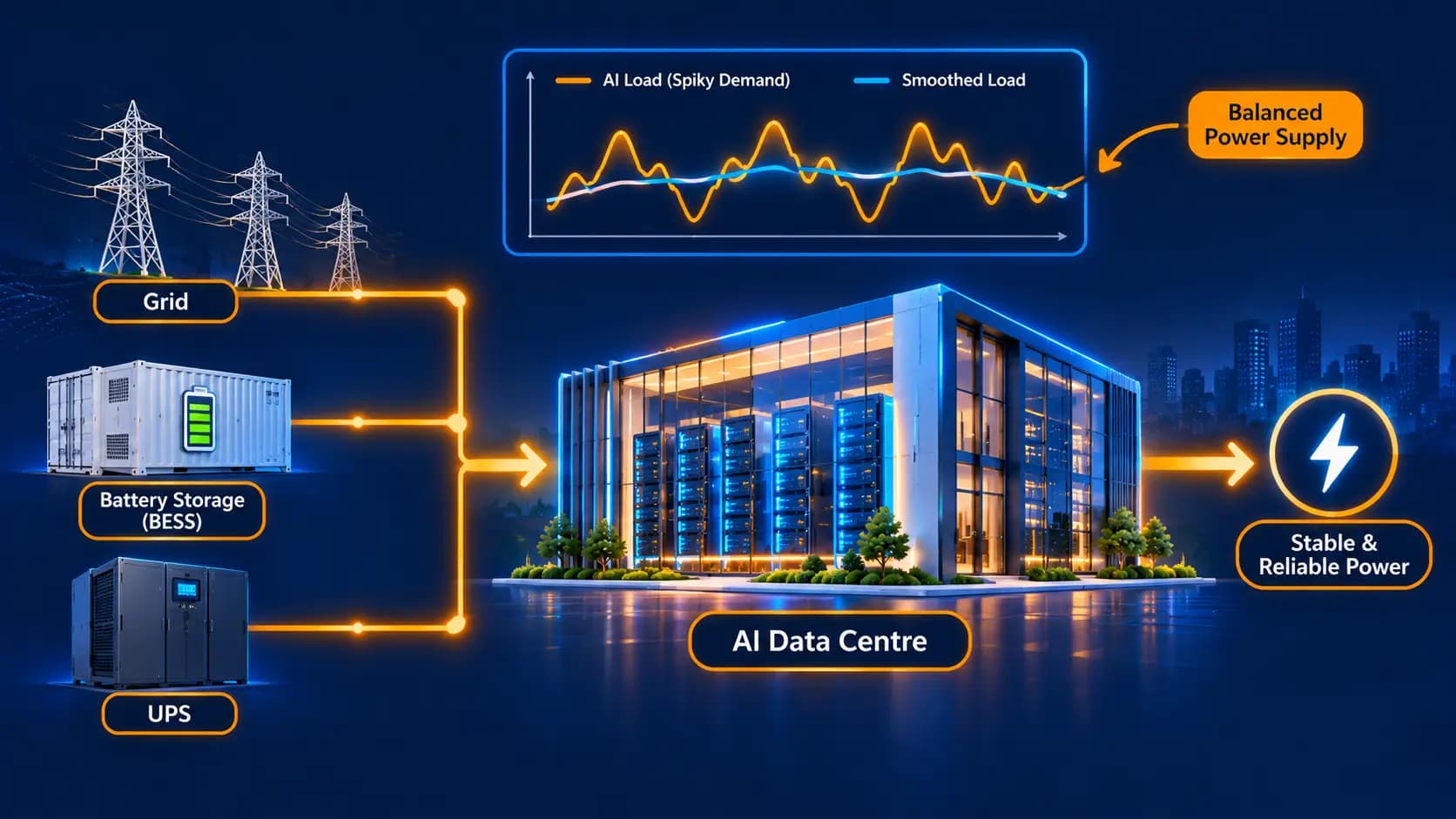
How AI data centres are reshaping power infrastructure
AI workloads are driving a steep rise in data-centre power demand. Training and running large AI models pulls far more power, in sharper swings, than traditional computing, which is straining grids and forcing operators to rethink how data centres are powered. The response is a shift toward on-site battery storage (BESS), smarter UPS, high-density power electronics and tighter grid integration.
Why AI changes the power equation
A traditional server rack draws a steady, modest load. An AI rack packed with accelerators draws several times more power, and it does so unevenly: training jobs ramp up and down in sharp bursts. That combination of high density and volatility raises peak demand, generates more heat, and puts far more stress on both the facility and the grid than conventional computing ever did.
The new data-centre power challenges
AI has turned power from a background utility into the main design constraint. The core challenges are:
Higher power density per rack, pushing the limits of existing distribution and cooling.
Volatile, spiky loads from AI training that are hard for the grid to absorb.
Grid connection delays and capacity limits as demand outpaces available supply.
Cooling and efficiency, where every watt lost in conversion adds heat and cost.
Resilience, because an AI cluster outage is expensive and disruptive.
For the broader fundamentals, see our guide to data centre power infrastructure.
How battery storage (BESS) fits in
Battery energy storage has quickly become one of the most important tools for AI data centres. On-site storage smooths the spiky loads of AI training, provides backup during outages, shaves peak demand to cut energy costs, and lets a facility support the grid rather than only draw from it. Industry analysts now describe AI data centres as one of the fastest-growing new customers for battery storage. A BESS works through three control layers, the BMS, PCS and EMS, which you can read about in what is a BESS.
The evolving role of the UPS
The UPS has always kept critical load running through disturbances, but in AI data centres its job is expanding. Battery-based UPS systems are moving from pure backup toward active power management, helping ride through load swings and bridge cleanly to backup generation. Choosing the right topology matters more than ever, which we cover in data centre UPS types and how to choose a data centre UPS.
The power electronics behind it all
Underneath the storage and UPS sits the power electronics that actually move and convert the energy. High-density power conversion systems and modern switching technology such as silicon carbide keep efficiency high across the full load range, which matters because every point of efficiency saved is heat and cost removed. As AI loads grow, the quality of the conversion stage becomes a direct lever on a data centre's running cost and resilience.
What it means for India
India is building data-centre capacity quickly, and it is doing so alongside one of the world's fastest-growing battery-storage markets. Analysts project a steep rise in Indian battery-storage requirements over the coming decade, driven by renewables, the grid and increasingly by digital infrastructure. For operators building here, pairing data centres with storage and strong power electronics is becoming a practical necessity rather than an option.
How Enerzolve supports data-centre power
Enerzolve builds the power electronics that sit behind resilient data-centre power: power conversion systems, battery storage integration and UPS, engineered together and built in India. Because the conversion and control layers are designed as one system, a data centre gets predictable, efficient power management rather than a set of mismatched parts. If you are planning power infrastructure for a new or expanding data centre, talk to our engineering team.
Conclusion
AI has turned data-centre power from a background concern into the defining design challenge. Meeting it takes more than a bigger connection: it takes battery storage to absorb volatile loads, smarter UPS for resilience, and efficient power electronics to keep it all cool and affordable. The data centres that get this right will be the ones that can scale AI without being held back by the grid. To build resilient, efficient data-centre power on integrated power electronics, talk to the Enerzolve team.
Frequently asked questions
AI training and inference run dense clusters of accelerators that draw far more power per rack than traditional servers, and in sharper swings. That raises peak demand, heat and grid stress, so AI data centres need more power and more resilient power infrastructure.
On-site battery storage (BESS) smooths the spiky loads of AI training, provides backup during outages, shaves peak demand to cut costs, and can support the grid. It turns a volatile, power-hungry load into a more manageable one.
The UPS keeps critical load running through power disturbances. In AI data centres it is also moving from pure backup toward active power management, helping ride through load swings and bridge to backup generation.
Because AI loads are large and volatile, operators are adding batteries to firm up supply, manage peaks and improve resilience, which is making AI data centres one of the fastest-growing customers for battery energy storage.
By combining high-density power electronics, battery storage that can absorb and release power quickly, smart UPS, and an energy management layer that coordinates the grid, storage and load in real time.
Keep reading
What is a BESS? Battery Energy Storage Systems Explained
A BESS is a system of systems. The BMS protects the cells, the PCS converts the power, and the EMS decides what the whole thing should do.
HES vs MDMS: How the AMI Software Layer Works
The HES talks to the meters, the MDMS makes sense of the data. One collects, the other perfects — and a serious AMI rollout needs both.
Grid-Forming vs Grid-Following Inverters (What Grid-Forming Means)
A grid-following inverter is a passenger. A grid-forming inverter can be the driver — and as conventional generation retires, that difference matters more every year.
Ultrasonic vs AMR Water Meters: Which One Fits Your Network?
Accuracy, maintenance, communication, and cost — how the two technologies actually differ, and how to pick per application rather than per vendor.
Planning a metering or power conversion program?
Talk to the engineering team about specifications, standards, and deployment.
Contact Enerzolve