
How to Choose a Smart Meter for a Utility
A practical guide to choosing a smart energy meter for a utility: accuracy, certifications, RDSS and IS 16444 compliance, communication, billing, and interoperability.
Enerzolve Smart Grid Team··Smart Grid & Metering·7 min read
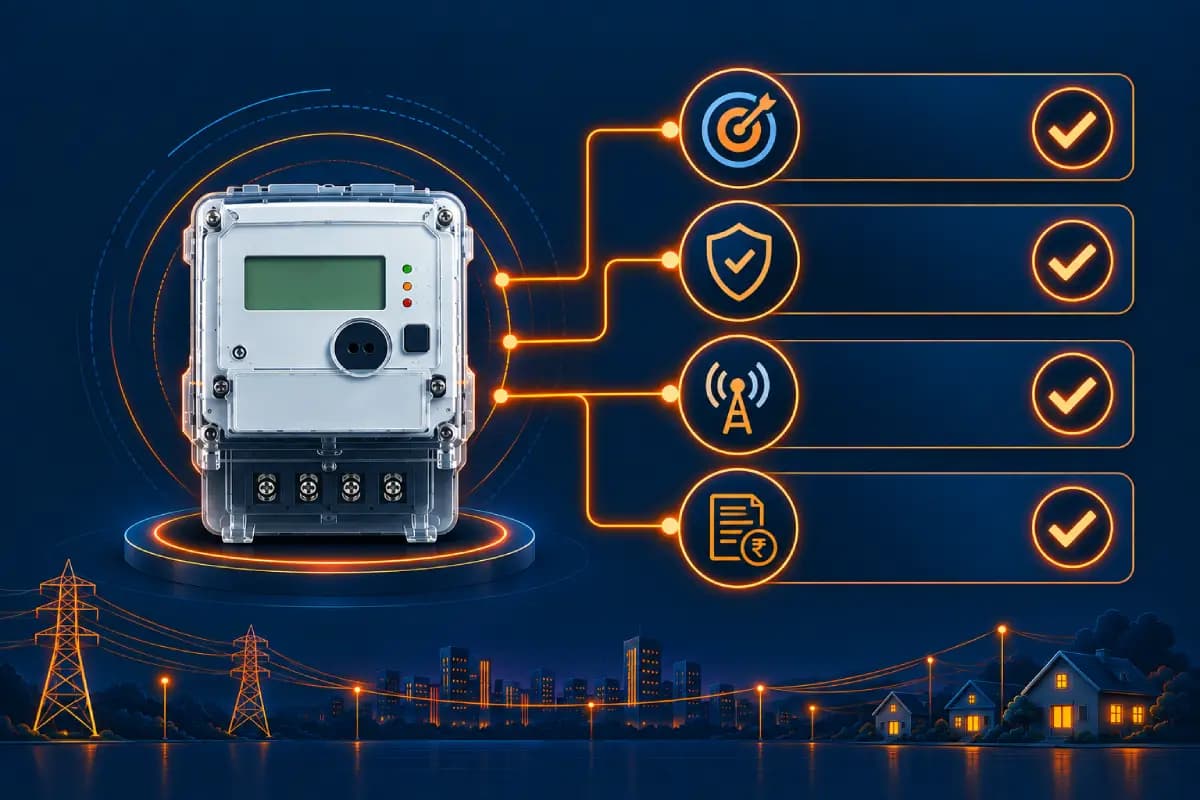
How do you choose the right smart meter?
Choosing a smart meter for a utility comes down to evaluating a few things in the right order: accuracy and measurement quality, compliance and certifications, communication and interoperability, billing and tariff support, and the manufacturer behind it. The meter that scores well across all of these, not just on price or a single spec, is the one that will bill accurately, survive real conditions, and integrate cleanly for years.
This guide walks through what a utility or DISCOM should actually evaluate when selecting the meter itself. If you are choosing the wider system, meters plus head end and data management, see our companion guide on how to choose an AMI system; this one focuses on the meter.
1. Accuracy and measurement quality
Start with accuracy, because it sets the ceiling on billing precision. Look for a utility-grade accuracy class (Class 1.0 for single phase billing), and just as importantly, whether the meter holds that accuracy over years of service. A low starting current matters too, it lets the meter capture small, continuous loads that a less sensitive meter would miss and never bill. The current sensing technology, such as a precision shunt, affects both long-term accuracy and tamper resistance. For a full breakdown, see our guide to smart energy meter specifications.
2. Compliance and certifications
For deployment in India, compliance is a gate, not a preference. Confirm the meter meets IS 16444 and qualifies under the national programme (RDSS), and check its certifications: BIS as a baseline, plus STQC and MTCTE where applicable, and NABL-accredited type testing. Certifications are how you verify the meter before installing a single unit; a meter without the right ones should not make the shortlist. Our guides on RDSS and IS 16444 compliance and smart meter certifications cover this in depth.
3. Communication and interoperability
A smart meter is only as useful as its ability to connect. Check which communication options it supports, RF Mesh, PLC, and cellular such as 4G and NB-IoT, and whether the vendor can match the technology to your terrain. Crucially, confirm it uses the open DLMS/COSEM protocol. Interoperability protects you: a meter built on open standards can work across systems and future expansions, while a proprietary one locks you into one vendor for every upgrade and spare.
4. Tamper detection and security
Meter tampering is a direct source of commercial loss, so evaluate the meter's tamper detection: magnetic immunity, cover-open and reverse-current detection, and event logging. As meters become networked, device-level security matters too, look for secure communication and a manufacturer with strong information-security credentials. A meter that resists both physical tampering and cyber threats protects revenue on two fronts.
5. Billing and tariff support
Confirm the meter supports the billing models you need: prepaid and postpaid, and the tariff structures defined in IS 16444, including time-of-use and time-of-day, plus net metering for consumers with rooftop solar. A meter that supports both prepaid and postpaid lets you apply the right billing model to each consumer segment without changing hardware. Our guide on prepaid vs postpaid smart meters explains the trade-offs.
6. The manufacturer behind the meter
Finally, evaluate the vendor, not just the device. This is where deployments succeed or fail. Consider:
Integrated technology. Does the vendor provide the meter, head end system, MDMS, and analytics as one platform, or just the device? An integrated platform reduces the integration complexity that stalls rollouts.
End-to-end engineering ownership. Does one party own the hardware, firmware, software, and system integration? Single-point technical responsibility means no finger-pointing between suppliers when something breaks.
Interoperability and agility. Can the vendor integrate with multiple meter makes, communication technologies, and your existing systems, and customise the product to your specific requirements?
Flexible execution. Can they support a pilot, a customised deployment, and a large-scale rollout, and provide local support and manufacturing for lead times and spares?
Certifications and process maturity. Do they hold process certifications (ISO 9001, ISO 27001, CMMI) that signal a mature, reliable, secure organisation?
A smart meter selection checklist
| Criterion | What to check |
|---|---|
| Accuracy | Class 1.0? Low starting current? Holds accuracy over time? |
| Compliance | IS 16444? RDSS-eligible? BIS, STQC, MTCTE, NABL type-tested? |
| Communication | RF, PLC, cellular? DLMS/COSEM? Matched to terrain? |
| Tamper & security | Magnetic immunity? Event logging? Secure comms? |
| Billing | Prepaid and postpaid? ToU / ToD? Net metering? |
| Manufacturer | Integrated platform? End-to-end ownership? Process certs? Local support? |
Why the manufacturer matters as much as the meter
Two meters can look identical on a datasheet and deliver very different outcomes, because the difference is often in the platform and the support around them. A meter from a vendor who also builds the advanced metering infrastructure it plugs into, and who owns the engineering end to end, integrates more cleanly and is accountable for the whole result. Enerzolve builds the smart energy meter together with its HES, MDMS, and analytics on one platform, engineered and manufactured in India, with the flexibility to support pilots through to large-scale utility deployments.
The takeaway
Choosing a smart meter means evaluating accuracy, compliance and certifications, communication and interoperability, tamper resistance and security, and billing support, and then evaluating the manufacturer behind the meter. The strongest choice is a compliant, interoperable, well-certified meter from a vendor who owns the engineering end to end and can be held accountable for the whole system. Judge every option against the outcomes you need, and weigh the platform and support as heavily as the spec sheet.
Frequently asked questions
A utility should evaluate accuracy class and measurement quality, IS 16444 and RDSS compliance with the right certifications, communication options and DLMS/COSEM interoperability, tamper detection and security, and prepaid/postpaid billing with ToU and ToD tariffs. It should also assess the manufacturer's platform, engineering ownership, and support.
For deployment in India's national programme, yes. Meters must comply with IS 16444 and qualify under RDSS, and carry the appropriate certifications such as BIS, STQC, and MTCTE with NABL-accredited type testing. Compliance protects the utility's scheme eligibility and de-risks the rollout.
Interoperability, through open standards like DLMS/COSEM, lets a meter work across different systems and future expansions rather than locking the utility into one vendor. It protects the utility's flexibility and negotiating position over the life of a deployment.
It is a strong advantage. A vendor who provides the meter, head end system, MDMS, and analytics as one integrated platform reduces integration complexity and gives single-point accountability for the whole system, rather than leaving the utility to reconcile parts from different suppliers.
Very important. Two meters can look similar on a datasheet but deliver different outcomes depending on the platform, engineering ownership, and support behind them. Evaluate the manufacturer's integration capability, process certifications, and ability to support pilots through large-scale rollouts as heavily as the meter's specifications.
Keep reading
What is a BESS? Battery Energy Storage Systems Explained
A BESS is a system of systems. The BMS protects the cells, the PCS converts the power, and the EMS decides what the whole thing should do.
HES vs MDMS: How the AMI Software Layer Works
The HES talks to the meters, the MDMS makes sense of the data. One collects, the other perfects — and a serious AMI rollout needs both.
Grid-Forming vs Grid-Following Inverters (What Grid-Forming Means)
A grid-following inverter is a passenger. A grid-forming inverter can be the driver — and as conventional generation retires, that difference matters more every year.
Ultrasonic vs AMR Water Meters: Which One Fits Your Network?
Accuracy, maintenance, communication, and cost — how the two technologies actually differ, and how to pick per application rather than per vendor.
Planning a metering or power conversion program?
Talk to the engineering team about specifications, standards, and deployment.
Contact Enerzolve